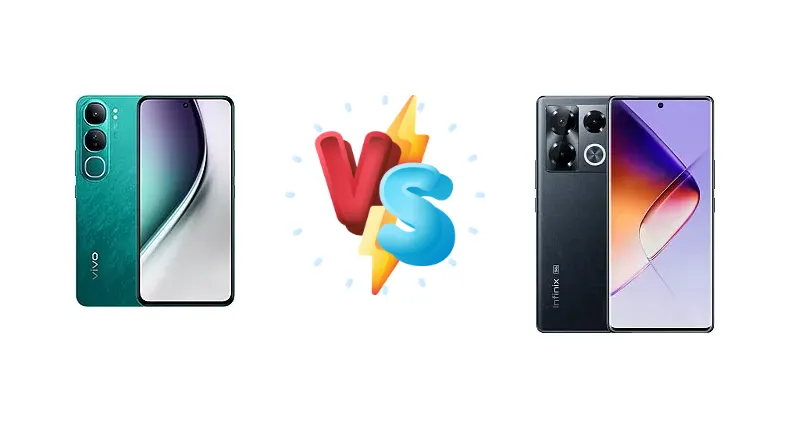
The mid-range smartphone market is fiercely competitive, and the vivo Y200 4G and Infinix Note 40 Pro+ represent compelling options for budget-conscious buyers. While both aim to deliver a solid experience, they take different approaches – the vivo prioritizing a streamlined experience with a Snapdragon chipset, while the Infinix pushes boundaries with faster charging and a more powerful Dimensity processor. This comparison dives deep into the specifics to determine which device best suits your needs.
🏆 Quick Verdict
For the average user prioritizing fast charging and a brighter, more vibrant display, the Infinix Note 40 Pro+ is the clear winner. Its 100W charging and 1130 nits peak brightness offer a tangible advantage. However, users seeking a potentially more thermally stable experience for sustained tasks might lean towards the vivo Y200 4G.
| Network |
|---|
| 2G bands | GSM 850 / 900 / 1800 / 1900 | GSM 850 / 900 / 1800 / 1900 |
| 3G bands | HSDPA 850 / 900 / 2100 | HSDPA 850 / 900 / 1700(AWS) / 1900 / 2100 |
| 4G bands | 1, 3, 5, 7, 8, 20, 28, 38, 40, 41 | 1, 2, 3, 4, 5, 7, 8, 12, 17, 20, 28, 38, 40, 41, 42, 66 |
| 5G bands | - | 1, 3, 5, 7, 8, 12, 20, 28, 38, 40, 41, 66, 77, 78 SA/NSA |
| Speed | HSPA, LTE | HSPA, LTE, 5G |
| Technology | GSM / HSPA / LTE | GSM / HSPA / LTE / 5G |
| Launch |
|---|
| Announced | 2025, January | 2024, March 18 |
| Status | Available. Released 2025, January | Available. Released 2024, March 19 |
| Body |
|---|
| Build | Glass front, plastic back, plastic frame | Glass front, plastic frame, silicone polymer (eco leather) back |
| Dimensions | 163.2 x 75.9 x 7.8 mm (6.43 x 2.99 x 0.31 in) | 164.3 x 74.5 x 8.1 mm (6.47 x 2.93 x 0.32 in) |
| SIM | Nano-SIM + Nano-SIM | Nano-SIM + Nano-SIM |
| Weight | 188 g or 190 g (6.63 oz) | 190 g or 196 g (6.70 oz) |
| Display |
|---|
| Protection | - | Corning Gorilla Glass |
| Resolution | 1080 x 2400 pixels, 20:9 ratio (~395 ppi density) | 1080 x 2436 pixels (~393 ppi density) |
| Size | 6.67 inches, 107.4 cm2 (~86.7% screen-to-body ratio) | 6.78 inches, 109.9 cm2 (~89.8% screen-to-body ratio) |
| Type | AMOLED, 1B colors, 120Hz, 1200 nits (HBM), 1800 nits (peak) | AMOLED, 1B colors, 120Hz, 1300 nits (peak) |
| Platform |
|---|
| CPU | Octa-core (4x2.8 GHz Cortex-A73 & 4x1.9 GHz Cortex-A53) | Octa-core (2x2.2 GHz Cortex-A78 & 6x2.0 GHz Cortex-A55) |
| Chipset | Qualcomm SM6225 Snapdragon 685 (6 nm) | Mediatek Dimensity 7020 (6 nm) |
| GPU | Adreno 610 | IMG BXM-8-256 |
| OS | Android 14, Funtouch 14 | Android 14, up to 2 major Android upgrades, XOS 14 |
| Memory |
|---|
| Card slot | microSDXC (uses shared SIM slot) | No |
| Internal | 128GB 8GB RAM, 256GB 8GB RAM | 256GB 12GB RAM, 512GB 12GB RAM |
| Main Camera |
|---|
| Dual | 50 MP, f/1.8, (wide), PDAF
Auxiliary lens | - |
| Features | Ring-LED flash, panorama, HDR | Dual-LED flash, HDR, panorama |
| Triple | - | 108 MP, f/1.8, 24mm (wide), 1/1.67", 0.64µm, PDAF, OIS
2 MP, f/2.4
2 MP, f/2.4 |
| Video | 1080p@30fps | 1440p@30fps, 1080p@30/60fps |
| Selfie camera |
|---|
| Features | - | Dual-LED flash |
| Single | 32 MP, f/2.5, (wide) | 32 MP, f/2.2, (wide), 1/3.1", 0.7µm |
| Video | 1080p@30fps | 1440p@30fps, 1080p@30/60fps |
| Sound |
|---|
| 35mm jack | No | No |
| Loudspeaker | Yes, with stereo speakers | Yes, with stereo speakers |
| Comms |
|---|
| Bluetooth | 5.0, A2DP, LE | Yes |
| Infrared port | - | Yes |
| NFC | No | Yes (market/region dependent) |
| Positioning | GPS, GALILEO, GLONASS, QZSS, BDS | GPS |
| Radio | No | FM radio |
| USB | USB Type-C 2.0, OTG | USB Type-C 2.0, OTG |
| WLAN | Wi-Fi 802.11 a/b/g/n/ac, dual-band | Wi-Fi 802.11 a/b/g/n/ac, dual-band |
| Features |
|---|
| Sensors | Fingerprint (under display, optical), accelerometer, gyro, proximity, compass | Fingerprint (under display, optical), accelerometer, gyro, proximity, compass |
| Battery |
|---|
| Charging | 80W wired, 80% in 30 min
Reverse wired | 100W wired, 50% in 12 min
20W wireless MagCharge
Reverse wired
Reverse wireless |
| Type | Li-Ion 5000 mAh | 4600 mAh |
| Misc |
|---|
| Colors | Titanium Silver, Emerald Green | Obsidian Black, Vintage Green, Racing Edition |
| Models | - | X6851B |
| Price | About 210 EUR | About 290 EUR |
vivo Y200 4G
- Potentially better thermal management due to Snapdragon 685 efficiency
- Reliable Qualcomm chipset with established software support
- 80W fast charging is still respectable
- Less powerful processor compared to Dimensity 7020
- Lacks wireless charging capabilities
- Display likely less bright than the Infinix
Infinix Note 40 Pro+
- 100W SuperCharge for incredibly fast charging
- Brighter 1130 nits display for excellent outdoor visibility
- More powerful Dimensity 7020 processor for smoother performance
- Dimensity 7020 may run hotter under sustained load
- Software optimization may be less refined than vivo
- Camera specs beyond the main sensor are unknown
Display Comparison
The Infinix Note 40 Pro+ boasts a significantly brighter display, reaching a measured 1130 nits, compared to an unspecified brightness for the vivo Y200 4G. This difference is crucial for outdoor use, where the Infinix will remain easily visible under direct sunlight. While both likely utilize IPS LCD panels given the price bracket, the higher peak brightness of the Infinix is a substantial advantage. We lack information on the panel technology (LTPO, PWM dimming) for either device, but the brightness difference is the defining factor here.
Camera Comparison
Without detailed camera specs beyond the main sensors, a direct comparison is difficult. Both phones likely feature multi-camera setups with a primary sensor, ultrawide, and depth/macro lenses. However, the absence of information regarding sensor size, aperture, and optical image stabilization (OIS) makes it impossible to definitively declare a winner. We can assume both will perform adequately in good lighting conditions, but low-light performance will heavily depend on sensor size and image processing algorithms, which remain unknown.
Performance
The core difference lies in the chipsets: the Infinix Note 40 Pro+ utilizes the Mediatek Dimensity 7020 (6nm), featuring 2x 2.2 GHz Cortex-A78 cores and 6x 2.0 GHz Cortex-A55 cores, while the vivo Y200 4G is powered by the Qualcomm Snapdragon 685 (6nm) with 4x 2.8 GHz Cortex-A73 and 4x 1.9 GHz Cortex-A53 cores. The Dimensity 7020’s Cortex-A78 cores represent a performance uplift over the Snapdragon 685’s Cortex-A73 cores, translating to snappier app launches and smoother multitasking. However, the Snapdragon 685’s efficiency could lead to better sustained performance and potentially lower temperatures during prolonged gaming sessions. The Infinix’s chipset is likely to offer a more noticeable performance boost in graphically intensive tasks.
Battery Life
The Infinix Note 40 Pro+ shines in the charging department with its 100W wired charging, capable of reaching 50% charge in just 12 minutes. The vivo Y200 4G offers 80W charging, achieving 80% in 30 minutes. The Infinix’s faster charging is a significant convenience factor. Furthermore, the Infinix supports 20W MagCharge wireless charging and reverse wired/wireless charging, features absent in the vivo Y200 4G. The Infinix also boasts an active use score of 12:23h, suggesting excellent battery life, though we lack comparable data for the vivo Y200 4G. The faster charging and wireless charging capabilities give the Infinix a clear edge.
Buying Guide
Buy the vivo Y200 4G if you need a reliable daily driver with a focus on efficient power management and a proven chipset. It’s ideal for users who prioritize stability over raw performance. Buy the Infinix Note 40 Pro+ if you prefer blazing-fast charging, a significantly brighter display for outdoor visibility, and a processor capable of handling more demanding applications and multitasking.
Frequently Asked Questions
❓ Does the Dimensity 7020 in the Infinix Note 40 Pro+ tend to overheat during prolonged gaming sessions?
While the Dimensity 7020 is a capable processor, it's built on a 6nm process, which can generate more heat than some competing chipsets. The Infinix Note 40 Pro+’s thermal management system will be crucial. Expect some throttling during extended gaming, but it shouldn't be severe enough to render games unplayable. Monitoring temperatures during gameplay is recommended.
❓ How effective is the 20W MagCharge wireless charging on the Infinix Note 40 Pro+ compared to wired charging?
20W MagCharge is a convenient feature, but it's significantly slower than the 100W wired charging. Expect a full charge from 0% to take considerably longer – likely over 2 hours. MagCharge is best suited for topping up the battery overnight or for short bursts of charging when wired charging isn't available.
❓ Is the 80W charging on the vivo Y200 4G still considered fast charging in 2024?
While 80W is still considered fast charging, it's becoming less competitive as 100W and even 120W charging become more prevalent. The vivo Y200 4G’s 80W charging will still provide a substantial boost in a short amount of time, but it won’t be as quick as the Infinix Note 40 Pro+’s 100W solution.