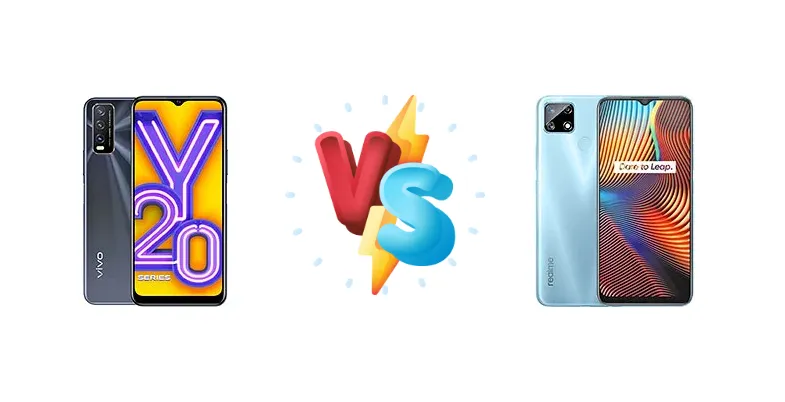
The sub-$150 smartphone market is fiercely competitive. Both the vivo Y20 and Realme 7i aim to deliver essential features at an accessible price point. However, they take different approaches to achieving this, with the Y20 leveraging Qualcomm's Snapdragon 460 and the 7i opting for MediaTek's Helio G85. This comparison dives deep into the architectural differences and real-world implications to determine which device offers the best value.
🏆 Quick Verdict
For most users, the Realme 7i emerges as the stronger choice. Its Helio G85 chipset, built on a 12nm process, provides a noticeable performance advantage over the Snapdragon 460 in the vivo Y20, particularly in gaming and multitasking. While both offer 18W charging, the 7i’s reverse charging adds a layer of convenience.
| Network |
|---|
| 2G bands | GSM 850 / 900 / 1800 / 1900 | GSM 850 / 900 / 1800 / 1900 |
| 3G bands | HSDPA 850 / 900 / 2100 | HSDPA 850 / 900 / 1700(AWS) / 1900 / 2100 |
| 4G bands | 1, 3, 5, 8, 38, 40, 41 | 1, 2, 3, 4, 5, 7, 8, 20, 28, 38, 40, 41 |
| Speed | HSPA, LTE | HSPA, LTE |
| Technology | GSM / HSPA / LTE | GSM / HSPA / LTE |
| | 1, 3, 5, 7, 8, 18, 19, 20, 26, 28, 38, 39, 40, 41 | - |
| Launch |
|---|
| Announced | 2020, August 26. Released 2020, August 28 | 2020, December 22. Released 2020, December 23 |
| Status | Discontinued | Discontinued |
| Body |
|---|
| Build | Glass front, plastic back, plastic frame | - |
| Dimensions | 164.4 x 76.3 x 8.4 mm (6.47 x 3.00 x 0.33 in) | 164.5 x 75.9 x 9.8 mm (6.48 x 2.99 x 0.39 in) |
| SIM | Nano-SIM + Nano-SIM | Nano-SIM + Nano-SIM |
| Weight | 192.3 g (6.77 oz) | 208 g (7.34 oz) |
| Display |
|---|
| Resolution | 720 x 1600 pixels, 20:9 ratio (~270 ppi density) | 720 x 1600 pixels, 20:9 ratio (~270 ppi density) |
| Size | 6.51 inches, 102.3 cm2 (~81.6% screen-to-body ratio) | 6.5 inches, 102.0 cm2 (~81.7% screen-to-body ratio) |
| Type | IPS LCD | IPS LCD, 450 nits (typ), 560 nits (peak) |
| Platform |
|---|
| CPU | Octa-core (4x1.8 GHz Kryo 240 & 4x1.6 GHz Kryo 240) | Octa-core (2x2.0 GHz Cortex-A75 & 6x1.8 GHz Cortex-A55) |
| Chipset | Qualcomm SM4250 Snapdragon 460 (11 nm) | Mediatek MT6769Z Helio G85 (12 nm) |
| GPU | Adreno 610 | Mali-G52 MC2 |
| OS | Android 10, Funtouch 10.5 | Android 10, Realme UI |
| Memory |
|---|
| Card slot | microSDXC (dedicated slot) | microSDXC (dedicated slot) |
| Internal | 64GB 3GB RAM, 64GB 4GB RAM, 64GB 6GB RAM | 64GB 4GB RAM |
| | eMMC 5.1 | eMMC 5.1 |
| Main Camera |
|---|
| Features | LED flash, HDR | LED flash, HDR, panorama |
| Triple | 13 MP, f/2.2, (wide), PDAF
2 MP (macro)
Auxiliary lens | 48 MP, f/1.8, 26mm (wide), 1/2.0", 0.8µm, PDAF
8 MP, f/2.3, 16mm, 119˚ (ultrawide), 1/4.0", 1.12µm
2 MP (macro) |
| Video | 1080p@30fps | 1080p@30/60fps |
| Selfie camera |
|---|
| Features | - | HDR, panorama |
| Single | 8 MP, f/1.8, (wide) | 8 MP, f/2.0, 26mm (wide), 1/4.0", 1.12µm |
| Video | 1080p@30fps | 1080p@30fps |
| Sound |
|---|
| 3.5mm jack | Yes | Yes |
| 35mm jack | Yes | Yes |
| Loudspeaker | Yes | Yes |
| Comms |
|---|
| Bluetooth | 5.0, A2DP, LE | 5.0, A2DP, LE, aptX HD |
| NFC | No | No |
| Positioning | GPS, GLONASS, BDS, GALILEO | GPS, GLONASS, BDS |
| Radio | FM radio | FM radio |
| USB | microUSB 2.0, OTG | USB Type-C 2.0, OTG |
| WLAN | Wi-Fi 802.11 a/b/g/n/ac, dual-band, Wi-Fi Direct | Wi-Fi 802.11 a/b/g/n/ac, dual-band, Wi-Fi Direct |
| Features |
|---|
| Sensors | Fingerprint (side-mounted), accelerometer, proximity, compass | Fingerprint (rear-mounted), accelerometer, proximity, compass |
| Battery |
|---|
| Charging | 18W wired | 18W wired
5W reverse wired |
| Type | 5000 mAh | 6000 mAh |
| Misc |
|---|
| Colors | Obsidian Black, Dawn White, Purist Blue | Glory Silver, Victory Blue |
| Models | V2029, V2029_PK | - |
| Price | About 150 EUR | About 190 EUR |
| SAR | 1.19 W/kg (head) 0.58 W/kg (body) | - |
| Pricing |
|---|
| 64GB 3GB RAM | Rp 2,099,000 | - |
| 64GB 4GB RAM | ₹ 13,990 | - |
vivo Y20
- Qualcomm Snapdragon 460 offers good efficiency for basic tasks.
- Clean and streamlined user experience (typical of vivo).
- Potentially better software support from Qualcomm.
- Less powerful chipset compared to the Helio G85.
- Limited gaming performance.
- Lacks reverse charging.
Realme 7i (Global)
- More powerful MediaTek Helio G85 chipset for better performance.
- Reverse wired charging for added convenience.
- Generally more vibrant image processing.
- MediaTek chipsets sometimes have less consistent software updates.
- Potential for slightly higher power consumption.
- Realme UI can be more feature-rich, but also more bloated.
Display Comparison
Neither device boasts a standout display. Both likely utilize LCD panels, a common choice in this price bracket. The Realme 7i’s display size is not specified, but the Y20’s is also not a key selling point. Without detailed specs like peak brightness or color gamut coverage, it’s difficult to declare a clear winner. However, Realme generally focuses on maximizing screen real estate, potentially offering a more immersive viewing experience. The absence of high refresh rates is expected at this price point.
Camera Comparison
Both phones lack detailed camera specifications beyond the presence of a main sensor. The Y20’s 64GB variants suggest a 13MP main camera, while the 7i likely features a similar resolution. Without knowing sensor size, aperture, or image processing algorithms, a direct comparison is challenging. However, Realme’s image processing tends to be more vibrant and saturated, appealing to users who prefer punchy photos. The inclusion of a 2MP macro camera on both devices is largely a marketing tactic, offering limited practical benefit due to the low resolution and lack of autofocus.
Performance
The core difference lies in the chipsets. The Realme 7i’s MediaTek Helio G85 (12nm) features a more powerful CPU configuration – two Cortex-A75 cores clocked at 2.0 GHz alongside six Cortex-A55 cores at 1.8 GHz – compared to the vivo Y20’s Qualcomm Snapdragon 460 (11nm) with its four Kryo 240 cores at 1.8 GHz and four at 1.6 GHz. The Helio G85’s architecture is geared towards better sustained performance, making it more suitable for gaming. While the Snapdragon 460’s 11nm process is theoretically more efficient, the architectural advantages of the Helio G85 outweigh this benefit in real-world usage. The 7i will handle demanding apps and multitasking with greater ease.
Battery Life
Both devices are equipped with 18W wired charging, offering comparable charging speeds. The Realme 7i adds the convenience of 5W reverse wired charging, allowing it to act as a power bank for other devices. While battery capacity isn’t specified for either phone, typical capacities in this segment range from 5000mAh to 5500mAh. The Helio G85’s slightly higher power consumption might be offset by software optimizations, but the Realme 7i’s reverse charging capability provides a tangible advantage for users who frequently travel or rely on multiple devices.
Buying Guide
Buy the vivo Y20 if you prioritize a streamlined, efficient experience for basic tasks like calling, texting, and light social media use, and value Qualcomm’s reputation for software optimization. Buy the Realme 7i (Global) if you want a more capable device for gaming, streaming, and multitasking, and appreciate the added versatility of reverse wireless charging. The 7i is the better option for users who push their phones beyond the basics.
Frequently Asked Questions
❓ Will the Realme 7i overheat during prolonged gaming sessions?
The Helio G85 is known to generate more heat than the Snapdragon 460. However, Realme typically implements thermal management solutions to mitigate overheating. Expect some throttling during extended gaming, but it shouldn't be severe enough to render the phone unusable. The 7i’s performance advantage still makes it the better choice for gamers despite this potential drawback.
❓ Is the 18W charging on either phone truly 'fast charging'?
18W charging is considered moderate fast charging. While it won't charge the phone as quickly as higher wattage solutions (33W, 65W, etc.), it's still significantly faster than standard 5W charging. Expect a full charge from 0-100% to take around 2-3 hours, depending on usage patterns.
❓ Does the Realme 7i support popular games like PUBG Mobile at high frame rates?
The Realme 7i can run PUBG Mobile, but achieving consistently high frame rates (60fps) will depend on the graphics settings. You'll likely need to balance visual quality with performance to maintain a smooth gaming experience. The Helio G85 is capable, but don't expect flagship-level performance.