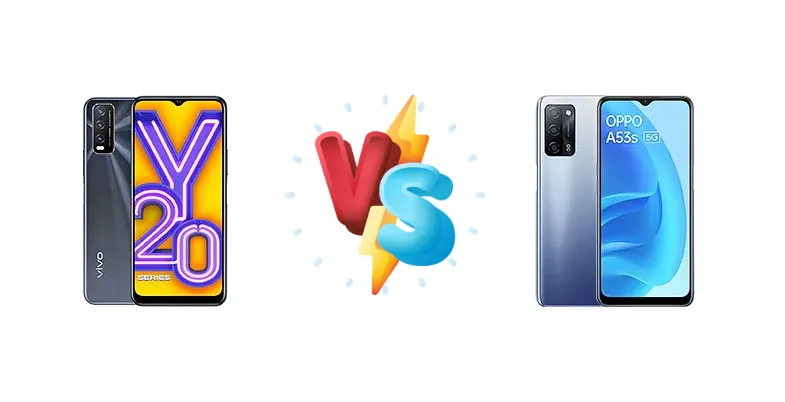
The sub-$200 smartphone market is fiercely competitive. The Oppo A53s 5G aims to deliver 5G connectivity and a modern processor at an accessible price, while the vivo Y20 focuses on a balance of efficiency with Qualcomm's Snapdragon 460. This comparison dissects the key differences to help you choose the right device for your needs.
🏆 Quick Verdict
For users prioritizing 5G connectivity and faster processing speeds for tasks like streaming and light gaming, the Oppo A53s 5G is the clear winner. However, the vivo Y20’s Snapdragon 460 offers potentially better power efficiency and a smoother experience for everyday tasks, making it ideal for those on a tighter budget or with moderate usage.
| Network |
|---|
| 2G bands | GSM 850 / 900 / 1800 / 1900 | GSM 850 / 900 / 1800 / 1900 |
| 3G bands | HSDPA 850 / 900 / 2100 | HSDPA 800 / 850 / 900 / 2100 |
| 4G bands | 1, 3, 5, 8, 38, 40, 41 | 1, 3, 5, 8, 34, 38, 39, 40, 41 |
| 5G bands | - | 1, 28, 41, 77, 78 SA/NSA |
| Speed | HSPA, LTE | HSPA, LTE, 5G |
| Technology | GSM / HSPA / LTE | GSM / HSPA / LTE / 5G |
| | 1, 3, 5, 7, 8, 18, 19, 20, 26, 28, 38, 39, 40, 41 | - |
| Launch |
|---|
| Announced | 2020, August 26. Released 2020, August 28 | 2021, April 27 |
| Status | Discontinued | Available. Released 2021, May 07 |
| Body |
|---|
| Build | Glass front, plastic back, plastic frame | - |
| Dimensions | 164.4 x 76.3 x 8.4 mm (6.47 x 3.00 x 0.33 in) | 164 x 75.7 x 8.4 mm (6.46 x 2.98 x 0.33 in) |
| SIM | Nano-SIM + Nano-SIM | Nano-SIM + Nano-SIM |
| Weight | 192.3 g (6.77 oz) | 189.6 g (6.70 oz) |
| Display |
|---|
| Resolution | 720 x 1600 pixels, 20:9 ratio (~270 ppi density) | 720 x 1600 pixels, 20:9 ratio (~269 ppi density) |
| Size | 6.51 inches, 102.3 cm2 (~81.6% screen-to-body ratio) | 6.52 inches, 102.6 cm2 (~82.7% screen-to-body ratio) |
| Type | IPS LCD | IPS LCD, 480 nits (typ) |
| Platform |
|---|
| CPU | Octa-core (4x1.8 GHz Kryo 240 & 4x1.6 GHz Kryo 240) | Octa-core (2x2.2 GHz Cortex-A76 & 6x2.0 GHz Cortex-A55) |
| Chipset | Qualcomm SM4250 Snapdragon 460 (11 nm) | Mediatek Dimensity 700 (7 nm) |
| GPU | Adreno 610 | Mali-G57 MC2 |
| OS | Android 10, Funtouch 10.5 | Android 11, ColorOS 11.1 |
| Memory |
|---|
| Card slot | microSDXC (dedicated slot) | microSDXC (dedicated slot) |
| Internal | 64GB 3GB RAM, 64GB 4GB RAM, 64GB 6GB RAM | 128GB 6GB RAM, 128GB 8GB RAM |
| | eMMC 5.1 | UFS 2.2 |
| Main Camera |
|---|
| Features | LED flash, HDR | LED flash, HDR, panorama |
| Single | - | 8 MP, f/2.0, 26mm (wide) |
| Triple | 13 MP, f/2.2, (wide), PDAF
2 MP (macro)
Auxiliary lens | 13 MP, f/2.2, 25mm (wide), 1/3.06", 1.12µm, PDAF
2 MP (macro)
Auxiliary lens |
| Video | 1080p@30fps | 1080p@30fps |
| Selfie camera |
|---|
| Features | - | HDR |
| Single | 8 MP, f/1.8, (wide) | 8 MP, f/2.0, 26mm (wide) |
| Video | 1080p@30fps | 1080p@30fps |
| Sound |
|---|
| 3.5mm jack | Yes | Yes |
| 35mm jack | Yes | Yes |
| Loudspeaker | Yes | Yes |
| Comms |
|---|
| Bluetooth | 5.0, A2DP, LE | 5.0, A2DP, LE, aptX HD |
| NFC | No | No |
| Positioning | GPS, GLONASS, BDS, GALILEO | GPS, GLONASS, GALILEO, BDS, QZSS |
| Radio | FM radio | No |
| USB | microUSB 2.0, OTG | USB Type-C 2.0, OTG |
| WLAN | Wi-Fi 802.11 a/b/g/n/ac, dual-band, Wi-Fi Direct | Wi-Fi 802.11 a/b/g/n/ac, dual-band, Wi-Fi Direct |
| Features |
|---|
| Sensors | Fingerprint (side-mounted), accelerometer, proximity, compass | Fingerprint (side-mounted), accelerometer, gyro, proximity, compass |
| Battery |
|---|
| Charging | 18W wired | 10W wired |
| Type | 5000 mAh | Li-Po 5000 mAh |
| Misc |
|---|
| Colors | Obsidian Black, Dawn White, Purist Blue | Crystal Blue, Ink Black |
| Models | V2029, V2029_PK | CPH2321 |
| Price | About 150 EUR | About 170 EUR |
| SAR | 1.19 W/kg (head) 0.58 W/kg (body) | - |
| Pricing |
|---|
| 64GB 3GB RAM | Rp 2,099,000 | - |
| 64GB 4GB RAM | ₹ 13,990 | - |
vivo Y20
- Faster processor (Dimensity 700)
- 5G connectivity for faster data speeds
- Potentially better image processing
- More responsive user experience
- Slower charging (10W)
- Potentially shorter battery life due to 5G and processor
Oppo A53s 5G
- Faster charging (18W)
- More power-efficient processor (Snapdragon 460)
- Potentially longer battery life
- Lower price point (depending on RAM configuration)
- No 5G connectivity
- Slower processor for demanding tasks
Display Comparison
Neither device boasts a standout display. Both likely utilize LCD panels, a common trait in this price bracket. The focus here isn't on visual fidelity, but functionality. Without specific display specs, we can infer that both will offer adequate viewing angles and color reproduction for everyday use. The absence of high refresh rates or advanced panel technologies like LTPO suggests a focus on cost reduction.
Camera Comparison
Camera performance is likely similar, relying heavily on software processing. Both phones likely feature a primary camera alongside depth and macro sensors. Without detailed sensor size information, it’s difficult to make a definitive judgment. However, the image signal processor (ISP) within the Dimensity 700 may offer slightly better image processing capabilities, potentially resulting in more detailed and vibrant photos in good lighting conditions. The 2MP macro cameras on both devices are likely to offer limited utility, serving primarily as a marketing feature.
Performance
The core difference lies in the chipsets. The Oppo A53s 5G’s MediaTek Dimensity 700 (7nm) significantly outperforms the vivo Y20’s Qualcomm Snapdragon 460 (11nm). The 7nm process node of the Dimensity 700 translates to greater transistor density and improved power efficiency *at the same performance level*, or higher performance at the same power draw. The Dimensity 700’s CPU configuration – 2x2.2 GHz Cortex-A76 & 6x2.0 GHz Cortex-A55 – provides a noticeable boost in single-core and multi-core performance compared to the Snapdragon 460’s Octa-core (4x1.8 GHz Kryo 240 & 4x1.6 GHz Kryo 240). This means faster app loading times, smoother multitasking, and a more responsive user experience on the Oppo. The Snapdragon 460, while capable, is geared towards basic functionality.
Battery Life
The Oppo A53s 5G’s 10W charging is significantly slower than the vivo Y20’s 18W charging. While neither phone boasts a massive battery, the Snapdragon 460’s inherent power efficiency in the vivo Y20 could translate to longer real-world battery life, despite potentially having a similar capacity battery. The faster charging on the Y20 allows for quicker top-ups, mitigating the impact of a potentially smaller battery capacity. The 5G connectivity of the Oppo A53s 5G will also draw more power, impacting overall battery endurance.
Buying Guide
Buy the vivo Y20 if you need a reliable, efficient smartphone for basic tasks like calling, texting, social media, and light web browsing, and value longer battery life over cutting-edge features. Buy the Oppo A53s 5G if you prioritize 5G connectivity for faster download speeds, enjoy occasional gaming, and want a more responsive experience for demanding apps, even if it means sacrificing some battery life.
Frequently Asked Questions
❓ Will the Oppo A53s 5G overheat during extended gaming sessions?
The Dimensity 700 is generally efficient, but prolonged gaming on the Oppo A53s 5G may lead to some thermal throttling. While not extreme, expect a slight performance dip after 30-60 minutes of demanding games. The phone's plastic build doesn't aid in heat dissipation.
❓ Is the 3GB of RAM in the base vivo Y20 model sufficient for multitasking?
3GB of RAM is adequate for basic multitasking – switching between a few apps like messaging, social media, and web browsing. However, running multiple demanding apps simultaneously may result in slowdowns and app reloading. Upgrading to the 4GB RAM variant is recommended for a smoother experience.
❓ Does the Oppo A53s 5G support all 5G bands in [Region]? (e.g., US, Europe)
5G band support varies by region and carrier. You'll need to verify that the Oppo A53s 5G supports the specific 5G bands used by your mobile carrier to ensure compatibility. Check Oppo's official website or your carrier's documentation for detailed band information.
❓ How significant is the difference in app loading times between the two phones?
The Oppo A53s 5G, with its Dimensity 700, will exhibit noticeably faster app loading times compared to the vivo Y20. Expect apps to launch 20-40% quicker on the Oppo, especially larger and more complex applications.