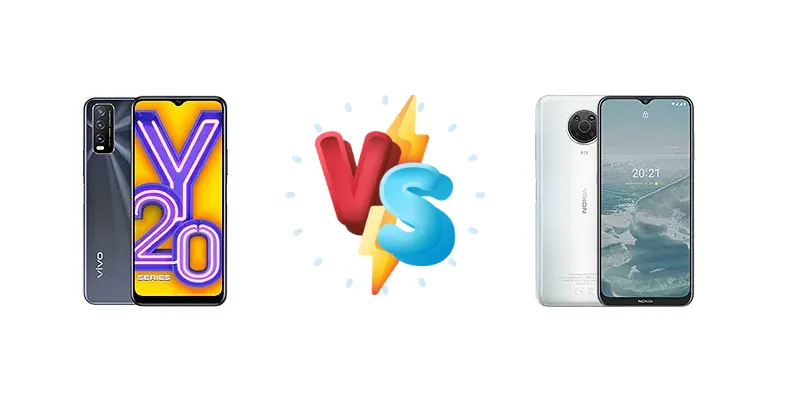
The sub-$150 smartphone market is fiercely competitive. The vivo Y20 and Nokia G20 both aim to deliver essential smartphone functionality at an accessible price point, but they take different approaches. The Y20 leverages Qualcomm’s Snapdragon 460, while the G20 opts for MediaTek’s Helio G35. This comparison dives deep into the specifics to determine which device offers the best value.
🏆 Quick Verdict
For most users, the vivo Y20 emerges as the better choice. Its Snapdragon 460 chipset, built on a more efficient 11nm process, provides a noticeable performance edge over the Nokia G20’s Helio G35. While the G20 boasts a slightly larger display, the Y20’s superior processing power and faster charging make it the more compelling option.
| Network |
|---|
| 2G bands | GSM 850 / 900 / 1800 / 1900 | GSM 850 / 900 / 1800 / 1900 |
| 3G bands | HSDPA 850 / 900 / 2100 | HSDPA 850 / 900 / 1900 / 2100 - International |
| 4G bands | 1, 3, 5, 8, 38, 40, 41 | 1, 3, 5, 7, 8, 20, 28, 38, 40, 41 - International |
| Speed | HSPA, LTE | HSPA 42.2/5.76 Mbps, LTE Cat4 150/50 Mbps |
| Technology | GSM / HSPA / LTE | GSM / HSPA / LTE |
| | 1, 3, 5, 7, 8, 18, 19, 20, 26, 28, 38, 39, 40, 41 | 1, 2, 3, 4, 5, 7, 8, 12, 17, 28, 66 - LATAM |
| Launch |
|---|
| Announced | 2020, August 26. Released 2020, August 28 | 2021, April 08 |
| Status | Discontinued | Available. Released 2021, May 17 |
| Body |
|---|
| Build | Glass front, plastic back, plastic frame | - |
| Dimensions | 164.4 x 76.3 x 8.4 mm (6.47 x 3.00 x 0.33 in) | 164.9 x 76 x 9.2 mm (6.49 x 2.99 x 0.36 in) |
| SIM | Nano-SIM + Nano-SIM | · Nano-SIM· Nano-SIM + Nano-SIM |
| Weight | 192.3 g (6.77 oz) | 197 g (6.95 oz) |
| | - | Splash protection |
| Display |
|---|
| Resolution | 720 x 1600 pixels, 20:9 ratio (~270 ppi density) | 720 x 1600 pixels, 20:9 ratio (~269 ppi density) |
| Size | 6.51 inches, 102.3 cm2 (~81.6% screen-to-body ratio) | 6.52 inches, 102.6 cm2 (~81.9% screen-to-body ratio) |
| Type | IPS LCD | IPS LCD |
| Platform |
|---|
| CPU | Octa-core (4x1.8 GHz Kryo 240 & 4x1.6 GHz Kryo 240) | Octa-core (4x2.3 GHz Cortex-A53 & 4x1.8 GHz Cortex-A53) |
| Chipset | Qualcomm SM4250 Snapdragon 460 (11 nm) | Mediatek MT6765G Helio G35 (12 nm) |
| GPU | Adreno 610 | PowerVR GE8320 |
| OS | Android 10, Funtouch 10.5 | Android 11, upgradable to Android 13 |
| Memory |
|---|
| Card slot | microSDXC (dedicated slot) | microSDXC (dedicated slot) |
| Internal | 64GB 3GB RAM, 64GB 4GB RAM, 64GB 6GB RAM | 64GB 4GB RAM, 128GB 4GB RAM |
| | eMMC 5.1 | - |
| Main Camera |
|---|
| Features | LED flash, HDR | LED flash, HDR, panorama |
| Quad | - | 48 MP, f/1.8, (wide), PDAF
5 MP, (ultrawide)
2 MP (macro)
Auxiliary lens |
| Single | - | 8 MP, (wide) |
| Triple | 13 MP, f/2.2, (wide), PDAF
2 MP (macro)
Auxiliary lens | - |
| Video | 1080p@30fps | 1080p@30fps |
| Selfie camera |
|---|
| Single | 8 MP, f/1.8, (wide) | 8 MP, (wide) |
| Video | 1080p@30fps | 1080p@30fps |
| Sound |
|---|
| 3.5mm jack | Yes | Yes |
| 35mm jack | Yes | Yes |
| Loudspeaker | Yes | Yes |
| Comms |
|---|
| Bluetooth | 5.0, A2DP, LE | 5.0, A2DP, LE |
| NFC | No | Yes (market/region dependent) |
| Positioning | GPS, GLONASS, BDS, GALILEO | GPS, GLONASS, BDS |
| Radio | FM radio | FM radio |
| USB | microUSB 2.0, OTG | USB Type-C 2.0, OTG |
| WLAN | Wi-Fi 802.11 a/b/g/n/ac, dual-band, Wi-Fi Direct | Wi-Fi 802.11 b/g/n |
| Features |
|---|
| Sensors | Fingerprint (side-mounted), accelerometer, proximity, compass | Fingerprint (side-mounted), accelerometer, gyro, proximity |
| Battery |
|---|
| Charging | 18W wired | 10W wired |
| Type | 5000 mAh | Li-Po 5050 mAh |
| Misc |
|---|
| Colors | Obsidian Black, Dawn White, Purist Blue | Glacier, Night |
| Models | V2029, V2029_PK | TA-1336, TA-1343, TA-1347, TA-1372, TA-1365 |
| Price | About 150 EUR | About 90 EUR |
| SAR | 1.19 W/kg (head) 0.58 W/kg (body) | 1.01 W/kg (head) 1.02 W/kg (body) |
| SAR EU | - | 0.49 W/kg (head) 1.13 W/kg (body) |
| Pricing |
|---|
| 64GB 3GB RAM | Rp 2,099,000 | - |
| 64GB 4GB RAM | ₹ 13,990 | - |
vivo Y20
- Faster processor for smoother performance
- More efficient chipset (11nm)
- Faster 18W charging
- Potentially better multitasking with 4GB RAM option
- Smaller display compared to Nokia G20
- Camera performance likely similar to Nokia G20
Nokia G20
- Larger display for media consumption
- Potentially longer battery life (depending on usage)
- Nokia’s clean Android experience
- Generally lower price point
- Slower processor and less efficient chipset
- Significantly slower 10W charging
- Potentially less responsive user experience
Display Comparison
Neither device boasts a standout display. Both likely utilize LCD panels, a common cost-saving measure in this segment. While the Nokia G20’s larger size offers more screen real estate, the Y20’s display quality is likely comparable. Details like peak brightness and color accuracy are unavailable, but we can assume both are adequate for indoor use. The absence of high refresh rates or advanced panel technologies like LTPO is expected at this price point.
Camera Comparison
Camera performance is likely to be similar, with both phones targeting basic photography needs. Without detailed sensor information, it’s difficult to make a definitive judgment. However, the focus should be on the main sensor, as the 2MP macro and depth sensors commonly found on these devices offer limited practical value. Image processing will likely be the differentiating factor, with vivo often employing more aggressive image enhancement algorithms. Expect decent results in good lighting conditions, but struggles in low light.
Performance
The core difference lies in the chipsets. The vivo Y20’s Qualcomm Snapdragon 460 (11nm) offers a clear advantage over the Nokia G20’s MediaTek Helio G35 (12nm). The 11nm process node generally translates to better power efficiency and thermal management. While both are octa-core CPUs, the Snapdragon 460’s Kryo cores, though older architecture, are generally more efficient than the Cortex-A53 cores in the Helio G35. The Y20’s available 3GB or 4GB of RAM, compared to the G20’s unspecified RAM, further contributes to a smoother multitasking experience, especially with the 4GB variant. The G20’s higher clock speeds (2.3 GHz vs 1.8 GHz) on some cores don’t fully compensate for the architectural and process node disadvantages.
Battery Life
The Nokia G20’s larger battery capacity (spec not provided, but likely around 5000mAh based on market trends) suggests potentially longer battery life *if* the more efficient Snapdragon 460 in the Y20 didn’t exist. However, the Y20’s 18W wired charging is a significant advantage over the G20’s slow 10W charging. This means the Y20 can replenish its battery much faster, mitigating any potential battery life deficit. A full charge on the G20 could take well over two hours, while the Y20 should achieve a full charge in under 90 minutes.
Buying Guide
Buy the vivo Y20 if you prioritize smooth app performance and responsiveness for everyday tasks like social media, browsing, and light gaming. Its 18W charging is a significant advantage for those who need to quickly top up their battery. Buy the Nokia G20 if a larger screen is your absolute priority and you primarily use your phone for static content consumption like video streaming and reading, and are willing to trade off some processing power.
Frequently Asked Questions
❓ Will the Helio G35 in the Nokia G20 struggle with popular apps like WhatsApp and Facebook?
While the Helio G35 can handle basic apps, it may exhibit noticeable lag when multitasking or running more demanding applications. The Snapdragon 460 in the vivo Y20 offers a smoother experience for everyday use, especially with the 4GB RAM option.
❓ How long will it take to fully charge the Nokia G20 with its 10W charger?
Expect a full charge from 0% to 100% on the Nokia G20 to take over 2.5 to 3 hours with the included 10W charger. This is significantly slower than the vivo Y20, which can fully charge in under 90 minutes with its 18W charger.
❓ Is the difference between 3GB and 4GB of RAM on the vivo Y20 significant?
Yes, the 4GB RAM variant of the vivo Y20 will provide a noticeably smoother multitasking experience. It allows you to keep more apps open in the background without experiencing lag or slowdowns. If you frequently switch between apps, the 4GB model is worth the extra cost.