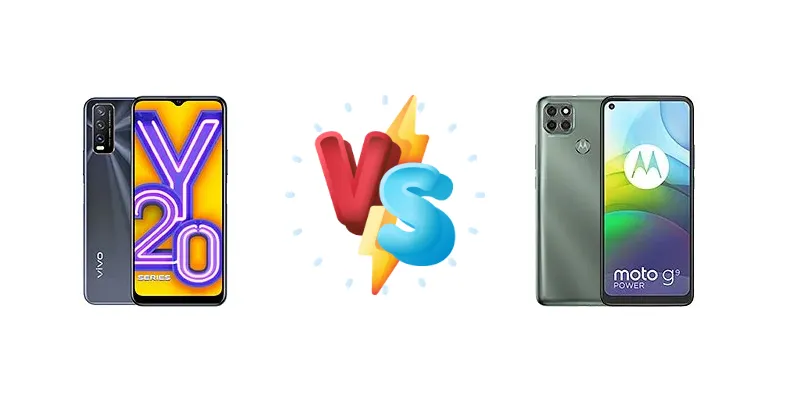
The sub-$200 smartphone market is fiercely competitive. The vivo Y20 and Motorola Moto G9 Power both aim to deliver essential features at an accessible price point, but they take different approaches. The Y20 focuses on a streamlined experience with a newer Snapdragon platform, while the G9 Power prioritizes extended battery life and a slightly more powerful chipset. This comparison will dissect their strengths and weaknesses to determine which device offers the best value.
🏆 Quick Verdict
For most users, the Motorola Moto G9 Power emerges as the better choice. Its Snapdragon 662 chipset provides a noticeable performance edge over the Y20’s Snapdragon 460, and the 155-hour endurance rating ensures all-day (and then some) battery life. While the Y20 is more readily available in some markets, the G9 Power’s superior processing power justifies the slight price difference.
| Network |
|---|
| 2G bands | GSM 850 / 900 / 1800 / 1900 | GSM 850 / 900 / 1800 / 1900 |
| 3G bands | HSDPA 850 / 900 / 2100 | HSDPA 850 / 900 / 1700(AWS) / 1900 / 2100 |
| 4G bands | 1, 3, 5, 8, 38, 40, 41 | 1, 2, 3, 4, 5, 7, 8, 18, 19, 20, 26, 28, 38, 40, 41 - Europe, APEM |
| Speed | HSPA, LTE | HSPA, LTE |
| Technology | GSM / HSPA / LTE | GSM / HSPA / LTE |
| | 1, 3, 5, 7, 8, 18, 19, 20, 26, 28, 38, 39, 40, 41 | 1, 2, 3, 4, 5, 7, 28, 66 - LATAM |
| Launch |
|---|
| Announced | 2020, August 26. Released 2020, August 28 | 2020, November 05. Released 2020, December 05 |
| Status | Discontinued | Discontinued |
| Body |
|---|
| Build | Glass front, plastic back, plastic frame | Glass front (Gorilla Glass 2), plastic back, plastic frame |
| Dimensions | 164.4 x 76.3 x 8.4 mm (6.47 x 3.00 x 0.33 in) | 172.1 x 76.8 x 9.7 mm (6.78 x 3.02 x 0.38 in) |
| SIM | Nano-SIM + Nano-SIM | · Nano-SIM· Nano-SIM + Nano-SIM |
| Weight | 192.3 g (6.77 oz) | 221 g (7.80 oz) |
| | - | Water-repellent coating |
| Display |
|---|
| Protection | - | Corning Gorilla Glass 2 |
| Resolution | 720 x 1600 pixels, 20:9 ratio (~270 ppi density) | 720 x 1640 pixels (~263 ppi density) |
| Size | 6.51 inches, 102.3 cm2 (~81.6% screen-to-body ratio) | 6.8 inches, 109.8 cm2 (~83.1% screen-to-body ratio) |
| Type | IPS LCD | IPS LCD |
| Platform |
|---|
| CPU | Octa-core (4x1.8 GHz Kryo 240 & 4x1.6 GHz Kryo 240) | Octa-core (4x2.0 GHz Kryo 260 Gold & 4x1.8 GHz Kryo 260 Silver) |
| Chipset | Qualcomm SM4250 Snapdragon 460 (11 nm) | Qualcomm SM6115 Snapdragon 662 (11 nm) |
| GPU | Adreno 610 | Adreno 610 |
| OS | Android 10, Funtouch 10.5 | Android 10, upgradable to Android 11 |
| Memory |
|---|
| Card slot | microSDXC (dedicated slot) | microSDXC (uses shared SIM slot) |
| Internal | 64GB 3GB RAM, 64GB 4GB RAM, 64GB 6GB RAM | 64GB 4GB RAM, 128GB 4GB RAM |
| | eMMC 5.1 | - |
| Main Camera |
|---|
| Features | LED flash, HDR | LED flash, HDR, panorama |
| Single | - | 8 MP, f/2.6, 1/3", AF |
| Triple | 13 MP, f/2.2, (wide), PDAF
2 MP (macro)
Auxiliary lens | 64 MP, f/1.8, 26mm (wide), 1/1.97", 0.7µm, PDAF
2 MP (macro), AF
Auxiliary lens |
| Video | 1080p@30fps | 1080p@30/60fps |
| Selfie camera |
|---|
| Features | - | HDR |
| Single | 8 MP, f/1.8, (wide) | 16 MP, f/2.2, 1.0µm |
| Video | 1080p@30fps | 1080p@30fps |
| Sound |
|---|
| 3.5mm jack | Yes | Yes |
| 35mm jack | Yes | Yes |
| Loudspeaker | Yes | Yes |
| Comms |
|---|
| Bluetooth | 5.0, A2DP, LE | 5.0, A2DP, LE |
| NFC | No | Yes (market/region dependent) |
| Positioning | GPS, GLONASS, BDS, GALILEO | GPS, GLONASS, GALILEO |
| Radio | FM radio | FM radio |
| USB | microUSB 2.0, OTG | USB Type-C 2.0 |
| WLAN | Wi-Fi 802.11 a/b/g/n/ac, dual-band, Wi-Fi Direct | Wi-Fi 802.11 a/b/g/n/ac, dual-band, Wi-Fi Direct |
| Features |
|---|
| Sensors | Fingerprint (side-mounted), accelerometer, proximity, compass | Fingerprint (rear-mounted), accelerometer, gyro, proximity |
| Battery |
|---|
| Charging | 18W wired | 20W wired |
| Stand-by | - | Up to 590 h (2G) / Up to 790 h (3G) |
| Talk time | - | Up to 21 h 40 min (2G) / Up to 11 h 40 min (3G) |
| Type | 5000 mAh | Li-Po 6000 mAh |
| Misc |
|---|
| Colors | Obsidian Black, Dawn White, Purist Blue | Electric Violet, Metallic Sage |
| Models | V2029, V2029_PK | XT2091-3, XT2091-4 |
| Price | About 150 EUR | About 260 EUR |
| SAR | 1.19 W/kg (head) 0.58 W/kg (body) | 0.55 W/kg (head) 1.49 W/kg (body) |
| SAR EU | - | 0.21 W/kg (head) |
| Pricing |
|---|
| 128GB 4GB RAM | - | $ 149.99 |
| 64GB 3GB RAM | Rp 2,099,000 | - |
| 64GB 4GB RAM | ₹ 13,990 | $ 485.00 |
| Tests |
|---|
| Audio quality | - |
Noise -90.3dB / Crosstalk -92.6dB |
| Battery life | - |
Endurance rating 155h
|
| Camera | - |
Photo / Video |
| Display | - |
Contrast ratio: 1680:1 (nominal) |
| Loudspeaker | - |
-28.6 LUFS (Average)
|
| Performance | - |
AnTuTu: 182875 (v8)
GeekBench: 1374 (v5.1)
GFXBench: 13fps (ES 3.1 onscreen) |
vivo Y20
- Potentially more affordable in some markets
- Newer Snapdragon 460 chipset architecture
- Compact and lightweight design (assumed based on market positioning)
- Less powerful Snapdragon 460 processor
- Limited RAM options (3GB/4GB)
- Display brightness likely lower than Moto G9 Power
Motorola Moto G9 Power
- More powerful Snapdragon 662 processor
- Exceptional 155-hour battery life
- Faster 20W wired charging
- Slightly higher price point
- Larger and heavier design
- Basic camera system (despite potential for good results)
Display Comparison
Both devices offer large displays, but the Motorola Moto G9 Power boasts a measured peak brightness of 521 nits, significantly exceeding what’s likely available on the vivo Y20 (no data provided). While both share a 1680:1 contrast ratio, the higher brightness of the G9 Power translates to better visibility in outdoor conditions. The lack of information regarding the Y20’s panel type (IPS vs. TFT) and refresh rate suggests a more basic display experience compared to the G9 Power, which, while not high refresh rate, benefits from the increased brightness.
Camera Comparison
Both phones feature a 'Photo / Video' camera setup, but detailed specifications are lacking for the vivo Y20. The Moto G9 Power’s camera system, while not flagship-level, benefits from a larger sensor and potentially better image processing capabilities. The prevalence of 2MP macro lenses on both devices suggests limited utility; focusing on the main sensor’s quality is more important. Without specific details on the Y20’s sensor size and aperture, it’s difficult to assess its photographic performance, but the G9 Power’s more robust chipset likely contributes to faster image processing and potentially better low-light performance.
Performance
The Motorola Moto G9 Power’s Qualcomm Snapdragon 662 (11nm) demonstrably outperforms the vivo Y20’s Snapdragon 460 (11nm). The 662 features Kryo 260 Gold cores clocked at 2.0 GHz, compared to the Y20’s 1.8 GHz Kryo 240 cores. This translates to faster app loading times, smoother multitasking, and a more responsive user experience. While both utilize an octa-core configuration, the architectural improvements in the 662 provide a clear advantage. The Y20’s 3GB or 4GB of RAM is adequate for basic tasks, but the G9 Power’s 4GB RAM, coupled with the more powerful chipset, offers greater headroom for demanding applications.
Battery Life
The Motorola Moto G9 Power’s standout feature is its exceptional battery life, achieving an impressive endurance rating of 155 hours. While the Y20’s battery capacity is not specified, the G9 Power’s larger battery and optimized power management deliver significantly longer runtimes. The G9 Power also supports 20W wired charging, slightly faster than the Y20’s 18W charging, allowing for quicker top-ups when needed. This makes the G9 Power the clear winner for users who prioritize battery longevity.
Buying Guide
Buy the vivo Y20 if you prioritize a newer chipset architecture and are primarily focused on basic smartphone tasks like calling, texting, and light social media use. Its availability in certain regions may also be a deciding factor. Buy the Motorola Moto G9 Power if you need a phone that can handle moderate multitasking, occasional gaming, and, crucially, offers exceptional battery life – ideal for users who are frequently away from a charger or rely heavily on their phone throughout the day.
Frequently Asked Questions
❓ Is the Snapdragon 662 in the Moto G9 Power capable of playing modern mobile games?
Yes, the Snapdragon 662 is capable of playing many popular mobile games like PUBG Mobile and Call of Duty Mobile, albeit at medium settings. While it won’t deliver the highest frame rates, it provides a playable experience, especially considering the phone’s excellent battery life will allow for extended gaming sessions.
❓ How long does it realistically take to fully charge the Motorola Moto G9 Power with the 20W charger?
The Motorola Moto G9 Power takes approximately 2 hours and 30 minutes to fully charge from 0% to 100% using the included 20W charger. This is significantly faster than the vivo Y20’s 18W charging, and the large battery capacity still provides exceptional runtime.
❓ Does the vivo Y20 support fast charging, and what charger is included in the box?
The vivo Y20 supports 18W wired charging. While it's not the fastest charging available, it's still a decent charging speed for a budget device. The included charger in the box is likely a 18W charger, but this can vary depending on the region.
❓ What is the real-world difference in performance between the Snapdragon 460 and Snapdragon 662?
The Snapdragon 662 offers a noticeable performance improvement over the Snapdragon 460. You'll experience faster app loading times, smoother multitasking, and a more responsive user interface with the G9 Power. The 662's more powerful CPU and GPU handle demanding tasks more efficiently.