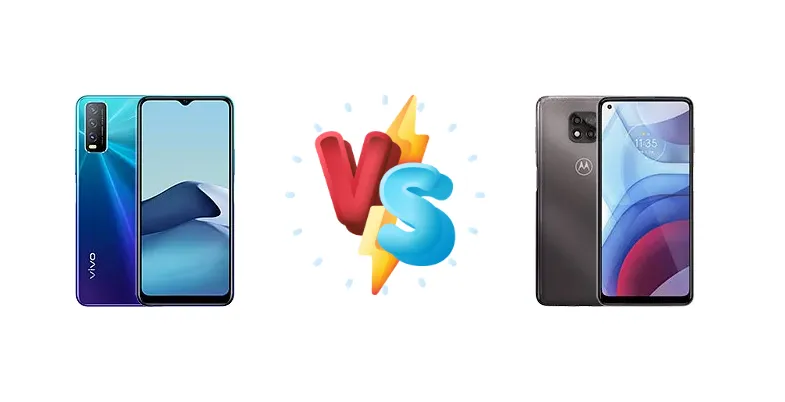
The sub-$200 smartphone market is fiercely competitive. Both the vivo Y20 2021 and the Motorola Moto G Power (2021) aim to deliver essential smartphone functionality at an accessible price. However, they take different approaches to achieving this, with Motorola prioritizing battery life and vivo focusing on a more streamlined user experience. This comparison dissects their core components to determine which device offers the best value.
🏆 Quick Verdict
For the average user prioritizing sustained performance and faster charging, the Motorola Moto G Power (2021) is the better choice. Its Snapdragon 662 chipset, built on an 11nm process, provides a noticeable performance edge over the vivo Y20 2021’s Helio P35, despite the latter’s slightly higher CPU clock speeds on some cores.
| Network |
|---|
| 2G bands | GSM 850 / 900 / 1800 / 1900 | GSM 850 / 900 / 1800 / 1900 |
| 3G bands | HSDPA 850 / 900 / 2100 | HSDPA 850 / 900 / 1700(AWS) / 1900 / 2100 |
| 4G bands | 1, 3, 5, 7, 8, 38, 40, 41 | 1, 2, 3, 4, 5, 7, 8, 12, 13, 14, 17, 25, 26, 29, 30, 38, 41, 66, 71 |
| Speed | HSPA, LTE | HSPA, LTE |
| Technology | GSM / HSPA / LTE | GSM / CDMA / HSPA / EVDO / LTE |
| | - | CDMA2000 1xEV-DO |
| Launch |
|---|
| Announced | 2020, December 30. Released 2021, January 13 | 2021, January 08 |
| Status | Discontinued | Available. Released 2021, January 14 |
| Body |
|---|
| Build | Glass front, plastic back, plastic frame | Glass front, plastic back, plastic frame |
| Dimensions | 164.4 x 76.3 x 8.4 mm (6.47 x 3.00 x 0.33 in) | 165.3 x 75.9 x 9.5 mm (6.51 x 2.99 x 0.37 in) |
| SIM | Nano-SIM + Nano-SIM | Nano-SIM |
| Weight | 192 g (6.77 oz) | 206.5 g (7.30 oz) |
| | - | Water-repellent coating |
| Display |
|---|
| Resolution | 720 x 1600 pixels, 20:9 ratio (~270 ppi density) | 720 x 1600 pixels, 20:9 ratio (~266 ppi density) |
| Size | 6.51 inches, 102.3 cm2 (~81.6% screen-to-body ratio) | 6.6 inches, 105.2 cm2 (~83.8% screen-to-body ratio) |
| Type | IPS LCD | IPS LCD |
| Platform |
|---|
| CPU | Octa-core (4x2.35 GHz Cortex-A53 & 4x1.8 GHz Cortex-A53) | Octa-core (4x2.0 GHz Kryo 260 Gold & 4x1.8 GHz Kryo 260 Silver) |
| Chipset | Mediatek MT6765 Helio P35 (12 nm) | Qualcomm SM6115 Snapdragon 662 (11 nm) |
| GPU | PowerVR GE8320 | Adreno 610 |
| OS | Android 10, Funtouch 11 | Android 10 |
| Memory |
|---|
| Card slot | microSDXC (dedicated slot) | microSDXC (dedicated slot) |
| Internal | 64GB 4GB RAM, 64GB 6GB RAM | 32GB 3GB RAM, 64GB 4GB RAM |
| | eMMC 5.1 | eMMC 5.1 |
| Main Camera |
|---|
| Features | LED flash, HDR | LED flash, HDR, panorama |
| Triple | 13 MP, f/1.8, (wide), PDAF
2 MP (macro)
Auxiliary lens | 48 MP, f/1.7, (wide), 1/2.0", 0.8µm, PDAF
2 MP (macro)
Auxiliary lens |
| Video | 1080p@30fps | 1080p@30/60fps, gyro-EIS |
| Selfie camera |
|---|
| Features | - | HDR |
| Single | 8 MP, f/1.8, (wide) | 8 MP, f/2.0, 1.12µm |
| Video | 1080p@30fps | 1080p@30fps, gyro-EIS |
| Sound |
|---|
| 3.5mm jack | Yes | Yes |
| 35mm jack | Yes | Yes |
| Loudspeaker | Yes | Yes |
| Comms |
|---|
| Bluetooth | 5.0, A2DP, LE | 5.0, A2DP, LE |
| NFC | No | No |
| Positioning | GPS, GLONASS, GALILEO, BDS | GPS, GLONASS, GALILEO |
| Radio | FM radio | FM radio |
| USB | microUSB 2.0, OTG | USB Type-C 2.0 |
| WLAN | Wi-Fi 802.11 a/b/g/n/ac, dual-band, Wi-Fi Direct | Wi-Fi 802.11 a/b/g/n/ac, dual-band, Wi-Fi Direct |
| Features |
|---|
| Sensors | Fingerprint (side-mounted), accelerometer, gyro, proximity, compass | Fingerprint (side-mounted), accelerometer, gyro, proximity, compass, barometer |
| Battery |
|---|
| Charging | 10W wired | 15W wired |
| Type | 5000 mAh | Li-Po 5000 mAh |
| Misc |
|---|
| Colors | Dawn White, Nebula Blue | Flash Gray, Polar Silver |
| Models | V2043, V2048 | - |
| Price | About 120 EUR | About 60 EUR |
vivo Y20 2021
- Potentially cleaner software experience (depending on FunTouch OS version)
- Slightly higher CPU clock speeds on some cores
- Competitive price point
- Less powerful chipset (Helio P35)
- Slower charging (10W)
- Likely inferior GPU performance
Motorola Moto G Power (2021)
- More powerful and efficient chipset (Snapdragon 662)
- Faster charging (15W)
- Better sustained performance for gaming and multitasking
- Motorola’s software can include bloatware
- May be slightly more expensive than the vivo Y20 2021
Display Comparison
Neither device boasts a standout display. Both likely utilize LCD panels, a common cost-saving measure in this segment. The key difference lies under the hood: processing power impacts UI smoothness. While both resolutions are likely 720p+, the Snapdragon 662 in the Moto G Power will contribute to a more fluid scrolling experience. We can assume both have standard 60Hz refresh rates, as higher rates are uncommon at this price point.
Camera Comparison
Both phones likely feature a multi-camera setup with a primary sensor and several auxiliary lenses. However, details beyond the presence of these lenses are scarce. Given the price point, image quality will be heavily reliant on software processing. The Motorola Moto G Power (2021) benefits from Qualcomm’s image signal processor (ISP), which generally delivers better dynamic range and noise reduction. The vivo Y20 2021’s camera performance will likely be adequate for casual snapshots but will struggle in low-light conditions. We can expect both to include a 2MP macro lens, which offers limited practical benefit.
Performance
The Motorola Moto G Power (2021) holds a significant advantage in performance. Its Qualcomm Snapdragon 662 (11nm) is a more efficient and powerful chipset than the vivo Y20 2021’s MediaTek Helio P35 (12nm). The 11nm fabrication process allows for better thermal management and power efficiency. While the Helio P35 features a higher clock speed on its primary cores (2.35 GHz vs 2.0 GHz), the Snapdragon 662’s Kryo Gold cores offer superior architecture and sustained performance. This translates to faster app loading times, smoother multitasking, and a more responsive overall experience. The Snapdragon's Adreno 610 GPU also provides a better gaming experience than the Helio P35's PowerVR GE8320.
Battery Life
The Motorola Moto G Power (2021) features 15W wired charging, a clear advantage over the vivo Y20 2021’s 10W charging. While both likely have 5000mAh batteries, the Snapdragon 662’s superior power efficiency means the Moto G Power will likely achieve longer screen-on time. The faster charging also reduces the time spent tethered to a wall outlet, a significant convenience factor. Expect the Moto G Power to reach a full charge in approximately 2.5-3 hours, while the vivo Y20 2021 will take closer to 3.5-4 hours.
Buying Guide
Buy the vivo Y20 2021 if you need a basic, functional smartphone for light tasks like calling, texting, and occasional social media browsing, and value a potentially cleaner software experience. Buy the Motorola Moto G Power (2021) if you prioritize longer battery life, smoother multitasking, and a more responsive user interface, even if it means sacrificing some software polish.
Frequently Asked Questions
❓ Will the Motorola Moto G Power (2021) struggle with demanding games like PUBG Mobile?
While the Snapdragon 662 isn't a gaming powerhouse, it's capable of running PUBG Mobile at medium settings with reasonable frame rates. Expect some occasional frame drops during intense action, but it's a significantly better gaming experience than the Helio P35-powered vivo Y20 2021.
❓ Does the vivo Y20 2021’s FunTouch OS offer significant customization options?
FunTouch OS, vivo’s custom Android skin, offers a degree of customization, but it’s often criticized for its heavy-handed approach and pre-installed bloatware. Users seeking a cleaner Android experience may prefer the Motorola Moto G Power (2021), which typically offers a near-stock Android experience.
❓ How much faster is the charging on the Motorola Moto G Power (2021) compared to the vivo Y20 2021?
The Motorola Moto G Power (2021)'s 15W charging is approximately 50% faster than the vivo Y20 2021's 10W charging. This translates to a significantly reduced time to reach a full charge, making it more convenient for users who need to quickly top up their battery.