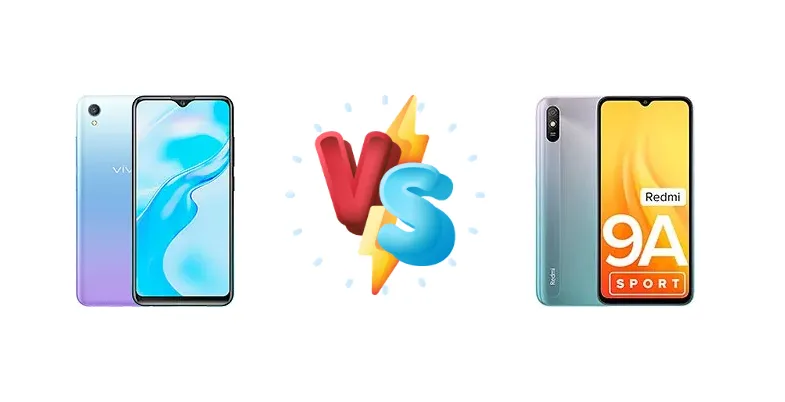
The vivo Y1s and Xiaomi Redmi 9A Sport represent the ultra-budget end of the smartphone spectrum. Both devices aim to deliver essential smartphone functionality at the lowest possible price point. This comparison dissects their core components to determine which offers the best value for users prioritizing affordability and basic performance.
🏆 Quick Verdict
For the average user seeking a functional, affordable smartphone, the Xiaomi Redmi 9A Sport is the slightly better choice. Its Mediatek Helio G25 chipset, while not a massive leap, offers a modest performance advantage over the vivo Y1s’ Helio P35, and the inclusion of 10W charging provides a convenience the Y1s lacks.
| Network |
|---|
| 2G bands | GSM 850 / 900 / 1800 / 1900 | GSM 850 / 900 / 1800 / 1900 |
| 3G bands | HSDPA 850 / 900 / 2100 | HSDPA 850 / 900 / 2100 |
| 4G bands | 1, 3, 5, 7, 8, 38, 40, 41 | 1, 3, 5, 8, 40, 41 |
| Speed | HSPA, LTE | HSPA, LTE |
| Technology | GSM / HSPA / LTE | GSM / HSPA / LTE |
| Launch |
|---|
| Announced | 2020, November 26. Released 2020, November 26 | 2021, September 28 |
| Status | Discontinued | Available. Released 2021, September 28 |
| Body |
|---|
| Build | Glass front, plastic back, plastic frame | - |
| Dimensions | 155.1 x 75.1 x 8.3 mm (6.11 x 2.96 x 0.33 in) | 164.9 x 77.1 x 9 mm (6.49 x 3.04 x 0.35 in) |
| SIM | Nano-SIM + Nano-SIM | Nano-SIM + Nano-SIM |
| Weight | 161 g (5.68 oz) | 194 g (6.84 oz) |
| | - | Water-repellent coating |
| Display |
|---|
| Resolution | 720 x 1520 pixels, 19:9 ratio (~270 ppi density) | 720 x 1600 pixels, 20:9 ratio (~269 ppi density) |
| Size | 6.22 inches, 96.6 cm2 (~82.9% screen-to-body ratio) | 6.53 inches, 102.9 cm2 (~81.0% screen-to-body ratio) |
| Type | IPS LCD | IPS LCD, 400 nits (typ) |
| Platform |
|---|
| CPU | Octa-core (4x2.35 GHz Cortex-A53 & 4x1.8 GHz Cortex-A53) | Octa-core (4x2.0 GHz Cortex-A53 & 4x1.5 GHz Cortex-A53) |
| Chipset | Mediatek MT6765 Helio P35 (12 nm) | Mediatek MT6762G Helio G25 (12 nm) |
| GPU | PowerVR GE8320 | PowerVR GE8320 |
| OS | Android 10, Funtouch 10.5 | Android 10, MIUI 12 |
| Memory |
|---|
| Card slot | microSDXC (dedicated slot) | microSDXC (dedicated slot) |
| Internal | 32GB 2GB RAM, 32GB 3GB RAM | 32GB 2GB RAM, 32GB 3GB RAM |
| | eMMC 5.1 | eMMC 5.1 |
| Main Camera |
|---|
| Features | LED flash, HDR, panorama | LED flash, HDR |
| Single | 13 MP, f/2.2, PDAF | 13 MP, f/2.2, 28mm (wide), 1.0µm, PDAF |
| Video | 1080p@30fps | 1080p@30/60fps |
| Selfie camera |
|---|
| Features | - | HDR |
| Single | 5 MP, f/1.8 | 5 MP, f/2.2, (wide), 1.12µm |
| Video | - | 1080p@30fps |
| Sound |
|---|
| 3.5mm jack | Yes | Yes |
| 35mm jack | Yes | Yes |
| Loudspeaker | Yes | Yes |
| Comms |
|---|
| Bluetooth | 5.0, A2DP, LE | 5.0, A2DP, LE |
| NFC | No | No |
| Positioning | GPS, GLONASS, GALILEO, BDS | GPS, GLONASS, BDS |
| Radio | FM radio | FM radio |
| USB | microUSB 2.0, OTG | microUSB 2.0, OTG |
| WLAN | Wi-Fi 802.11 b/g/n, Wi-Fi Direct | Wi-Fi 802.11 a/b/g/n, Wi-Fi Direct |
| Features |
|---|
| Sensors | Accelerometer, proximity, compass | Accelerometer, proximity |
| Battery |
|---|
| Charging | - | 10W wired |
| Type | Li-Ion 4030 mAh | Li-Po 5000 mAh |
| Misc |
|---|
| Colors | Aurora Blue, Olive Black | Carbon Black, Coral Green, Metallic Blue |
| Models | 1929 | - |
| Price | About 80 EUR | About 100 EUR |
vivo Y1s
- Potentially slightly faster individual CPU cores (Helio P35)
- Simple and straightforward user experience
- Compact and lightweight design
- Lacks dedicated charging support
- Helio P35 less optimized for gaming
- Likely slower overall performance compared to Redmi 9A Sport
Xiaomi Redmi 9A Sport
- Helio G25 offers better gaming performance
- Includes 10W wired charging
- Slightly more responsive user experience
- Lower CPU clock speeds on Cortex-A53 cores
- Similar display quality to vivo Y1s
- Camera performance is still limited
Display Comparison
Neither device boasts a standout display. Both likely utilize LCD panels, typical for this price bracket. Detailed specs like resolution and brightness are missing, but we can assume they are similar – likely 720p+ resolution. The focus here isn’t on visual fidelity, but on basic readability. Bezels are expected to be noticeable on both, maximizing screen real estate within a compact form factor. Color accuracy will likely be standard for budget devices, prioritizing power efficiency over color calibration.
Camera Comparison
Camera performance on both devices will be limited. Both are expected to feature a primary camera and a depth sensor, with the Y1s potentially having a slightly higher megapixel count on the main sensor (details missing). Image processing will be basic, prioritizing speed over detail. The Redmi 9A Sport’s image signal processor (ISP) within the Helio G25 may offer slightly better noise reduction, but don’t expect flagship-level results. Any secondary cameras (often 2MP macro lenses) are largely marketing features and offer minimal practical benefit.
Performance
The core difference lies in the chipsets. The Xiaomi Redmi 9A Sport’s Mediatek Helio G25 (12nm) features a slightly higher clock speed on its Cortex-A53 cores (2.0 GHz vs 2.35 GHz on the Y1s’ Helio P35). However, the G25’s architecture is optimized for gaming, offering a modest GPU improvement. While the Y1s’ P35 has faster individual cores, the G25’s overall efficiency and gaming focus give it an edge in sustained performance. Both devices will struggle with demanding tasks, but the Redmi 9A Sport will likely exhibit less lag during everyday use. RAM configurations are likely similar, further minimizing the performance gap.
Battery Life
Both devices likely house batteries in the 4000-5000 mAh range, providing all-day battery life with moderate usage. However, the Redmi 9A Sport includes 10W wired charging, a significant advantage over the vivo Y1s, which lacks any specified charging capability. This means the Redmi 9A Sport can be topped up more quickly, reducing downtime. While neither offers fast charging, the convenience of even 10W charging is a notable benefit.
Buying Guide
Buy the vivo Y1s if you prioritize a simple, no-frills experience and are comfortable with slower charging speeds. It’s a viable option for first-time smartphone users or those needing a basic backup device. Buy the Xiaomi Redmi 9A Sport if you prefer a slightly more responsive user experience, particularly when multitasking, and value the convenience of even basic wired charging support. It’s better suited for users who occasionally engage in light gaming or social media browsing.
Frequently Asked Questions
❓ Will the Redmi 9A Sport handle popular games like PUBG Mobile?
While the Helio G25 is gaming-focused, PUBG Mobile will likely need to be played on low settings with reduced frame rates to maintain a playable experience. Expect occasional frame drops and lag, especially during intense action sequences. The Y1s would struggle even more.
❓ How long does it take to fully charge the Redmi 9A Sport with the 10W charger?
With 10W charging, a full charge from 0% will likely take around 3-4 hours. While not fast, it's significantly better than the vivo Y1s, which lacks any specified charging capability and will require a much longer charging time.
❓ Is the difference in CPU clock speed between the Helio P35 and Helio G25 noticeable in everyday tasks?
The difference in clock speed is relatively small, and the overall user experience will be more impacted by the Helio G25’s architecture and GPU. You’ll likely notice smoother multitasking and app launches on the Redmi 9A Sport, but the difference won’t be dramatic.
❓ Can I use a faster charger with the Redmi 9A Sport to speed up charging?
While the Redmi 9A Sport supports 10W charging, it may be able to utilize a charger with slightly higher wattage (e.g., 15W) without causing damage. However, the phone's internal charging circuitry will limit the charging speed to its maximum supported rate.