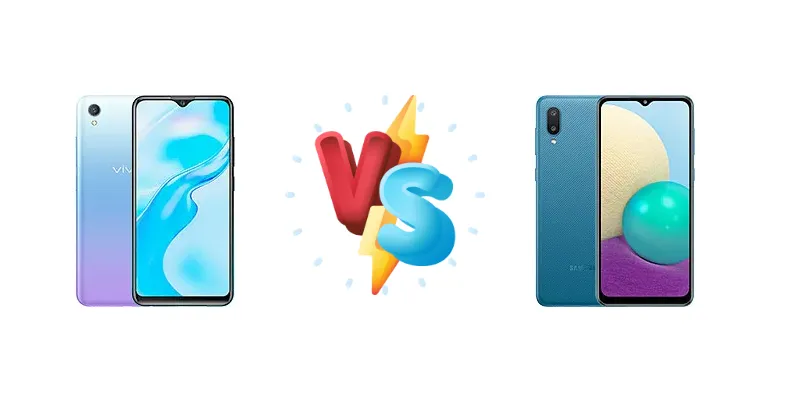
The vivo Y1s and Samsung Galaxy A02 represent the absolute bottom end of the smartphone market, targeting first-time buyers or those needing a very basic secondary device. Both rely on MediaTek chipsets, but a significant architectural difference exists. This comparison will dissect which phone delivers the best experience for the money, focusing on real-world performance implications.
🏆 Quick Verdict
For most users, the vivo Y1s offers a more responsive experience thanks to its newer Helio P35 chipset and octa-core CPU. While the Galaxy A02 offers more storage options at certain price points, the performance advantage of the Y1s outweighs this benefit for everyday tasks and light multitasking.
| Network |
|---|
| 2G bands | GSM 850 / 900 / 1800 / 1900 | GSM 850 / 900 / 1800 / 1900 |
| 3G bands | HSDPA 850 / 900 / 2100 | HSDPA 850 / 900 / 2100 |
| 4G bands | 1, 3, 5, 7, 8, 38, 40, 41 | 1, 3, 5, 7, 8, 20, 28, 38, 40, 41 |
| Speed | HSPA, LTE | HSPA 42.2/5.76 Mbps, LTE Cat4 150/50 Mbps |
| Technology | GSM / HSPA / LTE | GSM / HSPA / LTE |
| Launch |
|---|
| Announced | 2020, November 26. Released 2020, November 26 | 2021, January 27 |
| Status | Discontinued | Available. Released 2021, January 27 |
| Body |
|---|
| Build | Glass front, plastic back, plastic frame | Glass front, plastic back, plastic frame |
| Dimensions | 155.1 x 75.1 x 8.3 mm (6.11 x 2.96 x 0.33 in) | 164 x 75.9 x 9.1 mm (6.46 x 2.99 x 0.36 in) |
| SIM | Nano-SIM + Nano-SIM | · Nano-SIM· Nano-SIM + Nano-SIM |
| Weight | 161 g (5.68 oz) | 206 g (7.27 oz) |
| Display |
|---|
| Resolution | 720 x 1520 pixels, 19:9 ratio (~270 ppi density) | 720 x 1600 pixels, 20:9 ratio (~270 ppi density) |
| Size | 6.22 inches, 96.6 cm2 (~82.9% screen-to-body ratio) | 6.5 inches, 102.0 cm2 (~81.9% screen-to-body ratio) |
| Type | IPS LCD | PLS LCD |
| Platform |
|---|
| CPU | Octa-core (4x2.35 GHz Cortex-A53 & 4x1.8 GHz Cortex-A53) | Quad-core 1.5 GHz Cortex-A53 |
| Chipset | Mediatek MT6765 Helio P35 (12 nm) | Mediatek MT6739W (28 nm) |
| GPU | PowerVR GE8320 | PowerVR GE8100 |
| OS | Android 10, Funtouch 10.5 | Android 10, upgradable to Android 11, One UI Core 3.1 |
| Memory |
|---|
| Card slot | microSDXC (dedicated slot) | microSDXC (dedicated slot) |
| Internal | 32GB 2GB RAM, 32GB 3GB RAM | 32GB 2GB RAM, 32GB 3GB RAM, 32GB 4GB RAM, 64GB 3GB RAM |
| | eMMC 5.1 | eMMC 5.1 |
| Main Camera |
|---|
| Dual | - | 13 MP, f/1.9, (wide), AF
2 MP (macro) |
| Features | LED flash, HDR, panorama | LED flash |
| Single | 13 MP, f/2.2, PDAF | - |
| Video | 1080p@30fps | 1080p@30fps |
| Selfie camera |
|---|
| Single | 5 MP, f/1.8 | 5 MP, f/2.0 |
| Sound |
|---|
| 3.5mm jack | Yes | Yes |
| 35mm jack | Yes | Yes |
| Loudspeaker | Yes | Yes |
| Comms |
|---|
| Bluetooth | 5.0, A2DP, LE | 5.1, A2DP, LE |
| NFC | No | No |
| Positioning | GPS, GLONASS, GALILEO, BDS | GPS, GLONASS |
| Radio | FM radio | FM radio |
| USB | microUSB 2.0, OTG | microUSB 2.0 |
| WLAN | Wi-Fi 802.11 b/g/n, Wi-Fi Direct | Wi-Fi 802.11 b/g/n, Wi-Fi Direct |
| Features |
|---|
| Sensors | Accelerometer, proximity, compass | Accelerometer |
| | - | Virtual proximity sensing |
| Battery |
|---|
| Type | Li-Ion 4030 mAh | Li-Po 5000 mAh |
| Misc |
|---|
| Colors | Aurora Blue, Olive Black | Black, Blue |
| Models | 1929 | SM-A022F, SM-A022F/DS, SM-A022M, SM-A022M/DS, SM-A022G, SM-A022G/DS |
| Price | About 80 EUR | € 97.46 |
| SAR EU | - | 0.65 W/kg (head) 1.71 W/kg (body) |
| Pricing |
|---|
| 32GB 2GB RAM | - | $ 149.99 |
| 32GB 3GB RAM | - | $ 129.99 |
| 64GB 3GB RAM | - | $ 199.99 |
| RENEWED | - | £ 113.00 |
vivo Y1s
- Faster and more responsive performance due to the Helio P35 chipset.
- More efficient 12nm process leads to better battery life.
- Octa-core CPU handles multitasking better than the A02's quad-core.
- Potentially limited storage options compared to the A02.
- Camera performance likely similar to the A02 – basic.
Samsung Galaxy A02
- More storage configuration options (32GB/2GB, 32GB/3GB, 64GB/3GB).
- Potentially lower price point depending on the configuration.
- Widely available through Samsung's retail network.
- Significantly slower performance due to the older MT6739W chipset.
- Less efficient 28nm process results in shorter battery life.
- Quad-core CPU struggles with multitasking.
Display Comparison
Neither device boasts a standout display. Both are likely to feature LCD panels, though specific details like resolution and brightness are not provided. However, the focus here is performance, and display differences are unlikely to be a major deciding factor. Bezels are expected to be substantial on both, typical of this price bracket. Color accuracy will likely be basic, prioritizing power efficiency over fidelity.
Camera Comparison
Camera performance on both devices will be limited. The Galaxy A02 offers various configurations (32GB/2GB, 32GB/3GB, 64GB/3GB), but details on the camera sensors are scarce. It's safe to assume both rely on basic sensors. Any 2MP macro or depth sensors are likely to produce underwhelming results. The primary sensor's megapixel count isn't the defining factor here; image processing and sensor size are more crucial, and neither manufacturer provides this information. Expect acceptable photos in good lighting conditions, but significant noise and lack of detail in low light.
Performance
This is where the Y1s pulls ahead significantly. The MediaTek Helio P35 (MT6765) is built on a 12nm process and features an octa-core CPU (4x2.35 GHz Cortex-A53 & 4x1.8 GHz Cortex-A53). This contrasts sharply with the Galaxy A02’s MediaTek MT6739W, a 28nm quad-core processor clocked at 1.5 GHz. The 12nm node of the Helio P35 is far more efficient, leading to better thermal management and sustained performance. The octa-core configuration also provides a substantial advantage in multitasking and handling more demanding applications. The A02’s quad-core setup will struggle with even moderate app switching. While both use Cortex-A53 cores, the sheer number and clock speed difference favor the Y1s.
Battery Life
Battery capacity isn't specified for either device, but both likely house batteries in the 3000-4000 mAh range. The Helio P35’s superior power efficiency gives the Y1s an advantage in battery life, despite potentially having a similar capacity to the A02. The A02’s less efficient MT6739W will drain the battery faster under similar usage. Charging wattage is also unknown, but both are likely to ship with basic 5W or 10W chargers, resulting in slow charging times – expect several hours to reach 100%.
Buying Guide
Buy the vivo Y1s if you prioritize a smoother, more responsive user experience, even if it means potentially sacrificing storage space. Its Helio P35 chipset provides a noticeable performance boost for basic apps and web browsing. Buy the Samsung Galaxy A02 if storage capacity is your absolute top priority and you're willing to accept a slower, less fluid experience. The A02's various storage/RAM configurations offer flexibility, but at a performance cost.
Frequently Asked Questions
❓ Will the Samsung Galaxy A02 struggle with popular apps like Facebook or WhatsApp?
Yes, the MT6739W chipset in the Galaxy A02 is quite limited. While it can run these apps, you may experience noticeable lag, slow loading times, and difficulty multitasking. The vivo Y1s with its Helio P35 will provide a significantly smoother experience with these commonly used applications.
❓ Is the 64GB storage option on the Galaxy A02 worth the extra cost if I primarily use apps?
If you primarily use apps and rely heavily on cloud storage for photos and videos, the 64GB option might be beneficial. However, the performance difference between the A02 configurations is minimal. The Y1s's faster processor will make even a smaller amount of storage feel more usable due to quicker app loading and overall responsiveness.
❓ Can either of these phones handle basic mobile games like Candy Crush or Subway Surfers?
Both phones can *run* these games, but the experience will be far better on the vivo Y1s. The Helio P35 will provide smoother frame rates and less stuttering, especially during more visually intensive moments. The Galaxy A02 may struggle to maintain a consistent frame rate, leading to a less enjoyable gaming experience.