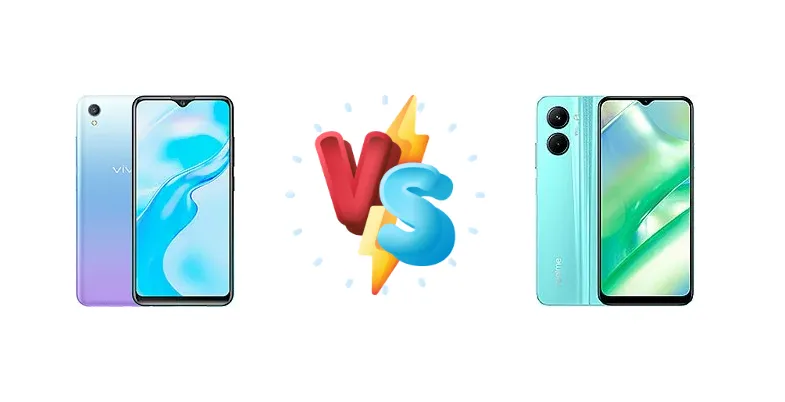
The sub-$150 smartphone market is fiercely competitive. Both the vivo Y1s and the Realme C33 2023 aim to deliver essential smartphone functionality at an accessible price. However, they take different approaches to achieving this, primarily through their choice of chipset. This comparison dissects the key differences to determine which device offers the best value for your money.
🏆 Quick Verdict
For the average user prioritizing responsiveness and future-proofing, the Realme C33 2023 is the better choice. Its Unisoc Tiger T612 chipset, featuring Cortex-A75 cores, provides a noticeable performance uplift over the vivo Y1s’ older Helio P35, despite both being fabricated on a 12nm process. While charging is slower, the overall user experience is smoother.
| Network |
|---|
| 2G bands | GSM 850 / 900 / 1800 / 1900 | GSM 850 / 900 / 1800 / 1900 |
| 3G bands | HSDPA 850 / 900 / 2100 | HSDPA 850 / 900 / 2100 |
| 4G bands | 1, 3, 5, 7, 8, 38, 40, 41 | 1, 3, 5, 8, 38, 40, 41 |
| Speed | HSPA, LTE | HSPA, LTE |
| Technology | GSM / HSPA / LTE | GSM / HSPA / LTE |
| Launch |
|---|
| Announced | 2020, November 26. Released 2020, November 26 | 2023, March 14 |
| Status | Discontinued | Available. Released 2023, March 14 |
| Body |
|---|
| Build | Glass front, plastic back, plastic frame | Glass front, plastic frame, plastic back |
| Dimensions | 155.1 x 75.1 x 8.3 mm (6.11 x 2.96 x 0.33 in) | 164.2 x 75.7 x 8.3 mm (6.46 x 2.98 x 0.33 in) |
| SIM | Nano-SIM + Nano-SIM | Nano-SIM + Nano-SIM |
| Weight | 161 g (5.68 oz) | 187 g (6.60 oz) |
| Display |
|---|
| Resolution | 720 x 1520 pixels, 19:9 ratio (~270 ppi density) | 720 x 1600 pixels, 20:9 ratio (~270 ppi density) |
| Size | 6.22 inches, 96.6 cm2 (~82.9% screen-to-body ratio) | 6.5 inches, 102.0 cm2 (~82.1% screen-to-body ratio) |
| Type | IPS LCD | IPS LCD, 400 nits (typ) |
| Platform |
|---|
| CPU | Octa-core (4x2.35 GHz Cortex-A53 & 4x1.8 GHz Cortex-A53) | Octa-core (2x1.8 GHz Cortex-A75 & 6x1.8 GHz Cortex-A55) |
| Chipset | Mediatek MT6765 Helio P35 (12 nm) | Unisoc Tiger T612 (12 nm) |
| GPU | PowerVR GE8320 | Mali-G57 |
| OS | Android 10, Funtouch 10.5 | Android 12, Realme UI S |
| Memory |
|---|
| Card slot | microSDXC (dedicated slot) | microSDXC (dedicated slot) |
| Internal | 32GB 2GB RAM, 32GB 3GB RAM | 64GB 4GB RAM, 128GB 4GB RAM |
| | eMMC 5.1 | UFS 2.2 |
| Main Camera |
|---|
| Dual | - | 50 MP, (wide), PDAF
Auxiliary lens |
| Features | LED flash, HDR, panorama | LED flash, HDR, panorama |
| Single | 13 MP, f/2.2, PDAF | 5 MP, f/2.2, 27mm (wide), 1/5.0", 1.12µm |
| Video | 1080p@30fps | 1080p@30fps |
| Selfie camera |
|---|
| Features | - | HDR |
| Single | 5 MP, f/1.8 | 5 MP, f/2.2, 27mm (wide), 1/5.0", 1.12µm |
| Video | - | 720p@30fps |
| Sound |
|---|
| 3.5mm jack | Yes | Yes |
| 35mm jack | Yes | Yes |
| Loudspeaker | Yes | Yes |
| Comms |
|---|
| Bluetooth | 5.0, A2DP, LE | 5.0, A2DP, LE |
| NFC | No | No |
| Positioning | GPS, GLONASS, GALILEO, BDS | GPS, GLONASS, GALILEO, BDS |
| Radio | FM radio | Unspecified |
| USB | microUSB 2.0, OTG | microUSB 2.0 |
| WLAN | Wi-Fi 802.11 b/g/n, Wi-Fi Direct | Wi-Fi 802.11 b/g/n |
| Features |
|---|
| Sensors | Accelerometer, proximity, compass | Fingerprint (side-mounted), accelerometer, proximity |
| Battery |
|---|
| Charging | - | 10W wired |
| Type | Li-Ion 4030 mAh | 5000 mAh |
| Misc |
|---|
| Colors | Aurora Blue, Olive Black | Sandy Gold, Aqua Blue, Night Sea |
| Models | 1929 | RMX3627 |
| Price | About 80 EUR | About 110 EUR |
vivo Y1s
- Potentially longer software support from vivo.
- Simple and straightforward user experience.
- Likely competitive price point.
- Older and less efficient Helio P35 chipset.
- Slower performance compared to the Realme C33.
- Limited multitasking capabilities.
Realme C33 2023
- More powerful Unisoc Tiger T612 chipset.
- Improved CPU architecture for better responsiveness.
- Potentially better multitasking performance.
- Slower 10W charging.
- Realme’s UI can be more feature-rich (and potentially bloated).
- Potentially shorter software support lifecycle.
Display Comparison
Neither device boasts a standout display. Both likely utilize LCD panels, typical for this price bracket. Without specific brightness or color gamut data, it’s difficult to declare a clear winner. However, the Realme C33’s slightly larger screen size (assumed based on typical Realme C-series designs) may offer a more immersive viewing experience. Bezels are expected to be substantial on both devices, reflecting their budget positioning.
Camera Comparison
Without detailed camera specs beyond the presence of multiple sensors, a direct comparison is challenging. Both devices likely feature a primary camera accompanied by depth or macro sensors. The image processing capabilities will heavily influence the final image quality. Given the price point, expect limited dynamic range and detail in challenging lighting conditions. The Realme C33’s potential for slightly better image processing algorithms, common in Realme’s software, could give it a marginal advantage, but this is speculative without sample images.
Performance
This is where the Realme C33 2023 pulls ahead. The Unisoc Tiger T612’s octa-core configuration, with 2x 1.8 GHz Cortex-A75 cores and 6x 1.8 GHz Cortex-A55 cores, represents a significant architectural improvement over the vivo Y1s’ MediaTek Helio P35. The Helio P35 relies on 4x 2.35 GHz Cortex-A53 cores and 4x 1.8 GHz Cortex-A53 cores. The A75 cores in the C33 offer substantially better single-core performance, crucial for app launch speeds and general responsiveness. While both are 12nm chips, the newer architecture of the T612 translates to a smoother user experience, especially when multitasking. The Y1s will likely struggle with more demanding applications.
Battery Life
Both devices likely feature batteries in the 5000mAh range, common for entry-level smartphones. However, the Realme C33 2023 is limited to 10W wired charging. The vivo Y1s charging speed is not specified, but is likely similar. This means longer charging times for both devices – expect several hours to reach a full charge. The slightly more efficient Unisoc T612 in the C33 might offer marginally better battery life under similar usage, offsetting the slower charging to some extent.
Buying Guide
Buy the vivo Y1s if you need a basic smartphone for essential tasks like calls, messaging, and light social media use, and prioritize a potentially longer software support lifecycle from the vivo brand. Buy the Realme C33 2023 if you prefer a more responsive experience for multitasking, occasional gaming, and appreciate a more modern CPU architecture, even if it means slightly slower charging.
Frequently Asked Questions
❓ Will the Realme C33 2023 handle popular games like PUBG Mobile or Call of Duty?
The Unisoc Tiger T612 can run PUBG Mobile and Call of Duty, but expect to play at lower graphics settings and frame rates. It's not a gaming powerhouse, but it offers a playable experience, unlike the Helio P35 in the vivo Y1s which would struggle significantly.
❓ Is the 10W charging on the Realme C33 2023 a major drawback?
While 10W charging is slow by modern standards, both phones are likely to take over 3 hours to fully charge. The more efficient chipset in the C33 might mitigate the impact of slower charging by extending battery life, reducing the frequency of needing to charge.
❓ Which phone is better for someone who primarily uses WhatsApp, Facebook, and YouTube?
The Realme C33 2023 is the better choice. The more powerful processor will ensure smoother scrolling through social media feeds and a more responsive YouTube experience, even with multiple apps open.
❓ Does the vivo Y1s receive regular software updates?
Vivo generally provides software updates for their devices, but the frequency and duration of support for the Y1s are uncertain. It's likely to receive fewer updates compared to more expensive Vivo models.