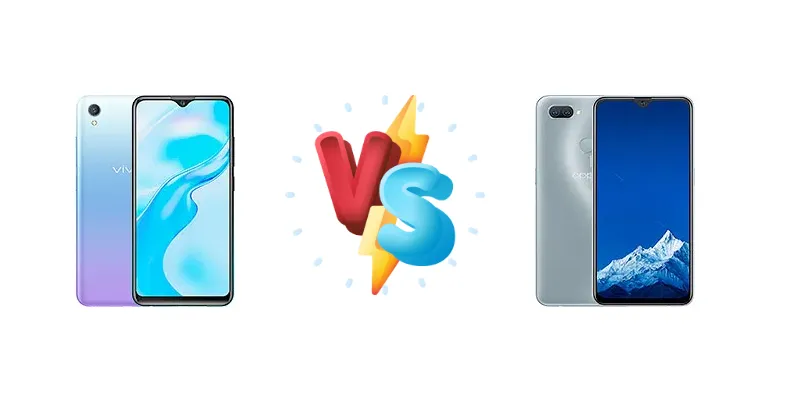
The vivo Y1s and Oppo A12s represent the extreme end of the smartphone price spectrum. Both devices rely on the Mediatek Helio P35 chipset, making a direct comparison crucial for budget-conscious consumers. This analysis will dissect their similarities and differences, focusing on how those translate into real-world usability.
🏆 Quick Verdict
For the average user prioritizing a slightly faster charging experience, the Oppo A12s is the better choice. While both phones share the same Helio P35 processor, the A12s’ 10W charging offers a marginal advantage over the Y1s’ likely 5W charging (unspecified). However, the difference is minimal, and both are suitable for basic tasks.
| Network |
|---|
| 2G bands | GSM 850 / 900 / 1800 / 1900 | GSM 850 / 900 / 1800 / 1900 |
| 3G bands | HSDPA 850 / 900 / 2100 | HSDPA 850 / 900 / 2100 |
| 4G bands | 1, 3, 5, 7, 8, 38, 40, 41 | 1, 3, 5, 8, 38, 40, 41 |
| EDGE | - | No |
| GPRS | - | Yes |
| Speed | HSPA, LTE | HSPA, LTE |
| Technology | GSM / HSPA / LTE | GSM / HSPA / LTE |
| Launch |
|---|
| Announced | 2020, November 26. Released 2020, November 26 | 2020, July 14. Released 2020, July 26 |
| Status | Discontinued | Discontinued |
| Body |
|---|
| Build | Glass front, plastic back, plastic frame | Glass front, plastic back, plastic frame |
| Dimensions | 155.1 x 75.1 x 8.3 mm (6.11 x 2.96 x 0.33 in) | 155.9 x 75.5 x 8.3 mm (6.14 x 2.97 x 0.33 in) |
| SIM | Nano-SIM + Nano-SIM | Nano-SIM + Nano-SIM |
| Weight | 161 g (5.68 oz) | 165 g (5.82 oz) |
| Display |
|---|
| Protection | - | Corning Gorilla Glass 3 |
| Resolution | 720 x 1520 pixels, 19:9 ratio (~270 ppi density) | 720 x 1520 pixels, 19:9 ratio (~271 ppi density) |
| Size | 6.22 inches, 96.6 cm2 (~82.9% screen-to-body ratio) | 6.2 inches, 95.9 cm2 (~81.5% screen-to-body ratio) |
| Type | IPS LCD | IPS LCD, 450 nits (typ) |
| Platform |
|---|
| CPU | Octa-core (4x2.35 GHz Cortex-A53 & 4x1.8 GHz Cortex-A53) | Octa-core (4x2.35 GHz Cortex-A53 & 4x1.8 GHz Cortex-A53) |
| Chipset | Mediatek MT6765 Helio P35 (12 nm) | Mediatek MT6765 Helio P35 (12 nm) |
| GPU | PowerVR GE8320 | PowerVR GE8320 |
| OS | Android 10, Funtouch 10.5 | Android 9.0 (Pie), ColorOS 6.1 |
| Memory |
|---|
| Call records | - | Yes |
| Card slot | microSDXC (dedicated slot) | microSDXC (dedicated slot) |
| Internal | 32GB 2GB RAM, 32GB 3GB RAM | 32GB 3GB RAM |
| Phonebook | - | Yes |
| | eMMC 5.1 | eMMC 5.1 |
| Main Camera |
|---|
| Dual | - | 13 MP, f/2.2, (wide), 1/3.1", 1.12µm, PDAF
Auxiliary lens |
| Features | LED flash, HDR, panorama | LED flash, HDR, panorama |
| Single | 13 MP, f/2.2, PDAF | - |
| Video | 1080p@30fps | 1080p@30fps |
| Selfie camera |
|---|
| Features | - | HDR |
| Single | 5 MP, f/1.8 | 5 MP, f/2.4, 1/5.0", 1.12µm |
| Sound |
|---|
| 3.5mm jack | Yes | Yes |
| 35mm jack | Yes | Yes |
| Loudspeaker | Yes | Yes |
| Comms |
|---|
| Bluetooth | 5.0, A2DP, LE | 5.0, A2DP, LE |
| NFC | No | No |
| Positioning | GPS, GLONASS, GALILEO, BDS | GPS, GLONASS, BDS |
| Radio | FM radio | FM radio |
| USB | microUSB 2.0, OTG | microUSB 2.0, OTG |
| WLAN | Wi-Fi 802.11 b/g/n, Wi-Fi Direct | Wi-Fi 802.11 a/b/g/n/ac, dual-band, Wi-Fi Direct |
| Features |
|---|
| Games | - | No |
| Messaging | - | SMS |
| Sensors | Accelerometer, proximity, compass | Fingerprint (rear-mounted), accelerometer, gyro, proximity, compass |
| Battery |
|---|
| Charging | - | 10W wired |
| Type | Li-Ion 4030 mAh | Li-Po 4230 mAh |
| Misc |
|---|
| Colors | Aurora Blue, Olive Black | Deep Blue, Flowing Silver |
| Models | 1929 | - |
| Price | About 80 EUR | About 120 EUR |
| SAR | - | 1.28 W/kg (head) 0.42 W/kg (body) |
| SAR EU | - | 1.49 W/kg (head) |
vivo Y1s
- Shared Helio P35 chipset ensures comparable performance.
- Likely a very affordable price point.
- Simple and functional Android experience.
- Charging speed is likely slower than the Oppo A12s.
- Limited camera capabilities.
- Display quality is expected to be basic.
Oppo A12s
- 10W charging offers a slight convenience advantage.
- Oppo’s ColorOS provides a feature-rich software experience.
- Shared Helio P35 chipset ensures comparable performance.
- Limited camera capabilities.
- Display quality is expected to be basic.
- May be slightly more expensive than the vivo Y1s.
Display Comparison
Both the vivo Y1s and Oppo A12s likely feature LCD panels, typical for this price point. Specifics like resolution and brightness are not provided, but we can assume they are optimized for power efficiency rather than visual fidelity. The absence of details suggests neither device boasts a standout display feature like high refresh rates or HDR support. Bezels are expected to be relatively thick, maximizing screen real estate within a compact form factor.
Camera Comparison
Camera specifications are not detailed enough to draw significant conclusions. Both devices likely feature a primary camera alongside auxiliary lenses, but the quality of these sensors is expected to be modest. The absence of Optical Image Stabilization (OIS) suggests image quality will suffer in low-light conditions. While marketing materials may highlight megapixel counts, the sensor size and image processing algorithms are more critical determinants of image quality, and these details are unavailable. Expect acceptable results in well-lit environments, but limited performance in challenging conditions.
Performance
The core of both devices is the Mediatek MT6765 Helio P35 (12 nm). This chipset features an octa-core CPU configuration with four cores clocked at 2.35 GHz and another four at 1.8 GHz, utilizing Cortex-A53 architecture. This configuration is adequate for basic tasks like calling, texting, and light social media browsing. However, demanding applications or multitasking will likely result in noticeable slowdowns. The shared chipset means performance will be virtually identical between the two phones, with any differences stemming from RAM management and software optimization.
Battery Life
Battery capacity is not specified for the vivo Y1s, but the Oppo A12s supports 10W wired charging. This suggests the Y1s likely charges at a slower rate, potentially around 5W. While the actual battery capacity will influence overall endurance, the 10W charging on the A12s provides a slight advantage in terms of topping up the battery quickly. Both phones are designed for all-day battery life with moderate usage, but heavy users may need to recharge before the end of the day.
Buying Guide
Buy the vivo Y1s if you need a simple, functional smartphone for essential communication and light app usage, and are comfortable with potentially slower charging speeds. Buy the Oppo A12s if you prefer a slightly quicker top-up time, even if it's a modest improvement, and appreciate Oppo's ColorOS software experience. Both are ideal for first-time smartphone users or as reliable backup devices.
Frequently Asked Questions
❓ Will the Helio P35 struggle with popular apps like WhatsApp and Facebook?
The Helio P35 is capable of running apps like WhatsApp and Facebook, but performance will be basic. Expect some lag when switching between apps or loading media-heavy content. These phones are best suited for light usage and aren't designed for demanding applications.
❓ Is the camera on either phone good enough for casual snapshots?
Both the vivo Y1s and Oppo A12s can take acceptable photos in good lighting conditions. However, don't expect high-quality images, especially in low light. The lack of OIS and detailed sensor information suggests image quality will be limited.
❓ Can either phone handle basic mobile gaming?
Basic 2D games will run adequately on both devices. However, more demanding 3D games will likely experience significant frame rate drops and lag. The Helio P35 is not a gaming-focused chipset.
❓ Do either of these phones support fast charging beyond 10W?
No, neither phone supports fast charging beyond 10W. The Oppo A12s supports 10W, while the vivo Y1s likely charges at a slower rate, around 5W. These are entry-level devices and do not include advanced charging technologies.