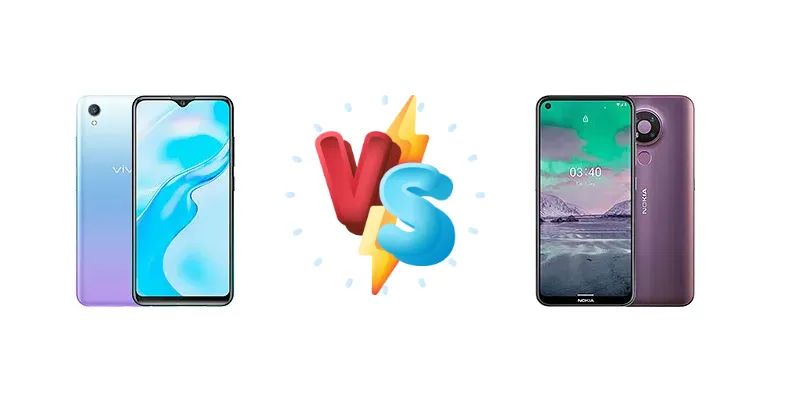
The sub-$150 smartphone market is fiercely competitive. The vivo Y1s and Nokia 3.4 represent two compelling options, but cater to slightly different priorities. The Y1s focuses on a streamlined experience, while the Nokia 3.4 aims for a more balanced feature set. This comparison dives deep into their core components to determine which device delivers the best value.
🏆 Quick Verdict
For most users, the Nokia 3.4 emerges as the better choice. Its Qualcomm Snapdragon 460 chipset, built on an 11nm process, provides a noticeable performance advantage over the vivo Y1s’ MediaTek Helio P35. While both phones offer similar battery capacities, the Nokia 3.4’s more efficient processor and 10W charging provide a more consistent experience.
| Network |
|---|
| 2G bands | GSM 850 / 900 / 1800 / 1900 | GSM 850 / 900 / 1800 / 1900 |
| 3G bands | HSDPA 850 / 900 / 2100 | HSDPA 850 / 900 / 1700(AWS) / 1900 / 2100 |
| 4G bands | 1, 3, 5, 7, 8, 38, 40, 41 | 1, 2, 3, 4, 5, 7, 8, 12, 17, 13, 28, 66 |
| Speed | HSPA, LTE | HSPA, LTE |
| Technology | GSM / HSPA / LTE | GSM / HSPA / LTE |
| Launch |
|---|
| Announced | 2020, November 26. Released 2020, November 26 | 2020, September 22. Released 2020, October 26 |
| Status | Discontinued | Discontinued |
| Body |
|---|
| Build | Glass front, plastic back, plastic frame | - |
| Dimensions | 155.1 x 75.1 x 8.3 mm (6.11 x 2.96 x 0.33 in) | 161 x 76 x 8.7 mm (6.34 x 2.99 x 0.34 in) |
| SIM | Nano-SIM + Nano-SIM | · Nano-SIM· Nano-SIM + Nano-SIM |
| Weight | 161 g (5.68 oz) | 180 g (6.35 oz) |
| Display |
|---|
| Resolution | 720 x 1520 pixels, 19:9 ratio (~270 ppi density) | 720 x 1560 pixels, 19.5:9 ratio (~269 ppi density) |
| Size | 6.22 inches, 96.6 cm2 (~82.9% screen-to-body ratio) | 6.39 inches, 100.2 cm2 (~81.9% screen-to-body ratio) |
| Type | IPS LCD | IPS LCD, 400 nits (typ) |
| Platform |
|---|
| CPU | Octa-core (4x2.35 GHz Cortex-A53 & 4x1.8 GHz Cortex-A53) | Octa-core (4x1.8 GHz Cortex-A73 & 4x1.8 GHz Cortex-A53) |
| Chipset | Mediatek MT6765 Helio P35 (12 nm) | Qualcomm SM4250 Snapdragon 460 (11 nm) |
| GPU | PowerVR GE8320 | Adreno 610 |
| OS | Android 10, Funtouch 10.5 | Android 10, upgradable to Android 11 |
| Memory |
|---|
| Card slot | microSDXC (dedicated slot) | microSDXC (dedicated slot) |
| Internal | 32GB 2GB RAM, 32GB 3GB RAM | 32GB 3GB RAM, 64GB 3GB RAM, 64GB 4GB RAM |
| | eMMC 5.1 | eMMC 5.1 |
| Main Camera |
|---|
| Features | LED flash, HDR, panorama | LED flash, HDR, panorama |
| Single | 13 MP, f/2.2, PDAF | - |
| Triple | - | 13 MP, (wide), PDAF
5 MP, (ultrawide)
Auxiliary lens |
| Video | 1080p@30fps | 1080p@30fps |
| Selfie camera |
|---|
| Single | 5 MP, f/1.8 | 8 MP, (wide) |
| Video | - | 1080p@30fps |
| Sound |
|---|
| 3.5mm jack | Yes | Yes |
| 35mm jack | Yes | Yes |
| Loudspeaker | Yes | Yes |
| Comms |
|---|
| Bluetooth | 5.0, A2DP, LE | 4.2, A2DP, aptX |
| NFC | No | Yes (market/region dependent) |
| Positioning | GPS, GLONASS, GALILEO, BDS | GPS, GLONASS, GALILEO, BDS |
| Radio | FM radio | FM radio |
| USB | microUSB 2.0, OTG | USB Type-C 2.0 |
| WLAN | Wi-Fi 802.11 b/g/n, Wi-Fi Direct | Wi-Fi 802.11 b/g/n |
| Features |
|---|
| Sensors | Accelerometer, proximity, compass | Fingerprint (rear-mounted), accelerometer, gyro, proximity |
| Battery |
|---|
| Charging | - | 10W wired |
| Type | Li-Ion 4030 mAh | Li-Po 4000 mAh |
| Misc |
|---|
| Colors | Aurora Blue, Olive Black | Fjord, Dusk, Charcoal |
| Models | 1929 | TA-1288, TA-1285, TA-1283 |
| Price | About 80 EUR | About 100 EUR |
| SAR | - | 0.83 W/kg (head) 1.05 W/kg (body) |
| SAR EU | - | 0.36 W/kg (head) 1.56 W/kg (body) |
vivo Y1s
- Potentially lighter software experience
- Simple and straightforward interface
- Compact size for easy handling
- Older and less efficient chipset
- Limited performance for demanding tasks
- No specified charging standard
Nokia 3.4
- More powerful and efficient Snapdragon 460 chipset
- 10W wired charging for faster replenishment
- Likely better software update support from Nokia
- Slightly larger size may not suit all users
- May have more pre-installed bloatware
- Performance still limited for high-end gaming
Display Comparison
Neither device boasts a standout display. Both likely utilize LCD panels, a common trait in this price bracket. The lack of specified display specs (resolution, brightness) suggests both are targeting basic usability. However, the Nokia 3.4’s slightly larger screen size (typically 6.39 inches vs. the Y1s’ 6.22 inches) may offer a more immersive viewing experience. Color accuracy and viewing angles are likely similar, leaning towards the average for budget displays.
Camera Comparison
Both phones likely feature modest camera setups. Without detailed sensor information, it’s difficult to make definitive claims. However, the Nokia 3.4’s camera system is likely to offer slightly better image quality due to Qualcomm’s image signal processing (ISP) capabilities within the Snapdragon 460. The Y1s’ camera performance will likely be adequate for casual snapshots in good lighting conditions, but will struggle in low-light scenarios. The inclusion of a 10W charger on the Nokia 3.4 suggests a focus on consistent usability, which extends to camera performance.
Performance
The core difference lies in the chipsets. The Nokia 3.4’s Qualcomm Snapdragon 460 (11nm) is a clear upgrade over the vivo Y1s’ MediaTek Helio P35 (12nm). The Snapdragon 460 utilizes more modern Cortex-A73 cores in its CPU configuration (4x1.8 GHz Cortex-A73 & 4x1.8 GHz Cortex-A53) compared to the Y1s’ all Cortex-A53 setup (4x2.35 GHz Cortex-A53 & 4x1.8 GHz Cortex-A53). This architectural advantage translates to better multi-tasking and responsiveness. While the Y1s’ higher clock speed on its A53 cores might offer a slight edge in single-core tasks, the Snapdragon 460’s superior architecture will dominate in real-world usage. The 11nm process node also contributes to better power efficiency, potentially extending battery life on the Nokia 3.4.
Battery Life
Both devices likely house around a 4000-5000 mAh battery, a standard capacity for this price range. However, the Snapdragon 460’s superior power efficiency gives the Nokia 3.4 an advantage in battery life. The Nokia 3.4 also includes 10W wired charging, a feature absent from the Y1s’ specifications, meaning faster replenishment of battery levels. While neither phone offers fast charging, the Nokia 3.4’s 10W charging will provide a more convenient charging experience.
Buying Guide
Buy the vivo Y1s if you prioritize a minimal software experience and are primarily focused on basic tasks like calling, texting, and light social media use. Its simpler chipset and potentially lighter software skin can translate to a smoother experience for these core functions. Buy the Nokia 3.4 if you need a phone capable of handling more demanding apps, occasional gaming, and appreciate the benefits of a more modern chipset architecture and guaranteed software updates.
Frequently Asked Questions
❓ Will the Nokia 3.4 struggle with popular apps like Facebook and WhatsApp?
The Snapdragon 460 in the Nokia 3.4 is capable of running apps like Facebook and WhatsApp smoothly. While it won't offer a flagship-level experience, it provides sufficient performance for everyday social media use and communication. The vivo Y1s may experience occasional lag with these apps due to its less powerful chipset.
❓ Is the Nokia 3.4 a good choice for mobile gaming?
The Nokia 3.4 is suitable for casual mobile gaming, but it's not designed for demanding titles. Games like PUBG Mobile will likely need to be played on lower graphics settings to maintain a playable frame rate. The Helio P35 in the vivo Y1s will struggle even more with gaming, making the Nokia 3.4 the preferable option for gamers on a budget.
❓ How often can I expect software updates on the Nokia 3.4?
Nokia is known for its commitment to software updates, even on its budget devices. The Nokia 3.4 is part of Android One, guaranteeing at least two years of Android version upgrades and three years of security patches. The vivo Y1s’ software update policy is less clear, and users may receive fewer updates.