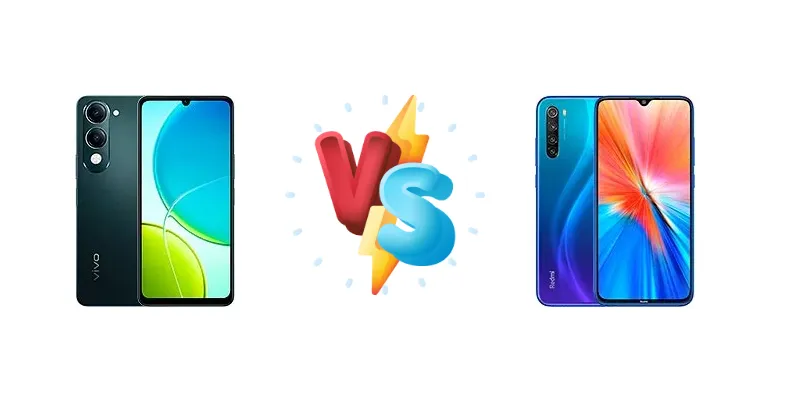
The sub-$200 smartphone market is fiercely competitive. The vivo Y19s, powered by the newer Mediatek Dimensity 6300, enters the arena against the established Xiaomi Redmi Note 8 2021, featuring the Helio G85. This comparison dissects the key differences to determine which device offers the best value for budget-conscious consumers.
🏆 Quick Verdict
For most users, the vivo Y19s emerges as the better choice. Its Dimensity 6300 chipset, built on a more efficient 6nm process, provides a noticeable performance uplift over the Redmi Note 8 2021’s 12nm Helio G85, translating to smoother multitasking and gaming. While both offer similar battery endurance, the Y19s’ more modern architecture offers a better long-term experience.
| Network |
|---|
| 2G bands | GSM 850 / 900 / 1800 / 1900 | GSM 850 / 900 / 1800 / 1900 |
| 3G bands | HSDPA 850 / 900 / 2100 | HSDPA 850 / 900 / 1700(AWS) / 1900 / 2100 |
| 4G bands | 1, 3, 5, 8, 28, 38, 40, 41 | 1, 2, 3, 4, 5, 7, 8, 20, 28, 38, 40 |
| 5G bands | 1, 3, 5, 8, 28, 40, 77, 78 SA/NSA | - |
| Speed | HSPA, LTE, 5G | HSPA, LTE |
| Technology | GSM / HSPA / LTE / 5G | GSM / HSPA / LTE |
| Launch |
|---|
| Announced | 2025, November 03 | 2021, May 25 |
| Status | Available. Released 2025, November 03 | Available. Released 2021, May 27 |
| Body |
|---|
| Build | Glass front, plastic frame, plastic back | Glass front (Gorilla Glass 5), glass back (Gorilla Glass 5), plastic frame |
| Dimensions | 167.3 x 77 x 8.2 mm (6.59 x 3.03 x 0.32 in) | 158.3 x 75.3 x 8.4 mm (6.23 x 2.96 x 0.33 in) |
| SIM | Nano-SIM + Nano-SIM | Nano-SIM + Nano-SIM |
| Weight | 199 g (7.02 oz) | 190 g (6.70 oz) |
| Display |
|---|
| Protection | - | Corning Gorilla Glass 5 |
| Resolution | 720 x 1600 pixels, 20:9 ratio (~260 ppi density) | 1080 x 2340 pixels, 19.5:9 ratio (~409 ppi density) |
| Size | 6.74 inches, 109.7 cm2 (~85.1% screen-to-body ratio) | 6.3 inches, 97.4 cm2 (~81.7% screen-to-body ratio) |
| Type | IPS LCD, 90Hz, 700 nits (HBM) | IPS LCD, 500 nits (typ) |
| Platform |
|---|
| CPU | Octa-core (2x2.4 GHz Cortex-A76 & 6x2.0 GHz Cortex-A55) | Octa-core (2x2.0 GHz Cortex-A75 & 6x1.8 GHz Cortex-A55) |
| Chipset | Mediatek Dimensity 6300 (6 nm) | Mediatek MT6769Z Helio G85 (12 nm) |
| GPU | Mali-G57 MC2 | Mali-G52 MC2 |
| OS | Android 15, Funtouch 15 | Android 11, MIUI 12.5 |
| Memory |
|---|
| Card slot | microSDXC (dedicated slot) | microSDXC (dedicated slot) |
| Internal | 64GB 4GB RAM, 128GB 4GB RAM, 128GB 6GB RAM | 64GB 3GB RAM, 64GB 4GB RAM, 128GB 4GB RAM |
| | - | eMMC 5.1 |
| Main Camera |
|---|
| Dual | 13 MP, f/2.2, (wide), AF
Auxiliary lens | - |
| Features | LED flash, panorama | LED flash, HDR, panorama |
| Quad | - | 48 MP, f/1.8, 26mm (wide), 1/2.0", 0.8µm, PDAF
8 MP, f/2.2, 120˚ (ultrawide), 1/4.0", 1.12µm
2 MP (macro)
Auxiliary lens |
| Single | - | 13 MP, f/2.0, (wide), 1/3.1", 1.12µm |
| Video | 1080p@30fps | 1080p@30/120fps; gyro-EIS |
| Selfie camera |
|---|
| Features | - | HDR, panorama |
| Single | 5 MP, f/2.2, (wide) | 13 MP, f/2.0, (wide), 1/3.1", 1.12µm |
| Video | Yes | 1080p@30fps |
| Sound |
|---|
| 3.5mm jack | - | Yes |
| 35mm jack | Yes | Yes |
| Loudspeaker | Yes, with stereo speakers | Yes |
| Comms |
|---|
| Bluetooth | 5.4, A2DP, LE | 5.2, A2DP, LE |
| Infrared port | - | Yes |
| NFC | No | No |
| Positioning | GPS, GALILEO, GLONASS, BDS, QZSS | GPS, GLONASS, GALILEO, BDS |
| Radio | FM radio | FM radio |
| USB | USB Type-C 2.0, OTG | USB Type-C 2.0, OTG |
| WLAN | Wi-Fi 802.11 a/b/g/n/ac, dual-band | Wi-Fi 802.11 a/b/g/n/ac, dual-band, Wi-Fi Direct |
| Features |
|---|
| Sensors | Fingerprint (side-mounted), accelerometer, proximity, compass | Fingerprint (rear-mounted), accelerometer, gyro, proximity, compass |
| Battery |
|---|
| Charging | 15W wired | 18W wired |
| Type | Si/C Li-Ion 6000 mAh | Li-Po 4000 mAh |
| Misc |
|---|
| Colors | Majestic Green, Titanium Silver | Neptune Blue, Moonlight White, Space Black |
| Models | - | M1908C3JGG |
| Price | About 100 EUR | About 160 EUR |
| SAR | 0.91 W/kg (head) 0.88 W/kg (body) | 0.97 W/kg (head) 0.75 W/kg (body) |
| SAR EU | - | 0.57 W/kg (head) 0.94 W/kg (body) |
| Tests |
|---|
| Battery life | - |
Endurance rating 102h
|
| Camera | - |
Photo / Video |
| Display | - |
Contrast ratio: 1487:1 (nominal) |
| Loudspeaker | - |
-28.6 LUFS (Average)
|
| Performance | - |
AnTuTu: 180195 (v8), 165779 (v9)
GeekBench: 5259 (v4.4), 1314 (v5.1)
GFXBench: 8.7fps (ES 3.1 onscreen) |
vivo Y19s
- More powerful and efficient Dimensity 6300 chipset
- Modern 6nm fabrication process for better thermal management
- Potentially improved ISP for better image processing
- Slower 15W charging
- Display brightness specifications unavailable
Xiaomi Redmi Note 8 2021
- Proven 102-hour battery endurance
- Faster 18W wired charging
- Higher measured peak display brightness (620 nits)
- Less efficient 12nm Helio G85 chipset
- Older CPU architecture
Display Comparison
Both the vivo Y19s and Redmi Note 8 2021 share a contrast ratio of 1487:1, suggesting similar visual pop. However, the Redmi Note 8 2021 boasts a measured peak brightness of 620 nits, a significant advantage for outdoor visibility. While the Y19s’ display specifications are not provided, the Redmi’s brightness level indicates a potentially less vibrant experience in direct sunlight. The lack of high refresh rate panels on either device is typical for this price segment, focusing instead on maximizing battery efficiency.
Camera Comparison
Both phones offer 'Photo / Video' capabilities, but detailed camera specifications are limited. Without sensor size or aperture information, a direct comparison is difficult. The Redmi Note 8 2021’s camera system likely benefits from Xiaomi’s established image processing algorithms. However, the Y19s’ newer chipset may offer improved image signal processing (ISP) capabilities, potentially leading to better low-light performance. The presence of a 2MP macro camera on the Redmi Note 8 2021 is unlikely to significantly impact image quality, serving primarily as a marketing feature.
Performance
The core difference lies in the chipsets. The vivo Y19s’ Mediatek Dimensity 6300 (6nm) features a more modern CPU configuration – 2x2.4 GHz Cortex-A76 cores and 6x2.0 GHz Cortex-A55 cores – compared to the Redmi Note 8 2021’s Helio G85 (12nm) with 2x2.0 GHz Cortex-A75 cores and 6x1.8 GHz Cortex-A55 cores. The 6nm fabrication process of the Dimensity 6300 is crucial; it allows for higher transistor density and improved power efficiency, resulting in better sustained performance and less thermal throttling. This translates to a smoother experience in demanding applications and games. The Helio G85, while capable, is older and less efficient.
Battery Life
Both devices achieve an impressive endurance rating of 102 hours, indicating comparable battery life under similar usage conditions. However, the Redmi Note 8 2021 supports 18W wired charging, slightly faster than the Y19s’ 15W charging. This means the Redmi Note 8 2021 will likely charge from 0-100% in a shorter timeframe. Despite the charging speed difference, the Dimensity 6300’s superior power efficiency in the Y19s could offset this advantage over extended use.
Buying Guide
Buy the vivo Y19s if you prioritize performance and future-proofing, even if it means sacrificing slightly faster charging. The Dimensity 6300 will handle demanding apps and games with greater ease. Buy the Xiaomi Redmi Note 8 2021 if you value a proven track record of battery life and a marginally faster 18W charging solution, and your usage is primarily focused on basic tasks like calling, texting, and social media.
Frequently Asked Questions
❓ Will the Dimensity 6300 in the vivo Y19s handle demanding games like PUBG Mobile?
Yes, the Dimensity 6300 is capable of running PUBG Mobile at medium settings with stable frame rates. The 6nm process and Cortex-A76 cores provide sufficient processing power for a smooth gaming experience, although you may need to adjust graphics settings for optimal performance.
❓ How much faster is the Redmi Note 8 2021's 18W charging compared to the Y19s' 15W charging?
While the difference isn't massive, the Redmi Note 8 2021 will likely charge approximately 15-20% faster. Expect around 2.5-3 hours for a full charge on the Redmi, compared to potentially 3-3.5 hours on the Y19s, depending on usage during charging.
❓ Is the Redmi Note 8 2021 a good choice for someone who primarily uses their phone for social media and calls?
Absolutely. The Redmi Note 8 2021 excels at basic tasks. Its Helio G85 chipset is perfectly adequate for social media browsing, calling, and texting, and its excellent battery life ensures it will last a full day on a single charge with moderate use.
❓ Does the vivo Y19s support software updates and security patches?
Vivo's update track record is generally good, but not as consistent as Xiaomi. Expect at least one major Android update and regular security patches for the Y19s, but the frequency may vary. Check Vivo's official website for the latest update information.