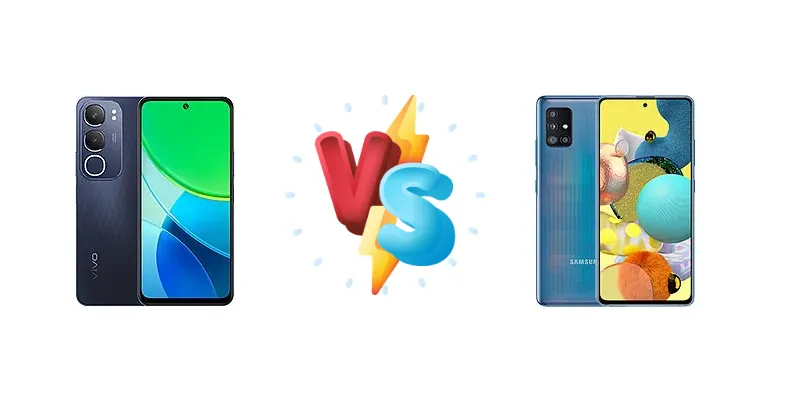
The sub-$300 5G smartphone market is fiercely competitive. The vivo Y19s Pro and Samsung Galaxy A51 5G UW represent compelling options, but cater to different priorities. The Y19s Pro emphasizes rapid charging, while the A51 5G UW leverages Qualcomm's Snapdragon 765G for a more robust performance profile. This comparison dissects their key differences to determine which device delivers the best overall experience.
🏆 Quick Verdict
For the average user prioritizing consistent performance and a more established brand ecosystem, the Samsung Galaxy A51 5G UW is the better choice. Its Snapdragon 765G chipset provides a noticeable advantage in demanding tasks. However, the vivo Y19s Pro’s 44W charging is a significant draw for those who value minimizing downtime.
| Network |
|---|
| 2G bands | GSM 850 / 900 / 1800 / 1900 | GSM 850 / 900 / 1800 / 1900 |
| 3G bands | HSDPA 850 / 900 / 2100 | HSDPA 850 / 900 / 1900 / 2100 |
| 4G bands | 1, 3, 5, 7, 8, 20, 28, 38, 40, 41 | 2, 4, 5, 13, 66 |
| 5G bands | - | 260, 261 mmWave |
| Speed | HSPA, LTE | HSPA, LTE, 5G |
| Technology | GSM / HSPA / LTE | GSM / HSPA / LTE / 5G |
| Launch |
|---|
| Announced | 2025, June 10 | 2020, August 14 |
| Status | Available. Released 2025, June 10 | Available. Released 2020, August 14 |
| Body |
|---|
| Build | Glass front, plastic back, plastic frame | Glass front (Gorilla Glass 3), plastic back, aluminum frame |
| Dimensions | 165.8 x 76.1 x 8.1 mm (6.53 x 3.00 x 0.32 in) | 158.8 x 73.4 x 8.6 mm (6.25 x 2.89 x 0.34 in) |
| SIM | Nano-SIM + Nano-SIM | Nano-SIM (pre-installed) |
| Weight | 200 g (7.05 oz) | 188.8 g (6.67 oz) |
| Display |
|---|
| Protection | - | Corning Gorilla Glass 3 |
| Resolution | 720 x 1608 pixels, 20:9 ratio (~264 ppi density) | 1080 x 2400 pixels, 20:9 ratio (~405 ppi density) |
| Size | 6.68 inches, 107.4 cm2 (~85.1% screen-to-body ratio) | 6.5 inches, 102.0 cm2 (~87.5% screen-to-body ratio) |
| Type | IPS LCD, 90Hz, 1000 nits (HBM) | Super AMOLED |
| Platform |
|---|
| CPU | Octa-core (2x1.8 GHz Cortex-A75 & 6x1.8 GHz Cortex-A55) | Octa-core (1x2.4 GHz Kryo 475 Prime & 1x2.2 GHz Kryo 475 Gold & 6x1.8 GHz Kryo 475 Silver) |
| Chipset | Unisoc Tiger T612 (12 nm) | Qualcomm SM7250 Snapdragon 765G 5G (7 nm) |
| GPU | Mali-G57 | Adreno 620 |
| OS | Android 15, Funtouch 15 | Android 10, One UI 2 |
| Memory |
|---|
| Card slot | microSDXC (dedicated slot) | microSDXC (uses shared SIM slot) |
| Internal | 64GB 4GB RAM, 128GB 6GB RAM, 256GB 6GB RAM, 256GB 8GB RAM | 128GB 6GB RAM |
| | - | UFS 2.1 |
| Main Camera |
|---|
| Features | Ring-LED flash, panorama | LED flash, panorama, HDR |
| Quad | - | 48 MP, f/2.0, 26mm (wide), 1/2.0", 0.8µm, PDAF
12 MP, f/2.2, 123˚ (ultrawide)
5 MP (macro)
Auxiliary lens |
| Single | 50 MP, f/1.8, (wide), 1/1.95", 0.8µm, PDAF
Auxiliary lens | 5 MP, AF |
| Video | 1080p@30fps | 4K@30fps, 1080p@30/120fps; gyro-EIS |
| Selfie camera |
|---|
| Features | - | HDR |
| Single | 5 MP, f/2.2 | 32 MP, f/2.2, 26mm (wide), 1/2.8", 0.8µm |
| Video | Yes | 4K@30fps, 1080p@30fps |
| Sound |
|---|
| 3.5mm jack | - | Yes |
| 35mm jack | Yes | Yes |
| Loudspeaker | Yes, with dual speakers | Yes |
| Comms |
|---|
| Bluetooth | 5.2, A2DP, LE | 5.0, A2DP, LE |
| NFC | No | Yes |
| Positioning | GPS, GLONASS, GALILEO, BDS, QZSS | GPS, GLONASS, GALILEO, BDS |
| Radio | FM radio | FM radio, RDS, recording |
| USB | USB Type-C 2.0, OTG | USB Type-C 2.0, OTG |
| WLAN | Wi-Fi 802.11 a/b/g/n/ac, dual-band | Wi-Fi 802.11 a/b/g/n/ac, dual-band, Wi-Fi Direct |
| Features |
|---|
| Sensors | Fingerprint (side-mounted), accelerometer, proximity, compass | Fingerprint (under display, optical), accelerometer, gyro, proximity, compass |
| | - | ANT+ |
| Battery |
|---|
| Charging | 44W wired, 40% in 30 min
Reverse wired | 15W wired |
| Stand-by | - | Up to 672 h |
| Talk time | - | Up to 5 h |
| Type | Li-Ion 6000 mAh | Li-Po 4500 mAh |
| Misc |
|---|
| Colors | Pearl Silver, Glossy Black, Glacier Blue | Prism Bricks Blue |
| Models | - | SM-A516V |
| Price | About 100 EUR | About 470 EUR |
| SAR | - | 0.70 W/kg (head) 1.25 W/kg (body) |
| SAR EU | - | 0.59 W/kg (head) 1.32 W/kg (body) |
vivo Y19s Pro
- Faster and more efficient Snapdragon 765G processor
- More established brand reputation and software support
- Potentially better camera image processing
- Significantly slower 15W charging
- May be more expensive than the vivo Y19s Pro
- Potentially less efficient chipset due to larger node size
Samsung Galaxy A51 5G UW
- Ultra-fast 44W wired charging with reverse wired charging
- Potentially lower price point
- Acceptable performance for everyday tasks
- Less powerful Unisoc Tiger T612 chipset
- Unisoc chipset may have limited software optimization
- Potentially lower camera image quality
Display Comparison
Neither device boasts a flagship-level display. While specific display specs (resolution, panel type) are not provided for the Y19s Pro, the A51 5G UW’s display is likely a standard FHD+ LCD. The key difference lies in the underlying processing power needed to drive the display smoothly; the Snapdragon 765G will likely handle graphically intensive content with more ease. The absence of high refresh rates on both devices suggests a focus on battery conservation rather than visual fluidity.
Camera Comparison
Without detailed camera specs beyond the presence of sensors, a direct comparison is limited. However, the Snapdragon 765G’s image signal processor (ISP) is generally more advanced than what’s found in Unisoc chipsets, offering better noise reduction and dynamic range. The A51 5G UW likely benefits from Samsung’s well-tuned image processing algorithms. The Y19s Pro may rely more heavily on software enhancements to compensate for potentially less capable hardware. The absence of information regarding sensor size and optical image stabilization (OIS) makes a definitive judgment impossible, but the A51 5G UW likely holds an edge in image quality.
Performance
The core differentiator here is the chipset. The Samsung Galaxy A51 5G UW’s Qualcomm Snapdragon 765G, fabricated on a 7nm process, offers a significant architectural advantage over the vivo Y19s Pro’s Unisoc Tiger T612 (12nm). The Snapdragon 765G’s Kryo CPU cores, particularly the 2.4 GHz Kryo 475 Prime, deliver superior single-core performance, crucial for app launch speeds and general responsiveness. The 7nm process also translates to better thermal efficiency, reducing the likelihood of throttling during sustained workloads. While both utilize octa-core CPUs, the Snapdragon’s core arrangement and fabrication process provide a clear performance lead. The Unisoc T612 will be adequate for everyday tasks, but will struggle with demanding games or heavy multitasking.
Battery Life
The Samsung Galaxy A51 5G UW features 15W wired charging, a relatively slow speed by today’s standards. In contrast, the vivo Y19s Pro’s 44W charging is a game-changer, capable of adding 40% charge in just 30 minutes. While battery capacity isn’t specified for either device, the Y19s Pro’s faster charging significantly mitigates any potential disadvantage in capacity. Users who prioritize minimizing charging time will overwhelmingly favor the Y19s Pro. The A51 5G UW will require considerably longer to fully recharge.
Buying Guide
Buy the vivo Y19s Pro if you absolutely need the fastest possible charging speeds and are comfortable with a less-known chipset. This phone is ideal for users who frequently find themselves needing a quick power boost. Buy the Samsung Galaxy A51 5G UW if you prioritize a smoother, more responsive user experience, especially when multitasking or gaming, and value the Samsung brand's software support and features.
Frequently Asked Questions
❓ Is the Unisoc Tiger T612 chipset in the vivo Y19s Pro capable of running demanding games like PUBG Mobile?
While the Unisoc Tiger T612 can run PUBG Mobile, expect to play at lower graphics settings and potentially experience frame drops during intense action. The Snapdragon 765G in the A51 5G UW offers a significantly smoother gaming experience with higher graphical fidelity.
❓ How long does it *actually* take to fully charge the Samsung Galaxy A51 5G UW with its 15W charger?
Expect a full charge from 0% to 100% on the Samsung Galaxy A51 5G UW to take approximately 2.5 to 3 hours with the included 15W charger. This is considerably slower than the vivo Y19s Pro’s 44W charging.
❓ Does the Samsung Galaxy A51 5G UW support carrier aggregation for improved 5G speeds?
Yes, the Snapdragon 765G supports carrier aggregation, allowing it to combine multiple 5G channels for faster and more reliable data speeds, provided your carrier supports it. This is a key advantage for users in areas with strong 5G coverage.
❓ Does the vivo Y19s Pro support reverse wired charging, and if so, how fast is it?
Yes, the vivo Y19s Pro supports reverse wired charging. While the exact wattage isn't specified, it leverages the 44W charging system, meaning it can likely charge other devices at a respectable speed, though likely not at the full 44W.