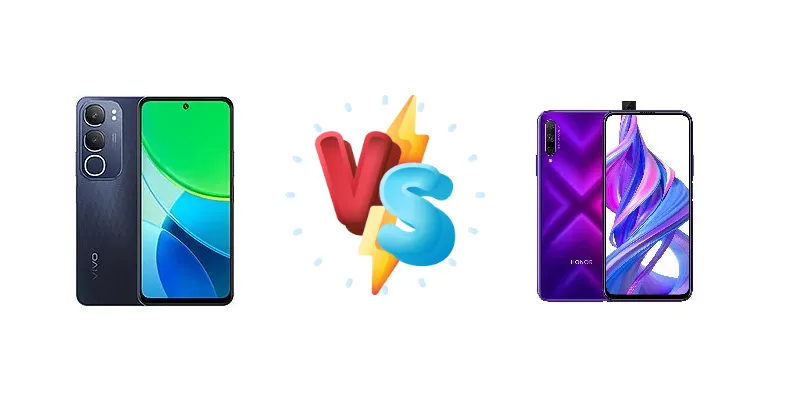
The mid-range smartphone market is fiercely competitive, and the vivo Y19s Pro and Honor 9X Pro represent compelling options for budget-conscious buyers. While both aim to deliver a solid experience, they take distinctly different approaches – the Y19s Pro prioritizing fast charging and a newer chipset, while the 9X Pro focuses on established performance and impressive battery endurance. This comparison dissects their key differences to determine which phone best suits your needs.
🏆 Quick Verdict
For the average user prioritizing longevity and consistent performance, the Honor 9X Pro emerges as the better choice. Its Kirin 810 chipset, coupled with a remarkable 104-hour endurance rating, outweighs the Y19s Pro’s faster charging, especially given the latter’s less powerful Unisoc processor.
| Network |
|---|
| 2G bands | GSM 850 / 900 / 1800 / 1900 | GSM 850 / 900 / 1800 / 1900 |
| 3G bands | HSDPA 850 / 900 / 2100 | HSDPA 850 / 900 / 2100 |
| 4G bands | 1, 3, 5, 7, 8, 20, 28, 38, 40, 41 | 1, 3, 7, 8, 20, 38, 40, 41 - International |
| Speed | HSPA, LTE | HSPA 42.2/5.76 Mbps, LTE (2CA) Cat12 600/50 Mbps |
| Technology | GSM / HSPA / LTE | GSM / CDMA / HSPA / EVDO / LTE |
| | - | 1, 3, 5, 8, 38, 39, 40, 41 - China |
| Launch |
|---|
| Announced | 2025, June 10 | 2019, July 23. Released 2019, August 09 |
| Status | Available. Released 2025, June 10 | Discontinued |
| Body |
|---|
| Build | Glass front, plastic back, plastic frame | Glass front, glass back, aluminum frame |
| Dimensions | 165.8 x 76.1 x 8.1 mm (6.53 x 3.00 x 0.32 in) | 163.5 x 77.3 x 8.8 mm (6.44 x 3.04 x 0.35 in) |
| SIM | Nano-SIM + Nano-SIM | Nano-SIM + Nano-SIM |
| Weight | 200 g (7.05 oz) | 202 g (7.13 oz) |
| Display |
|---|
| Resolution | 720 x 1608 pixels, 20:9 ratio (~264 ppi density) | 1080 x 2340 pixels, 19.5:9 ratio (~391 ppi density) |
| Size | 6.68 inches, 107.4 cm2 (~85.1% screen-to-body ratio) | 6.59 inches, 106.6 cm2 (~84.3% screen-to-body ratio) |
| Type | IPS LCD, 90Hz, 1000 nits (HBM) | IPS LCD |
| Platform |
|---|
| CPU | Octa-core (2x1.8 GHz Cortex-A75 & 6x1.8 GHz Cortex-A55) | Octa-core (2x2.27 GHz Cortex-A76 & 6x1.88 GHz Cortex-A55) |
| Chipset | Unisoc Tiger T612 (12 nm) | Kirin 810 (7 nm) |
| GPU | Mali-G57 | Mali-G52 MP6 |
| OS | Android 15, Funtouch 15 | Android 9.0 (Pie), upgradable to Android 10, EMUI 9.1, no Google Play Services |
| Memory |
|---|
| Card slot | microSDXC (dedicated slot) | microSDXC (uses shared SIM slot) |
| Internal | 64GB 4GB RAM, 128GB 6GB RAM, 256GB 6GB RAM, 256GB 8GB RAM | 128GB 8GB RAM, 256GB 6GB RAM, 256GB 8GB RAM |
| Main Camera |
|---|
| Features | Ring-LED flash, panorama | LED flash, HDR, panorama |
| Single | 50 MP, f/1.8, (wide), 1/1.95", 0.8µm, PDAF
Auxiliary lens | - |
| Triple | - | 48 MP, f/1.8, (wide), 1/2.0", 0.8µm, PDAF
8 MP, f/2.4, 120˚ (ultrawide)
Auxiliary lens |
| Video | 1080p@30fps | 1080p@30fps, gyro-EIS |
| Selfie camera |
|---|
| Single | 5 MP, f/2.2 | Motorized pop-up 16 MP, f/2.2, 26mm (wide), 1/3.06", 1.0µm |
| Video | Yes | 1080p@60fps |
| Sound |
|---|
| 3.5mm jack | - | Yes |
| 35mm jack | Yes | Yes |
| Loudspeaker | Yes, with dual speakers | Yes |
| Comms |
|---|
| Bluetooth | 5.2, A2DP, LE | 4.2, A2DP, LE (International)5.0, A2DP, LE (China) |
| NFC | No | No |
| Positioning | GPS, GLONASS, GALILEO, BDS, QZSS | GPS, GLONASS, BDS |
| Radio | FM radio | FM radio |
| USB | USB Type-C 2.0, OTG | USB Type-C 2.0 |
| WLAN | Wi-Fi 802.11 a/b/g/n/ac, dual-band | Wi-Fi 802.11 a/b/g/n/ac, dual-band, Wi-Fi Direct |
| Features |
|---|
| Sensors | Fingerprint (side-mounted), accelerometer, proximity, compass | Fingerprint (side-mounted), accelerometer, gyro, proximity, compass |
| Battery |
|---|
| Charging | 44W wired, 40% in 30 min
Reverse wired | 10W wired |
| Type | Li-Ion 6000 mAh | Li-Po 4000 mAh, non-removable |
| Misc |
|---|
| Colors | Pearl Silver, Glossy Black, Glacier Blue | Midnight Black, Phantom Purple |
| Models | - | HLK-AL10, HLK-TL10, HLK-L41, HLK-L42 |
| Price | About 100 EUR | About 230 EUR |
| Tests |
|---|
| Battery life | - |
Endurance rating 104h
|
| Camera | - |
Photo / Video |
| Display | - |
Contrast ratio: 1319:1 (nominal) |
| Loudspeaker | - |
-31.1 LUFS (Below average)
|
| Performance | - |
AnTuTu: 312668 (v8)
GeekBench: 7836 (v4.4), 1911 (v5.1)
GFXBench: 18fps (ES 3.1 onscreen) |
vivo Y19s Pro
- 44W Fast Charging: Significantly faster charging speeds.
- Newer Chipset: Unisoc T612 is a more recent design.
- Reverse Wired Charging: Can charge other devices.
- Less Powerful Chipset: Unisoc T612 lags behind Kirin 810 in performance.
- Missing Battery Capacity: Lack of mAh specification raises concerns.
Honor 9X Pro
- Exceptional Battery Life: 104-hour endurance rating is a major advantage.
- More Powerful Chipset: Kirin 810 offers superior performance and efficiency.
- Brighter Display: 517 nits peak brightness improves outdoor visibility.
- Slow Charging: 10W charging is significantly slower than the competition.
- Older Chipset: Kirin 810 is an older generation processor.
Display Comparison
Both the vivo Y19s Pro and Honor 9X Pro share a contrast ratio of 1319:1, suggesting similar visual depth. However, the Honor 9X Pro boasts a measured peak brightness of 517 nits, providing a noticeably brighter and more visible display in outdoor conditions. While both lack high refresh rate panels, the 9X Pro’s superior brightness makes it the more practical choice for everyday use, especially under direct sunlight. Details regarding panel technology (IPS vs. AMOLED) are missing, but given the price point, both likely utilize IPS LCDs.
Camera Comparison
Both phones are listed as having 'Photo / Video' capabilities, but specific details are absent. Without sensor size, aperture, or image processing information, a direct comparison is difficult. However, the market positioning suggests the Honor 9X Pro likely benefits from a more refined camera system, given Honor’s historical focus on imaging. The inclusion of a 2MP macro camera on either device is likely a marketing gimmick, offering limited practical benefit due to the small sensor size and lack of optical image stabilization (OIS).
Performance
The core difference lies in the chipsets: the vivo Y19s Pro utilizes the Unisoc Tiger T612 (12nm), while the Honor 9X Pro features the Kirin 810 (7nm). The Kirin 810, built on a smaller 7nm process, inherently offers better power efficiency and thermal performance compared to the 12nm Unisoc chip. The CPU configuration is also noteworthy; the 9X Pro’s Cortex-A76 cores (2x2.27 GHz) are architecturally superior to the Y19s Pro’s Cortex-A75 cores (2x1.8 GHz), translating to faster single-core performance. While both have six Cortex-A55 cores for efficiency, the Kirin 810’s overall architecture provides a more robust and responsive experience, particularly in demanding applications and gaming.
Battery Life
The Honor 9X Pro’s standout feature is its exceptional battery life, achieving an impressive endurance rating of 104 hours. This is significantly more impactful than the Y19s Pro’s lack of a specified mAh rating. While the Y19s Pro compensates with 44W wired charging (reaching 40% in 30 minutes), the 9X Pro’s longevity minimizes the need for frequent charging. The 10W charging on the 9X Pro is slow by today’s standards, but the extended battery life mitigates this drawback. The Y19s Pro also offers reverse wired charging, a convenience feature absent on the 9X Pro.
Buying Guide
Buy the vivo Y19s Pro if you absolutely need the fastest possible charging speeds and frequently find yourself needing a quick power boost. Its 44W charging is a significant advantage. Buy the Honor 9X Pro if you value sustained performance, exceptional battery life, and a more mature chipset known for its stability. This phone is ideal for users who prioritize all-day usability and don't want to constantly worry about finding an outlet.
Frequently Asked Questions
❓ Does the Kirin 810 in the Honor 9X Pro experience significant throttling under sustained load?
While the Kirin 810 isn't a flagship chipset, its 7nm process and thermal design generally handle sustained loads reasonably well. Reports suggest minimal throttling during extended gaming sessions, offering a more consistent experience than the Unisoc T612 in the Y19s Pro, which is more prone to thermal limitations due to its larger process node.
❓ How does the 44W charging on the vivo Y19s Pro compare to other phones in this price range?
44W charging is exceptionally fast for this price segment. It allows for a substantial charge in a short amount of time, making it ideal for users who frequently need to top up their battery. However, the Honor 9X Pro’s superior battery life reduces the reliance on fast charging, making the slower 10W charging less of a drawback.
❓ Is the lack of 5G connectivity a significant issue on either of these phones?
Neither the vivo Y19s Pro nor the Honor 9X Pro support 5G. However, given their target market and price point, this is not a major limitation. 5G coverage is still limited in many areas, and the benefits are not always noticeable for typical smartphone usage. Both phones are fully capable of utilizing 4G LTE networks.