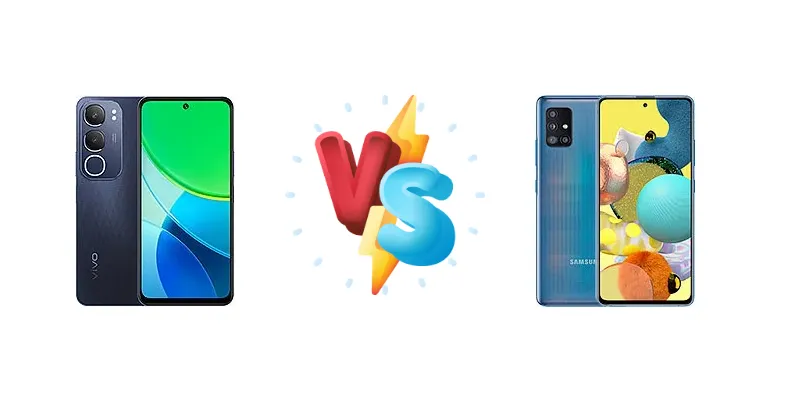
The smartphone landscape is crowded with affordable options, but finding the right balance of features and performance can be challenging. We pit the vivo Y19s 4G, a value-focused device, against the Samsung Galaxy A51 5G UW, offering 5G connectivity and a more established brand reputation. This comparison dives deep into the core components to determine which phone delivers the best experience for the price.
🏆 Quick Verdict
For the average user prioritizing longevity and consistent performance, the Samsung Galaxy A51 5G UW emerges as the better choice. Its Snapdragon 765G chipset, built on a more efficient 7nm process, provides a noticeable performance advantage and future-proofs with 5G support, despite both phones sharing the same 15W charging.
| Network |
|---|
| 2G bands | GSM 850 / 900 / 1800 / 1900 | GSM 850 / 900 / 1800 / 1900 |
| 3G bands | HSDPA 850 / 900 / 2100 | HSDPA 850 / 900 / 1900 / 2100 |
| 4G bands | 1, 3, 5, 7, 8, 20, 28, 38, 40, 41 | 2, 4, 5, 13, 66 |
| 5G bands | - | 260, 261 mmWave |
| Speed | HSPA, LTE | HSPA, LTE, 5G |
| Technology | GSM / HSPA / LTE | GSM / HSPA / LTE / 5G |
| Launch |
|---|
| Announced | 2024, October 15 | 2020, August 14 |
| Status | Available. Released 2024, October | Available. Released 2020, August 14 |
| Body |
|---|
| Build | Glass front, plastic back, plastic frame | Glass front (Gorilla Glass 3), plastic back, aluminum frame |
| Dimensions | 165.8 x 76.1 x 8.1 mm (6.53 x 3.00 x 0.32 in) | 158.8 x 73.4 x 8.6 mm (6.25 x 2.89 x 0.34 in) |
| SIM | Nano-SIM + Nano-SIM | Nano-SIM (pre-installed) |
| Weight | 198 g (6.98 oz) | 188.8 g (6.67 oz) |
| Display |
|---|
| Protection | Mohs level 4 | Corning Gorilla Glass 3 |
| Resolution | 720 x 1608 pixels, 20:9 ratio (~264 ppi density) | 1080 x 2400 pixels, 20:9 ratio (~405 ppi density) |
| Size | 6.68 inches, 107.4 cm2 (~85.1% screen-to-body ratio) | 6.5 inches, 102.0 cm2 (~87.5% screen-to-body ratio) |
| Type | IPS LCD, 90Hz, 1000 nits (HBM) | Super AMOLED |
| Platform |
|---|
| CPU | Octa-core (2x1.8 GHz Cortex-A75 & 6x1.8 GHz Cortex-A55) | Octa-core (1x2.4 GHz Kryo 475 Prime & 1x2.2 GHz Kryo 475 Gold & 6x1.8 GHz Kryo 475 Silver) |
| Chipset | Unisoc Tiger T612 (12 nm) | Qualcomm SM7250 Snapdragon 765G 5G (7 nm) |
| GPU | Mali-G57 | Adreno 620 |
| OS | Android 14, Funtouch 14 | Android 10, One UI 2 |
| Memory |
|---|
| Card slot | microSDXC (dedicated slot) | microSDXC (uses shared SIM slot) |
| Internal | 64GB 4GB RAM, 128GB 4GB RAM, 128GB 6GB RAM, 256GB 6GB RAM, 256GB 8GB RAM | 128GB 6GB RAM |
| | - | UFS 2.1 |
| Main Camera |
|---|
| Features | Ring-LED flash, panorama | LED flash, panorama, HDR |
| Quad | - | 48 MP, f/2.0, 26mm (wide), 1/2.0", 0.8µm, PDAF
12 MP, f/2.2, 123˚ (ultrawide)
5 MP (macro)
Auxiliary lens |
| Single | 50 MP, f/1.8, (wide), 1/1.95", 0.8µm, PDAF
Auxiliary lens | 5 MP, AF |
| Video | 1080p@30fps | 4K@30fps, 1080p@30/120fps; gyro-EIS |
| Selfie camera |
|---|
| Features | - | HDR |
| Single | 5 MP, f/2.2 | 32 MP, f/2.2, 26mm (wide), 1/2.8", 0.8µm |
| Video | Yes | 4K@30fps, 1080p@30fps |
| Sound |
|---|
| 3.5mm jack | - | Yes |
| 35mm jack | Yes | Yes |
| Loudspeaker | Yes, with dual speakers | Yes |
| Comms |
|---|
| Bluetooth | 5.2, A2DP, LE | 5.0, A2DP, LE |
| NFC | No | Yes |
| Positioning | GPS, GLONASS, GALILEO, BDS, QZSS | GPS, GLONASS, GALILEO, BDS |
| Radio | FM radio | FM radio, RDS, recording |
| USB | USB Type-C 2.0, OTG | USB Type-C 2.0, OTG |
| WLAN | Wi-Fi 802.11 a/b/g/n/ac, dual-band | Wi-Fi 802.11 a/b/g/n/ac, dual-band, Wi-Fi Direct |
| Features |
|---|
| Sensors | Fingerprint (side-mounted), accelerometer, proximity, compass | Fingerprint (under display, optical), accelerometer, gyro, proximity, compass |
| | - | ANT+ |
| Battery |
|---|
| Charging | 15W wired
Reverse wired | 15W wired |
| Stand-by | - | Up to 672 h |
| Talk time | - | Up to 5 h |
| Type | Li-Ion 5500 mAh | Li-Po 4500 mAh |
| Misc |
|---|
| Colors | Pearl Silver, Glossy Black, Glacier Blue | Prism Bricks Blue |
| Models | V2419 | SM-A516V |
| Price | € 101.15 / £ 149.90 | About 470 EUR |
| SAR | - | 0.70 W/kg (head) 1.25 W/kg (body) |
| SAR EU | - | 0.59 W/kg (head) 1.32 W/kg (body) |
| EU LABEL |
|---|
| Battery | 54:28h endurance, 1000 cycles | - |
| Energy | Class A | - |
| Free fall | Class B (180 falls) | - |
| Repairability | Class B | - |
vivo Y19s 4G
- Exceptional battery endurance (54:28h)
- Long-term battery health (1000 charge cycles)
- Potentially lower price point
- Less powerful chipset (Unisoc Tiger T612)
- Limited 5G connectivity
- Potentially lower display quality
Samsung Galaxy A51 5G UW
- More powerful chipset (Snapdragon 765G)
- 5G connectivity for faster data speeds
- Likely superior display quality
- Shorter battery life compared to vivo Y19s
- Potentially higher price point
- 15W charging is relatively slow
Display Comparison
While display specifications are absent from the provided data, the Samsung Galaxy A51 5G UW likely benefits from Samsung’s display expertise, potentially offering superior color accuracy and brightness compared to the vivo Y19s. The A51’s market positioning suggests a higher-quality panel. The absence of details on the Y19s’ panel type (IPS vs AMOLED) leaves room for speculation, but it’s unlikely to match Samsung’s offerings in this segment.
Camera Comparison
Without detailed camera specifications, a direct comparison is limited. However, Samsung generally emphasizes image processing and software optimization. The A51 5G UW likely benefits from Samsung’s established camera algorithms, potentially delivering more vibrant and detailed photos, especially in challenging lighting conditions. The Y19s, while potentially offering a usable camera, likely relies more on hardware limitations and less on sophisticated software enhancements. The absence of information regarding sensor sizes and apertures makes a definitive judgment impossible, but Samsung’s brand reputation suggests a more refined camera experience.
Performance
The core difference lies in the chipsets. The Samsung Galaxy A51 5G UW’s Qualcomm Snapdragon 765G, fabricated on a 7nm process, offers a significant architectural advantage over the vivo Y19s 4G’s Unisoc Tiger T612 (12nm). The Snapdragon 765G’s Kryo CPU cores – a Prime, Gold, and Silver configuration – are designed for efficient task allocation, resulting in smoother multitasking and better sustained performance. The Unisoc T612, while an octa-core processor, operates on a larger node, leading to potentially higher power consumption and thermal throttling under sustained load. This translates to a more responsive experience on the Samsung, particularly for demanding applications and games.
Battery Life
The vivo Y19s 4G boasts an impressive 54:28h endurance rating, indicating exceptional battery life. While the Samsung Galaxy A51 5G UW’s battery life isn’t specified, the more power-hungry Snapdragon 765G and 5G connectivity will likely result in shorter runtimes. However, both phones share the same 15W wired charging, meaning charge times will be comparable. The Y19s’ 1000 charge cycle rating suggests a focus on long-term battery health, potentially offering greater longevity over the lifespan of the device.
Buying Guide
Buy the vivo Y19s 4G if you need exceptional battery endurance and are primarily focused on essential smartphone tasks like calling, texting, and light social media use. Buy the Samsung Galaxy A51 5G UW if you prioritize smoother multitasking, occasional gaming, and the benefits of 5G connectivity, even if it means slightly shorter battery life.
Frequently Asked Questions
❓ Will the Snapdragon 765G in the A51 5G UW struggle with demanding games like Genshin Impact?
While the Snapdragon 765G isn't a flagship chipset, it's capable of running Genshin Impact at medium settings with reasonable frame rates. Expect some frame drops during intense combat scenarios, but it's playable. The Unisoc T612 in the Y19s will likely struggle significantly with this title.
❓ How much faster is 5G on the Samsung Galaxy A51 5G UW compared to 4G on the vivo Y19s?
5G speeds on the A51 5G UW can be significantly faster than 4G, potentially offering download speeds several times higher, depending on network availability and coverage. This translates to quicker app downloads, smoother streaming, and faster web browsing. However, 5G availability varies greatly by location.
❓ Is the 15W charging on both phones slow compared to newer fast charging standards?
Yes, 15W charging is relatively slow by today's standards. Expect a full charge to take around 2-3 hours. While both phones offer the same charging speed, the Y19s’ longer battery life means you won’t need to charge it as frequently.