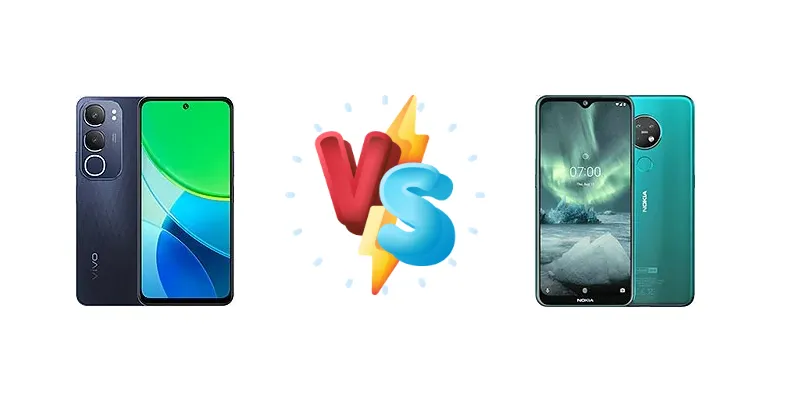
The vivo Y19s 4G and Nokia 7.2 represent different approaches to the budget smartphone market. The Nokia 7.2, released earlier, boasts a higher initial endurance rating and a brighter display, while the vivo Y19s 4G focuses on maximizing battery life through a newer chipset and optimized power management. This comparison dissects their key differences to help you choose the right device.
🏆 Quick Verdict
For the average user prioritizing all-day battery life and a modern chipset, the vivo Y19s 4G emerges as the better choice. While the Nokia 7.2 offers a superior display in terms of brightness, the Y19s’s significantly longer endurance and reverse charging capability provide a more practical benefit in daily use.
| Network |
|---|
| 2G bands | GSM 850 / 900 / 1800 / 1900 | GSM 850 / 900 / 1800 / 1900 |
| 3G bands | HSDPA 850 / 900 / 2100 | HSDPA 850 / 900 / 2100 - ROW |
| 4G bands | 1, 3, 5, 7, 8, 20, 28, 38, 40, 41 | 1, 3, 5, 7, 8, 20, 28, 38, 40, 41 - ROW |
| Speed | HSPA, LTE | HSPA 42.2/5.76 Mbps, LTE (2CA) Cat6 300/50 Mbps or LTE Cat4 150/50 Mbps |
| Technology | GSM / HSPA / LTE | GSM / HSPA / LTE |
| | - | 1, 3, 5, 8, 40, 41 - IN |
| Launch |
|---|
| Announced | 2024, October 15 | 2019, September 05. Released 2019, September 23 |
| Status | Available. Released 2024, October | Discontinued |
| Body |
|---|
| Build | Glass front, plastic back, plastic frame | Glass front (Gorilla Glass 3), glass back (Gorilla Glass 3), plastic frame |
| Dimensions | 165.8 x 76.1 x 8.1 mm (6.53 x 3.00 x 0.32 in) | 159.9 x 75.2 x 8.3 mm (6.30 x 2.96 x 0.33 in) |
| SIM | Nano-SIM + Nano-SIM | · Nano-SIM· Nano-SIM + Nano-SIM |
| Weight | 198 g (6.98 oz) | 180 g (6.35 oz) |
| Display |
|---|
| Protection | Mohs level 4 | Corning Gorilla Glass 3 |
| Resolution | 720 x 1608 pixels, 20:9 ratio (~264 ppi density) | 1080 x 2280 pixels, 19:9 ratio (~400 ppi density) |
| Size | 6.68 inches, 107.4 cm2 (~85.1% screen-to-body ratio) | 6.3 inches, 99.1 cm2 (~82.4% screen-to-body ratio) |
| Type | IPS LCD, 90Hz, 1000 nits (HBM) | IPS LCD, HDR10 |
| Platform |
|---|
| CPU | Octa-core (2x1.8 GHz Cortex-A75 & 6x1.8 GHz Cortex-A55) | Octa-core (4x2.2 GHz Kryo 260 Gold & 4x1.8 GHz Kryo 260 Silver) |
| Chipset | Unisoc Tiger T612 (12 nm) | Qualcomm SDM660 Snapdragon 660 (14 nm) |
| GPU | Mali-G57 | Adreno 512 |
| OS | Android 14, Funtouch 14 | Android 9.0 (Pie), upgradable to Android 11, Android One |
| Memory |
|---|
| Card slot | microSDXC (dedicated slot) | microSDXC (dedicated slot) |
| Internal | 64GB 4GB RAM, 128GB 4GB RAM, 128GB 6GB RAM, 256GB 6GB RAM, 256GB 8GB RAM | 64GB 4GB RAM, 64GB 6GB RAM, 128GB 4GB RAM, 128GB 6GB RAM |
| | - | eMMC 5.1 |
| Main Camera |
|---|
| Features | Ring-LED flash, panorama | Zeiss optics, LED flash, panorama, HDR |
| Single | 50 MP, f/1.8, (wide), 1/1.95", 0.8µm, PDAF
Auxiliary lens | - |
| Triple | - | 48 MP, f/1.8, (wide), 1/2.0", 0.8µm, PDAF
8 MP, f/2.2, 13mm (ultrawide), 1/4.0", 1.12µm
Auxiliary lens |
| Video | 1080p@30fps | 4K@30fps, 1080p@30fps (gyro-EIS) |
| Selfie camera |
|---|
| Features | - | Zeiss optics, HDR |
| Single | 5 MP, f/2.2 | 20 MP, f/2.0, (wide), 1/3", 0.9µm |
| Video | Yes | 1080p@30fps |
| Sound |
|---|
| 3.5mm jack | - | Yes |
| 35mm jack | Yes | Yes |
| Loudspeaker | Yes, with dual speakers | Yes |
| Comms |
|---|
| Bluetooth | 5.2, A2DP, LE | 5.0, A2DP, EDR, LE, aptX |
| NFC | No | Yes (excl. India) |
| Positioning | GPS, GLONASS, GALILEO, BDS, QZSS | GPS, GLONASS, GALILEO, BDS |
| Radio | FM radio | FM radio |
| USB | USB Type-C 2.0, OTG | USB Type-C 2.0, OTG |
| WLAN | Wi-Fi 802.11 a/b/g/n/ac, dual-band | Wi-Fi 802.11 b/g/n/ac, dual-band, Wi-Fi Direct |
| Features |
|---|
| Sensors | Fingerprint (side-mounted), accelerometer, proximity, compass | Fingerprint (rear-mounted), accelerometer, gyro, proximity, compass |
| Battery |
|---|
| Charging | 15W wired
Reverse wired | 10W wired |
| Type | Li-Ion 5500 mAh | Li-Po 3500 mAh, non-removable |
| Misc |
|---|
| Colors | Pearl Silver, Glossy Black, Glacier Blue | Cyan Green, Charcoal, Ice |
| Models | V2419 | TA-1193, TA-1178, TA-1196, TA-1181 |
| Price | € 101.15 / £ 149.90 | About 240 EUR |
| SAR | - | 1.15 W/kg (head) 0.90 W/kg (body) |
| SAR EU | - | 0.99 W/kg (head) 1.44 W/kg (body) |
| Tests |
|---|
| Audio quality | - |
Noise -93.0dB / Crosstalk -93.4dB |
| Battery life | - |
Endurance rating 69h
|
| Camera | - |
Photo / Video |
| Display | - |
Contrast ratio: 1342:1 (nominal) |
| Loudspeaker | - |
-29.6 LUFS (Average)
|
| Performance | - |
AnTuTu: 139495 (v7), 164484 (v8)
GeekBench: 5440 (v4.4), 1398 (v5.1)
GFXBench: 8.1fps (ES 3.1 onscreen) |
| EU LABEL |
|---|
| Battery | 54:28h endurance, 1000 cycles | - |
| Energy | Class A | - |
| Free fall | Class B (180 falls) | - |
| Repairability | Class B | - |
vivo Y19s 4G
- Significantly longer battery endurance (54:28h)
- More efficient Unisoc Tiger T612 chipset
- Reverse wired charging capability
- 1000 charge cycle rating suggests better long-term battery health
- Display specifications are unknown and likely inferior to Nokia 7.2
- Brand recognition may be lower than Nokia
Nokia 7.2
- Brighter display (585 nits)
- Higher contrast ratio (1342:1)
- Established brand reputation
- Potentially more refined camera system (speculation)
- Lower battery endurance (69h)
- Less efficient Snapdragon 660 chipset
- Slower 10W charging
- No reverse charging
Display Comparison
The Nokia 7.2’s display stands out with a measured peak brightness of 585 nits and a 1342:1 contrast ratio, offering a more visually engaging experience, particularly outdoors. The vivo Y19s 4G’s display specifications are not provided, but given its market positioning, it likely features a lower peak brightness. However, the Nokia 7.2’s older panel technology may not offer the same efficiency as newer displays, potentially impacting overall battery consumption. The contrast ratio, while good, is a nominal figure and real-world performance can vary.
Camera Comparison
Both devices are listed as having Photo/Video capabilities, but specific details are lacking. Without sensor size, aperture, or image processing details, a direct comparison is difficult. It’s reasonable to assume the Nokia 7.2, being a slightly older and potentially higher-tier device at launch, may have a more refined camera system. However, the absence of information prevents a definitive assessment. The presence of a 2MP macro lens on either device is unlikely to significantly impact image quality and should be considered a secondary feature.
Performance
The vivo Y19s 4G utilizes the Unisoc Tiger T612 (12nm) chipset with an octa-core CPU configuration (2x1.8 GHz Cortex-A75 & 6x1.8 GHz Cortex-A55). This newer chipset, built on a 12nm process, generally offers improved power efficiency compared to the Nokia 7.2’s Qualcomm Snapdragon 660 (14nm). The Snapdragon 660 features a CPU with a slightly higher peak clock speed (4x2.2 GHz Kryo 260 Gold & 4x1.8 GHz Kryo 260 Silver), but the architectural improvements in the Unisoc T612, combined with the smaller process node, likely translate to better sustained performance and thermal management. This benefits users who frequently multitask or play moderately demanding games.
Battery Life
The vivo Y19s 4G boasts an impressive 54:28h endurance rating, significantly exceeding the Nokia 7.2’s 69h rating (note: endurance ratings are not directly comparable across testing methodologies, but serve as a relative indicator). This difference is likely attributable to the more efficient Unisoc T612 chipset and optimized power management. The Y19s also supports 15W wired charging and reverse wired charging, a feature absent on the Nokia 7.2’s 10W charging. The Y19s’s 1000 charge cycles suggest a focus on long-term battery health, while the Nokia 7.2’s battery life, while initially good, may degrade faster over time.
Buying Guide
Buy the vivo Y19s 4G if you need exceptional battery life, occasional reverse charging for accessories, and a more modern processor for smoother app performance. Buy the Nokia 7.2 if you prioritize a brighter, more vibrant display for media consumption and prefer a phone with a more established brand reputation for software updates (though update support is now limited).
Frequently Asked Questions
❓ Does the Unisoc Tiger T612 in the vivo Y19s 4G struggle with demanding games like PUBG?
While not a flagship-level processor, the Unisoc Tiger T612 is capable of running PUBG Mobile at medium settings with reasonable frame rates. The 12nm process and optimized architecture help mitigate thermal throttling, allowing for sustained gameplay. However, users seeking the highest graphical fidelity may need to lower settings further.
❓ How much faster is the 15W charging on the vivo Y19s 4G compared to the Nokia 7.2's 10W charging?
The 15W charging on the vivo Y19s 4G will noticeably reduce charging times compared to the Nokia 7.2’s 10W charging. While exact 0-100% times aren't available, expect the Y19s to charge approximately 30-40% faster, making it more convenient for users who need a quick power boost.
❓ Is the Nokia 7.2 still receiving software updates?
Nokia's update commitment for the 7.2 has largely ended. While it initially benefited from Android One, it's unlikely to receive major Android version updates or frequent security patches. The vivo Y19s 4G, while also not a software update champion, may receive more consistent updates within its lifecycle.