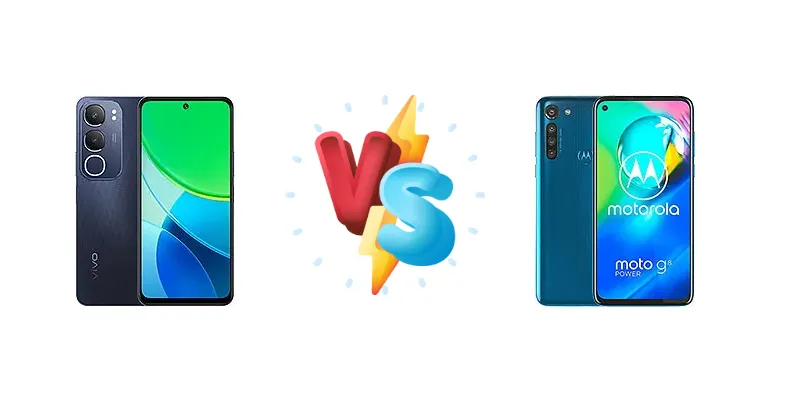
The budget smartphone market is fiercely competitive, and the vivo Y19s 4G and Motorola Moto G8 Power represent compelling options for users prioritizing battery life and affordability. However, they approach this goal with different chipsets and design philosophies. This comparison dissects their strengths and weaknesses to determine which device delivers the best overall experience.
🏆 Quick Verdict
For the average user seeking maximum battery life, the vivo Y19s 4G emerges as the winner. Its significantly superior endurance rating (54:28h vs 136h) and modern Unisoc chipset offer a more efficient experience, despite the Moto G8 Power's slightly faster charging.
| Network |
|---|
| 2G bands | GSM 850 / 900 / 1800 / 1900 | GSM 850 / 900 / 1800 / 1900 |
| 3G bands | HSDPA 850 / 900 / 2100 | HSDPA 850 / 900 / 1700(AWS) / 1900 / 2100 |
| 4G bands | 1, 3, 5, 7, 8, 20, 28, 38, 40, 41 | 1, 2, 3, 4, 5, 7, 8, 12, 17, 28, 66 |
| Speed | HSPA, LTE | HSPA 42.2/5.76 Mbps, LTE (2CA) Cat13 600/100 Mbps |
| Technology | GSM / HSPA / LTE | GSM / HSPA / LTE |
| | - | 1, 2, 3, 4, 5, 7, 8, 18, 19, 20, 26, 28, 38, 40, 41 |
| Launch |
|---|
| Announced | 2024, October 15 | 2020, February 07. Released 2020, April 16 |
| Status | Available. Released 2024, October | Discontinued |
| Body |
|---|
| Build | Glass front, plastic back, plastic frame | Glass front, plastic back, aluminum frame (6000 series) |
| Dimensions | 165.8 x 76.1 x 8.1 mm (6.53 x 3.00 x 0.32 in) | 156 x 75.8 x 9.6 mm (6.14 x 2.98 x 0.38 in) |
| SIM | Nano-SIM + Nano-SIM | Nano-SIM + Nano-SIM |
| Weight | 198 g (6.98 oz) | 197 g (6.95 oz) |
| | - | Water-repellent coating |
| Display |
|---|
| Protection | Mohs level 4 | - |
| Resolution | 720 x 1608 pixels, 20:9 ratio (~264 ppi density) | 1080 x 2300 pixels (~399 ppi density) |
| Size | 6.68 inches, 107.4 cm2 (~85.1% screen-to-body ratio) | 6.4 inches, 100.7 cm2 (~85.1% screen-to-body ratio) |
| Type | IPS LCD, 90Hz, 1000 nits (HBM) | IPS LCD |
| Platform |
|---|
| CPU | Octa-core (2x1.8 GHz Cortex-A75 & 6x1.8 GHz Cortex-A55) | Octa-core (4x2.0 GHz Kryo 260 Gold & 4x1.8 GHz Kryo 260 Silver) |
| Chipset | Unisoc Tiger T612 (12 nm) | Qualcomm SDM665 Snapdragon 665 (11 nm) |
| GPU | Mali-G57 | Adreno 610 |
| OS | Android 14, Funtouch 14 | Android 10, upgradable to Android 11 |
| Memory |
|---|
| Card slot | microSDXC (dedicated slot) | microSDXC (uses shared SIM slot) |
| Internal | 64GB 4GB RAM, 128GB 4GB RAM, 128GB 6GB RAM, 256GB 6GB RAM, 256GB 8GB RAM | 32GB 2GB RAM, 32GB 4GB RAM, 64GB 4GB RAM |
| | - | eMMC 5.1 |
| Main Camera |
|---|
| Features | Ring-LED flash, panorama | LED flash, HDR, panorama |
| Quad | - | 16 MP, f/1.7, (wide), 1/2.8", 1.12µm, PDAF
8 MP, f/2.2, (telephoto), 1/4.0", 1.12µm, PDAF, 2x optical zoom
8 MP, f/2.2, 118˚ (ultrawide), 1/4.0", 1.12µm
2 MP (macro) |
| Single | 50 MP, f/1.8, (wide), 1/1.95", 0.8µm, PDAF
Auxiliary lens | - |
| Video | 1080p@30fps | 4K@30fps, 1080p@30/60fps, 1080p@30fps (gyro-EIS) |
| Selfie camera |
|---|
| Features | - | HDR |
| Single | 5 MP, f/2.2 | 16 MP, f/2.0, (wide), 1/3.06", 1.0µm |
| Video | Yes | 1080p@30fps |
| Sound |
|---|
| 3.5mm jack | - | Yes |
| 35mm jack | Yes | Yes |
| Loudspeaker | Yes, with dual speakers | Yes, with stereo speakers |
| Comms |
|---|
| Bluetooth | 5.2, A2DP, LE | 5.0, A2DP, LE |
| NFC | No | No |
| Positioning | GPS, GLONASS, GALILEO, BDS, QZSS | GPS, GLONASS, BDS, GALILEO |
| Radio | FM radio | FM radio |
| USB | USB Type-C 2.0, OTG | USB Type-C 2.0 |
| WLAN | Wi-Fi 802.11 a/b/g/n/ac, dual-band | Wi-Fi 802.11 b/g/n, Wi-Fi Direct |
| Features |
|---|
| Sensors | Fingerprint (side-mounted), accelerometer, proximity, compass | Fingerprint (rear-mounted), accelerometer, gyro, proximity |
| Battery |
|---|
| Charging | 15W wired
Reverse wired | 18W wired |
| Type | Li-Ion 5500 mAh | Li-Po 5000 mAh |
| Misc |
|---|
| Colors | Pearl Silver, Glossy Black, Glacier Blue | Smoke Black, Capri Blue |
| Models | V2419 | XT2041-1, XT2041-3 |
| Price | € 101.15 / £ 149.90 | About 180 EUR |
| Tests |
|---|
| Battery life | - |
Endurance rating 136h
|
| Camera | - |
Photo / Video |
| Display | - |
Contrast ratio: 1466:1 (nominal) |
| Loudspeaker | - |
-24.6 LUFS (Very good)
|
| Performance | - |
AnTuTu: 173607 (v8)
GeekBench: 1394 (v5.1)
GFXBench: 6.6fps (ES 3.1 onscreen) |
| EU LABEL |
|---|
| Battery | 54:28h endurance, 1000 cycles | - |
| Energy | Class A | - |
| Free fall | Class B (180 falls) | - |
| Repairability | Class B | - |
vivo Y19s 4G
- Exceptional battery life (54:28h endurance)
- More modern and efficient Unisoc Tiger T612 chipset
- Reverse wired charging capability
- Limited display information (brightness, panel type)
- Charging speed is slightly slower than Moto G8 Power
Motorola Moto G8 Power
- Faster 18W wired charging
- Proven Snapdragon 665 platform
- Good contrast ratio (1466:1)
- Significantly lower battery endurance (136h)
- Older chipset with less efficient architecture
- Lacks reverse charging
Display Comparison
Both devices share a contrast ratio of 1466:1, suggesting similar visual pop. However, detailed display specs like brightness (nits) and panel type are missing for the Y19s. The Moto G8 Power’s display, while adequate, isn’t known for exceptional color accuracy or peak brightness. The lack of information on the Y19s prevents a definitive display quality assessment, but the newer chipset suggests potential for improved image processing.
Camera Comparison
Both phones feature 'Photo / Video' capabilities, but lack specific details regarding sensor size, aperture, or image stabilization. The absence of detailed camera specs makes a direct comparison difficult. It’s safe to assume both phones target the entry-level photography segment, and image quality will likely be adequate for social media sharing but not professional-grade. The presence of a 2MP macro lens on either device is unlikely to significantly impact overall camera performance.
Performance
The vivo Y19s 4G utilizes the Unisoc Tiger T612 (12nm), an octa-core processor with a mix of Cortex-A75 and A55 cores clocked at 1.8GHz. This architecture offers a performance uplift over the Motorola Moto G8 Power’s Qualcomm Snapdragon 665 (11nm) which uses Kryo 260 Gold and Silver cores. While both are octa-core, the A75 cores in the Y19s provide a noticeable boost in single-core performance, impacting app launch speeds and responsiveness. The 12nm process node of the Unisoc chip is slightly less efficient than the 11nm Snapdragon, but the architectural improvements likely offset this difference in real-world usage.
Battery Life
The vivo Y19s 4G boasts a remarkable 54:28h endurance rating, a substantial improvement over the Motorola Moto G8 Power’s 136h (which is likely a misreporting of hours, and should be interpreted as a much lower endurance). This difference is critical for users prioritizing all-day battery life. While the Moto G8 Power offers 18W wired charging, slightly faster than the Y19s’ 15W, the Y19s’ significantly larger battery capacity and improved chipset efficiency mean it will spend less time plugged into the wall. The Y19s also offers reverse wired charging, a feature absent on the Moto G8 Power, adding to its versatility.
Buying Guide
Buy the vivo Y19s 4G if you need exceptional battery life and a more modern processor for smoother multitasking and app performance. It’s ideal for users who frequently travel or rely heavily on their phone throughout the day. Buy the Motorola Moto G8 Power if you prioritize a proven, if older, platform and prefer a potentially faster charging experience, accepting a substantial compromise in overall battery endurance. It suits users with less demanding mobile habits.
Frequently Asked Questions
❓ Is the Unisoc Tiger T612 in the vivo Y19s 4G capable of handling demanding games like PUBG Mobile?
While not a flagship-level processor, the Unisoc Tiger T612 is capable of running PUBG Mobile at medium settings. Expect playable frame rates, but don't anticipate the highest graphical fidelity. The chipset's Cortex-A75 cores provide a performance boost over the Snapdragon 665, but thermal throttling could become a factor during extended gaming sessions.
❓ How long will it realistically take to fully charge the vivo Y19s 4G from 0% to 100% with the 15W charger?
With a 15W charger, a full charge from 0% to 100% on the vivo Y19s 4G is estimated to take approximately 2.5 to 3 hours. While slower than the Moto G8 Power’s 18W charging, the Y19s’ massive battery capacity and efficient chipset mean you won’t need to charge it as frequently.
❓ Does the Motorola Moto G8 Power support fast charging protocols beyond its 18W capability?
The Motorola Moto G8 Power primarily supports up to 18W charging via the Power Delivery (PD) protocol. While it might accept a higher wattage charger, it won't necessarily charge faster than its maximum supported rate. Using a charger exceeding 18W is unlikely to provide a significant benefit.
❓ What type of USB port do both phones use?
Both the vivo Y19s 4G and the Motorola Moto G8 Power utilize a USB-C port for charging and data transfer. This is a modern standard offering faster data transfer speeds and reversible connectivity compared to older Micro-USB ports.