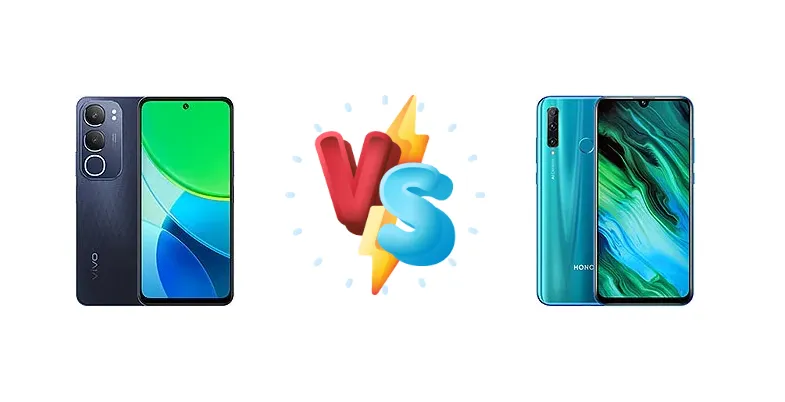
The vivo Y19s 4G and Honor 20e represent compelling options in the crowded budget smartphone market. While both aim to deliver essential functionality at an accessible price point, they diverge significantly in their core hardware choices. This comparison dissects these differences, focusing on performance, battery life, and overall value to determine which device best suits your needs.
🏆 Quick Verdict
For the average user prioritizing all-day battery life and consistent performance, the vivo Y19s 4G is the better choice. Its Unisoc Tiger T612 chipset, coupled with a remarkable 54:28h endurance rating, outweighs the Honor 20e’s slightly faster CPU cores, especially considering the Honor 20e’s slower 10W charging.
| Network |
|---|
| 2G bands | GSM 850 / 900 / 1800 / 1900 | GSM 900 / 1800 / 1900 |
| 3G bands | HSDPA 850 / 900 / 2100 | HSDPA 850 / 900 / 1900 / 2100 |
| 4G bands | 1, 3, 5, 7, 8, 20, 28, 38, 40, 41 | 1, 3, 5, 7, 8, 20 |
| Speed | HSPA, LTE | HSPA 42.2/5.76 Mbps, LTE (2CA) Cat6 300/50 Mbps |
| Technology | GSM / HSPA / LTE | GSM / HSPA / LTE |
| Launch |
|---|
| Announced | 2024, October 15 | 2020, April 16. Released 2020, April 27 |
| Status | Available. Released 2024, October | Discontinued |
| Body |
|---|
| Build | Glass front, plastic back, plastic frame | Glass front, plastic back, plastic frame |
| Dimensions | 165.8 x 76.1 x 8.1 mm (6.53 x 3.00 x 0.32 in) | 154.8 x 73.6 x 8 mm (6.09 x 2.90 x 0.31 in) |
| SIM | Nano-SIM + Nano-SIM | · Nano-SIM· Nano-SIM + Nano-SIM |
| Weight | 198 g (6.98 oz) | 164 g (5.78 oz) |
| Display |
|---|
| Protection | Mohs level 4 | - |
| Resolution | 720 x 1608 pixels, 20:9 ratio (~264 ppi density) | 1080 x 2340 pixels, 19.5:9 ratio (~415 ppi density) |
| Size | 6.68 inches, 107.4 cm2 (~85.1% screen-to-body ratio) | 6.21 inches, 94.7 cm2 (~83.1% screen-to-body ratio) |
| Type | IPS LCD, 90Hz, 1000 nits (HBM) | IPS LCD |
| Platform |
|---|
| CPU | Octa-core (2x1.8 GHz Cortex-A75 & 6x1.8 GHz Cortex-A55) | Octa-core (4x2.2 GHz Cortex-A73 & 4x1.7 GHz Cortex-A53) |
| Chipset | Unisoc Tiger T612 (12 nm) | Kirin 710F (12 nm) |
| GPU | Mali-G57 | Mali-G51 MP4 |
| OS | Android 14, Funtouch 14 | Android 9.0 (Pie), EMUI 9.1, Google Play Services |
| Memory |
|---|
| Card slot | microSDXC (dedicated slot) | microSDXC (uses shared SIM slot) |
| Internal | 64GB 4GB RAM, 128GB 4GB RAM, 128GB 6GB RAM, 256GB 6GB RAM, 256GB 8GB RAM | 64GB 4GB RAM |
| | - | eMMC 5.1 |
| Main Camera |
|---|
| Features | Ring-LED flash, panorama | LED flash, HDR, panorama |
| Single | 50 MP, f/1.8, (wide), 1/1.95", 0.8µm, PDAF
Auxiliary lens | - |
| Triple | - | 24 MP, f/1.8, PDAF
8 MP, f/2.4, 120˚ (ultrawide)
Auxiliary lens |
| Video | 1080p@30fps | 1080p@30/60fps |
| Selfie camera |
|---|
| Features | - | HDR |
| Single | 5 MP, f/2.2 | 8 MP, f/2.0, (wide) |
| Video | Yes | 1080p@30fps |
| Sound |
|---|
| 3.5mm jack | - | Yes |
| 35mm jack | Yes | Yes |
| Loudspeaker | Yes, with dual speakers | Yes |
| Comms |
|---|
| Bluetooth | 5.2, A2DP, LE | 4.2, A2DP, LE |
| NFC | No | Yes |
| Positioning | GPS, GLONASS, GALILEO, BDS, QZSS | GPS, GLONASS |
| Radio | FM radio | FM radio |
| USB | USB Type-C 2.0, OTG | microUSB 2.0, OTG |
| WLAN | Wi-Fi 802.11 a/b/g/n/ac, dual-band | Wi-Fi 802.11 b/g/n, Wi-Fi Direct |
| Features |
|---|
| Sensors | Fingerprint (side-mounted), accelerometer, proximity, compass | Fingerprint (rear-mounted), accelerometer, proximity, compass |
| Battery |
|---|
| Charging | 15W wired
Reverse wired | 10W wired |
| Type | Li-Ion 5500 mAh | Li-Po 3400 mAh |
| Misc |
|---|
| Colors | Pearl Silver, Glossy Black, Glacier Blue | Midnight Black, Phantom Blue |
| Models | V2419 | - |
| Price | € 101.15 / £ 149.90 | About 180 EUR |
| EU LABEL |
|---|
| Battery | 54:28h endurance, 1000 cycles | - |
| Energy | Class A | - |
| Free fall | Class B (180 falls) | - |
| Repairability | Class B | - |
vivo Y19s 4G
- Exceptional battery life (54:28h endurance)
- Reverse wired charging capability
- Modern chipset architecture (Unisoc Tiger T612)
- Slightly slower CPU clock speeds compared to Honor 20e
- Charging speed is moderate (15W)
Honor 20e
- Faster CPU cores (Kirin 710F)
- Potentially quicker app loading times
- Established brand reputation (Honor)
- Significantly lower battery endurance
- Slow charging speed (10W)
- Lacks reverse charging functionality
Display Comparison
Neither device boasts a standout display. Both are likely utilizing LCD panels, common in this price bracket. The focus here isn't on visual fidelity, but rather on efficiency. Without specific display specs, it's difficult to definitively declare a winner, but the Y19s' longer battery life suggests a potentially more power-efficient panel implementation.
Camera Comparison
Without detailed camera specifications, a direct comparison is challenging. Both phones likely feature a multi-camera setup with a primary sensor and supporting lenses. Given the market segment, image processing will likely prioritize scene optimization over raw detail. The absence of information regarding sensor size and aperture makes it impossible to assess low-light performance. It's safe to assume both phones will struggle in challenging lighting conditions, and the 2MP macro lenses commonly found on these devices offer limited practical benefit.
Performance
The core difference lies in the chipsets. The Honor 20e’s Kirin 710F features four Cortex-A73 cores clocked at 2.2 GHz, offering a theoretical advantage in single-core performance compared to the vivo Y19s’s 1.8 GHz Cortex-A75 cores. However, the Y19s’s Unisoc Tiger T612 utilizes a more modern architecture and a 12nm process, potentially offsetting the clock speed difference. The Y19s’s six Cortex-A55 cores provide efficient handling of background tasks, contributing to its impressive battery endurance. While the Honor 20e might feel snappier in quick app launches, the Y19s is likely to maintain smoother performance over extended use.
Battery Life
This is where the vivo Y19s 4G truly shines. Its 54:28h endurance rating is exceptional for a budget smartphone, indicating it can comfortably last through a full day of heavy use. The Honor 20e, with its 10W charging, will require significantly more time to replenish its battery. The Y19s’s 15W charging, while not fast by modern standards, offers a noticeable improvement in charging speed. Furthermore, the Y19s includes reverse wired charging, a feature absent on the Honor 20e, allowing it to act as a power bank for other devices.
Buying Guide
Buy the vivo Y19s 4G if you need a phone that can reliably last through a full day of moderate to heavy use, and appreciate the convenience of reverse wired charging. Buy the Honor 20e if you prioritize slightly quicker app loading times and occasional bursts of performance, and are willing to compromise on battery endurance and charging speed. The Honor 20e is best suited for users who are consistently near a power outlet.
Frequently Asked Questions
❓ Will the Unisoc Tiger T612 in the vivo Y19s struggle with demanding games like PUBG Mobile?
While the Unisoc Tiger T612 isn't a high-end gaming chipset, it's capable of running PUBG Mobile at medium settings with reasonable frame rates. Expect some frame drops during intense action, but the efficient architecture should prevent significant overheating. The Honor 20e's Kirin 710F might offer slightly better peak performance, but the Y19s's sustained performance could be superior due to better thermal management.
❓ How many years of software updates can I expect from the vivo Y19s 4G and Honor 20e?
Both vivo and Honor have historically offered limited software update support for their budget devices. Expect at most one major Android version update and a few security patches. Don't rely on these phones for long-term software support; they are best suited for users who prioritize current functionality over future updates.
❓ Is the 10W charging on the Honor 20e a significant drawback in daily use?
Yes, the 10W charging is a considerable limitation. It will take significantly longer to fully charge the Honor 20e compared to the vivo Y19s's 15W charging. This means you'll need to plan your charging schedule carefully, and topping up the battery quickly isn't an option.