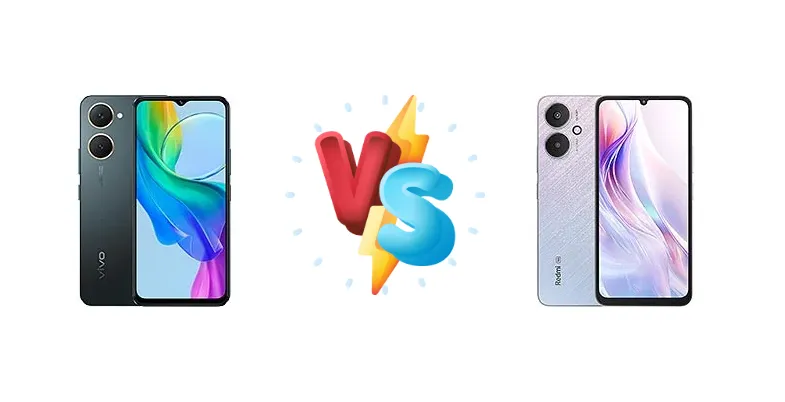
The sub-$200 5G smartphone market is fiercely competitive. Both the Xiaomi Redmi 13C 5G and the vivo Y18t aim to deliver 5G connectivity at an accessible price point, but they take different approaches. The Redmi 13C 5G leverages MediaTek's newer Dimensity 6100+ chipset, while the vivo Y18t opts for the Unisoc T612. This comparison dissects the key differences to determine which device offers the best value for your money.
🏆 Quick Verdict
For most users, the Xiaomi Redmi 13C 5G is the stronger choice. Its Dimensity 6100+ chipset provides a noticeable performance advantage over the vivo Y18t’s Unisoc T612, translating to smoother multitasking and a better gaming experience. While the Y18t offers reasonable efficiency, the Redmi 13C 5G’s faster charging and overall processing power make it the winner.
| Network |
|---|
| 2G bands | GSM 850 / 900 / 1800 / 1900 | GSM 850 / 900 / 1800 / 1900 |
| 3G bands | HSDPA 850 / 900 / 2100 | HSDPA 800 / 850 / 900 / 1700(AWS) / 1900 / 2100 - International |
| 4G bands | 1, 3, 5, 8, 38, 40, 41 | 1, 2, 3, 4, 5, 7, 8, 12, 13, 17, 18, 19, 20, 26, 28, 32, 38, 40, 41, 66 - International |
| 5G bands | - | 1, 3, 5, 7, 8, 20, 28, 38, 40, 41, 66, 77, 78 SA/NSA - International |
| Speed | HSPA, LTE | HSPA, LTE, 5G |
| Technology | GSM / HSPA / LTE | GSM / HSPA / LTE / 5G |
| Launch |
|---|
| Announced | 2024, November 12 | 2023, December 06 |
| Status | Available. Released 2024, November 12 | Available. Released 2023, December 16 |
| Body |
|---|
| Build | Glass front, plastic frame, plastic back | Glass front (Gorilla Glass 3), plastic frame, plastic back |
| Dimensions | 163.6 x 75.6 x 8.4 mm (6.44 x 2.98 x 0.33 in) | 168.1 x 77.9 x 8.2 mm (6.62 x 3.07 x 0.32 in) |
| SIM | Nano-SIM + Nano-SIM | Nano-SIM + Nano-SIM |
| Weight | 185 g (6.53 oz) | 192 g or 195 g (6.77 oz) |
| Display |
|---|
| Protection | - | Corning Gorilla Glass 3 |
| Resolution | 720 x 1612 pixels, 20:9 ratio (~269 ppi density) | 720 x 1600 pixels, 20:9 ratio (~260 ppi density) |
| Size | 6.56 inches, 103.4 cm2 (~83.6% screen-to-body ratio) | 6.74 inches, 109.7 cm2 (~83.8% screen-to-body ratio) |
| Type | IPS LCD, 90Hz, 840 nits (HBM) | IPS LCD, 90Hz, 450 nits (typ), 600 nits (HBM) |
| Platform |
|---|
| CPU | Octa-core (2x1.8 GHz Cortex-A75 & 6x1.8 GHz Cortex-A55) | Octa-core (2x2.2 GHz Cortex-A76 & 6x2.0 GHz Cortex-A55) |
| Chipset | Unisoc T612 (12 nm) | Mediatek Dimensity 6100+ (6 nm) |
| GPU | Mali-G57 MP1 | Mali-G57 MC2 |
| OS | Android 14, Funtouch 14 | Android 13, MIUI 14 |
| Memory |
|---|
| Card slot | microSDXC (dedicated slot) | microSDXC (dedicated slot) |
| Internal | 128GB 4GB RAM | 64GB 4GB RAM, 128GB 4GB RAM, 128GB 6GB RAM, 256GB 8GB RAM |
| Main Camera |
|---|
| Features | LED flash, panorama | LED flash, HDR |
| Single | 50 MP, f/1.8, (wide), PDAF
Auxiliary lens | 50 MP, f/1.8, 28mm (wide), 1/2.76", 1.12µm, PDAF
Auxiliary lens |
| Video | 1080p@30fps | 1080p@30fps |
| Selfie camera |
|---|
| Features | - | HDR |
| Single | 8 MP, f/2.0, (wide) | 5 MP, f/2.2, (wide) |
| Video | Yes | 1080p@30fps |
| Sound |
|---|
| 35mm jack | Yes | Yes |
| Loudspeaker | Yes | Yes |
| Comms |
|---|
| Bluetooth | 5.2, A2DP, LE | 5.3, A2DP, LE |
| NFC | No | Yes (market/region dependent) |
| Positioning | GPS, GALILEO, GLONASS, BDS, QZSS | GPS, GLONASS, GALILEO, BDS |
| Radio | FM radio | FM radio |
| USB | USB Type-C 2.0, OTG | USB Type-C 2.0, OTG |
| WLAN | Wi-Fi 802.11 a/b/g/n/ac, dual-band | Wi-Fi 802.11 a/b/g/n/ac, dual-band |
| Features |
|---|
| Sensors | Accelerometer, proximity, compass | Fingerprint (side-mounted), accelerometer, compass |
| Battery |
|---|
| Charging | 15W wired | 18W wired, PD |
| Type | Li-Ion 5000 mAh | 5000 mAh |
| Misc |
|---|
| Colors | Space Black, Gem Green | Starry Black, Twilight Blue, Starry Silver, Starlight Black, Startrail Green, Startrail Silver |
| Models | - | 23124RN87G, 23124RN87I, 23124RN87C |
| Price | About 110 EUR | $ 198.99 / £ 119.00 / € 116.99 / ₹ 10,895 |
| SAR | - | 1.09 W/kg (head) 1.09 W/kg (body) |
| SAR EU | - | 0.98 W/kg (head) 0.98 W/kg (body) |
vivo Y18t
- Faster and more efficient Unisoc T612 processor
- Potentially longer battery life during light use
- Slightly more affordable (likely)
- Less powerful CPU and GPU for gaming and demanding apps
- Slower 15W charging
- Likely less refined software experience
Xiaomi Redmi 13C 5G
- Significantly faster MediaTek Dimensity 6100+ processor
- Faster 18W charging with PD support
- Better multitasking and gaming performance
- Potentially slightly lower battery life under heavy load
- May be slightly more expensive
- Larger size may not suit all users
Display Comparison
Neither device boasts a standout display. Both are likely to feature LCD panels, common in this price bracket. However, details like peak brightness and color accuracy are missing. The Redmi 13C 5G’s larger screen size (typically 6.74 inches vs. the Y18t’s 6.56 inches) may appeal to media consumers, but this comes at the cost of potentially lower pixel density. Without specific display specs, it’s difficult to declare a clear winner; the Redmi 13C 5G’s larger size is the only differentiating factor.
Camera Comparison
Both phones likely feature a primary camera paired with depth and macro sensors. However, specific sensor details are unavailable. Given the price point, image quality will likely be adequate for social media sharing but not exceptional. The Redmi 13C 5G may benefit from MediaTek’s image signal processor (ISP), potentially offering slightly better image processing capabilities. Without detailed sensor information, it’s difficult to assess the camera performance accurately, but the Redmi 13C 5G’s chipset offers a slight edge in potential image quality.
Performance
The performance gap is the most significant differentiator. The Xiaomi Redmi 13C 5G’s MediaTek Dimensity 6100+ (6nm) is built on a more advanced process node than the vivo Y18t’s Unisoc T612 (12nm). This translates to improved power efficiency and, crucially, a substantial performance boost. The Dimensity 6100+ features Cortex-A76 cores clocked at 2.2 GHz, compared to the Y18t’s Cortex-A75 cores at 1.8 GHz. This architectural advantage, combined with the higher clock speed, will result in faster app loading times, smoother multitasking, and a more enjoyable gaming experience on the Redmi 13C 5G. The Redmi 13C 5G is the clear winner for users who demand more from their smartphone.
Battery Life
The Redmi 13C 5G’s 18W charging with Power Delivery (PD) support offers a faster and more versatile charging experience than the vivo Y18t’s 15W wired charging. While battery capacity isn’t specified, the faster charging speed of the Redmi 13C 5G means less time tethered to a wall outlet. The more efficient Dimensity 6100+ chipset may also contribute to slightly better battery life, despite potentially similar battery capacities. The Redmi 13C 5G’s charging speed and potential efficiency give it an advantage.
Buying Guide
Buy the vivo Y18t if you prioritize a slightly more power-efficient processor for basic tasks and extended battery life during light usage. Buy the Xiaomi Redmi 13C 5G if you need a phone capable of handling more demanding applications, enjoy mobile gaming, or value faster charging speeds and a more responsive user experience.
Frequently Asked Questions
❓ Will the Unisoc T612 in the vivo Y18t struggle with graphically intensive games like PUBG Mobile?
Yes, the Unisoc T612 is a budget chipset and will likely struggle to deliver a smooth gaming experience in demanding titles like PUBG Mobile, even at lower settings. Expect noticeable frame drops and potential lag. The Redmi 13C 5G’s Dimensity 6100+ is significantly better suited for gaming.
❓ Does the Redmi 13C 5G support carrier aggregation for improved 5G speeds?
While not explicitly stated, MediaTek Dimensity chipsets generally support carrier aggregation. This means the Redmi 13C 5G is likely to be able to combine multiple 5G bands for faster and more reliable 5G connectivity, provided your carrier supports it. The Unisoc T612’s 5G capabilities are less well-defined.
❓ Is the 15W charging on the vivo Y18t slow compared to other phones?
15W charging is relatively slow by today's standards, especially compared to the Redmi 13C 5G’s 18W charging with PD. Expect a longer charging time to reach 100%, potentially taking over 2 hours. This is a trade-off for the Y18t’s potentially slightly better power efficiency.