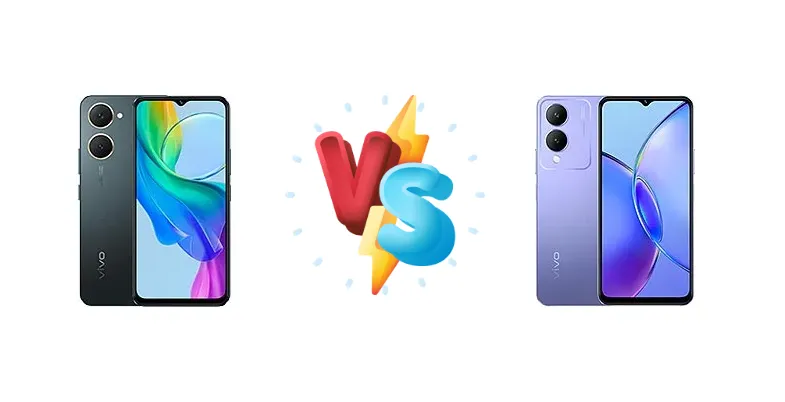
The vivo Y18t and Y17s represent vivo’s continued push into the affordable smartphone market. Both devices target users seeking a balance between functionality and price, but they diverge in their core processing power. The Y18t features the Unisoc T612, while the Y17s utilizes the MediaTek Helio G85. This comparison will dissect these differences, revealing which phone offers the best value for your money.
🏆 Quick Verdict
For most users, the vivo Y17s emerges as the slightly better choice. While both phones share a 15W charging rate, the Helio G85 chipset in the Y17s provides a noticeable performance edge in demanding tasks and gaming, making it a more versatile device overall. The added benefit of reverse wired charging further sweetens the deal.
| Network |
|---|
| 2G bands | GSM 850 / 900 / 1800 / 1900 | GSM 850 / 900 / 1800 / 1900 |
| 3G bands | HSDPA 850 / 900 / 2100 | HSDPA 850 / 900 / 2100 |
| 4G bands | 1, 3, 5, 8, 38, 40, 41 | 1, 3, 5, 7, 8, 20, 28, 38, 40, 41 |
| Speed | HSPA, LTE | HSPA, LTE |
| Technology | GSM / HSPA / LTE | GSM / HSPA / LTE |
| Launch |
|---|
| Announced | 2024, November 12 | 2023, September 18 |
| Status | Available. Released 2024, November 12 | Available. Released 2023, October 02 |
| Body |
|---|
| Build | Glass front, plastic frame, plastic back | Glass front, plastic frame, plastic back |
| Dimensions | 163.6 x 75.6 x 8.4 mm (6.44 x 2.98 x 0.33 in) | 163.7 x 75.4 x 8.1 mm (6.44 x 2.97 x 0.32 in) |
| SIM | Nano-SIM + Nano-SIM | Nano-SIM + Nano-SIM |
| Weight | 185 g (6.53 oz) | 186 g (6.56 oz) |
| Display |
|---|
| Resolution | 720 x 1612 pixels, 20:9 ratio (~269 ppi density) | 720 x 1612 pixels, 20:9 ratio (~269 ppi density) |
| Size | 6.56 inches, 103.4 cm2 (~83.6% screen-to-body ratio) | 6.56 inches, 103.4 cm2 (~83.8% screen-to-body ratio) |
| Type | IPS LCD, 90Hz, 840 nits (HBM) | IPS LCD, 700 nits (peak) |
| Platform |
|---|
| CPU | Octa-core (2x1.8 GHz Cortex-A75 & 6x1.8 GHz Cortex-A55) | Octa-core (2x2.0 GHz Cortex-A75 & 6x1.8 GHz Cortex-A55) |
| Chipset | Unisoc T612 (12 nm) | Mediatek MT6769 Helio G85 (12 nm) |
| GPU | Mali-G57 MP1 | Mali-G52 MC2 |
| OS | Android 14, Funtouch 14 | Android 13, Funtouch 13 |
| Memory |
|---|
| Card slot | microSDXC (dedicated slot) | microSDXC (dedicated slot) |
| Internal | 128GB 4GB RAM | 64GB 4GB RAM, 128GB 4GB RAM, 128GB 6GB RAM |
| Main Camera |
|---|
| Dual | - | 50 MP, f/1.8, (wide), PDAF
Auxiliary lens |
| Features | LED flash, panorama | LED flash, panorama |
| Single | 50 MP, f/1.8, (wide), PDAF
Auxiliary lens | - |
| Video | 1080p@30fps | 1080p@30fps |
| Selfie camera |
|---|
| Single | 8 MP, f/2.0, (wide) | 8 MP, f/2.0, (wide) |
| Video | Yes | 1080p@30fps |
| Sound |
|---|
| 35mm jack | Yes | Yes |
| Loudspeaker | Yes | Yes |
| Comms |
|---|
| Bluetooth | 5.2, A2DP, LE | 5.0, A2DP, LE |
| NFC | No | No |
| Positioning | GPS, GALILEO, GLONASS, BDS, QZSS | GPS, GLONASS, GALILEO, BDS, QZSS |
| Radio | FM radio | FM radio |
| USB | USB Type-C 2.0, OTG | USB Type-C 2.0, OTG |
| WLAN | Wi-Fi 802.11 a/b/g/n/ac, dual-band | Wi-Fi 802.11 a/b/g/n/ac, dual-band |
| Features |
|---|
| Sensors | Accelerometer, proximity, compass | Fingerprint (side-mounted), accelerometer, proximity, compass |
| Battery |
|---|
| Charging | 15W wired | 15W wired
Reverse wired |
| Type | Li-Ion 5000 mAh | 5000 mAh |
| Misc |
|---|
| Colors | Space Black, Gem Green | Glitter Purple, Forest Green |
| Price | About 110 EUR | - |
vivo Y18t
- Potentially better battery life during light use due to Unisoc T612's efficiency.
- Competitive price point.
- Functional for basic smartphone tasks.
- Less powerful chipset compared to the Helio G85.
- Limited gaming performance.
- Lacks reverse charging capability.
vivo Y17s
- More powerful MediaTek Helio G85 chipset.
- Better gaming performance.
- Convenient reverse wired charging.
- Potentially slightly shorter battery life during heavy use.
- May be marginally more expensive than the Y18t.
- Similar camera capabilities to the Y18t.
Display Comparison
Both the vivo Y18t and Y17s likely feature LCD panels, typical for this price segment. Specific details like resolution and peak brightness are not provided, but we can assume they are similar, aiming for a functional viewing experience rather than a premium one. Bezels are likely to be noticeable on both devices, and color accuracy will be standard for budget displays. The absence of high refresh rate panels is expected, focusing on power conservation.
Camera Comparison
Without detailed sensor information, a direct camera comparison is difficult. However, both phones likely feature a primary camera paired with depth and macro sensors (the latter often being of limited utility). The image processing capabilities of the MediaTek Helio G85 may offer slightly better dynamic range and noise reduction compared to the Unisoc T612’s ISP. The absence of Optical Image Stabilization (OIS) is expected on both devices, relying on software stabilization for video recording.
Performance
The core difference lies in the chipsets. The vivo Y17s’ MediaTek Helio G85 boasts a slightly higher CPU clock speed (2.0 GHz vs 1.8 GHz on the Y18t’s Unisoc T612) for its Cortex-A75 cores. While both utilize the same core configuration (2x A75 + 6x A55), the G85’s higher clock speed translates to quicker processing in CPU-bound tasks. The Helio G85 also has a more mature GPU, offering a better gaming experience. The Unisoc T612 prioritizes efficiency, potentially leading to slightly better battery life during light usage, but will struggle more with graphically intensive applications. Both devices likely feature similar RAM configurations, but the chipset difference will be the primary bottleneck.
Battery Life
Both the vivo Y18t and Y17s are equipped with 15W wired charging, suggesting similar charging speeds – approximately 2-3 hours for a full charge. The Y17s gains a significant advantage with its inclusion of reverse wired charging, allowing it to function as a power bank for accessories like earbuds or smartwatches. While battery capacity isn't specified, the Unisoc T612’s efficiency *could* translate to slightly longer battery life during light usage, but the Helio G85’s performance advantage will likely negate this in real-world scenarios with moderate to heavy use.
Buying Guide
Buy the vivo Y18t if you prioritize a potentially smoother experience with everyday tasks like browsing and social media, and are less concerned with demanding gaming or multitasking. Its Unisoc T612 aims for efficiency. Buy the vivo Y17s if you value a more responsive experience, particularly when gaming or running multiple apps, and appreciate the convenience of reverse wired charging to top up accessories.
Frequently Asked Questions
❓ Will the Helio G85 in the Y17s struggle with demanding games like PUBG or Call of Duty?
While the Helio G85 isn't a flagship gaming chip, it's capable of running PUBG and Call of Duty Mobile at medium settings with acceptable frame rates. Expect some frame drops during intense action, but it's a significantly better gaming experience than the Unisoc T612.
❓ How useful is the reverse wired charging feature on the Y17s in real-world scenarios?
The reverse wired charging is surprisingly practical. It's ideal for topping up wireless earbuds, smartwatches, or even a friend's phone in an emergency. While it won't fully charge another device quickly, it provides a convenient boost when you're on the go.
❓ Is the Unisoc T612 a reliable chipset for everyday use?
The Unisoc T612 is perfectly adequate for basic tasks like browsing, social media, and messaging. However, it will exhibit noticeable slowdowns when multitasking or running demanding applications. It prioritizes power efficiency over raw performance.
❓ Are software updates likely to be consistent on both devices?
vivo's update track record for its Y series is somewhat inconsistent. Expect a few major Android updates, but timely security patches are not guaranteed. Both devices will likely receive similar levels of software support.