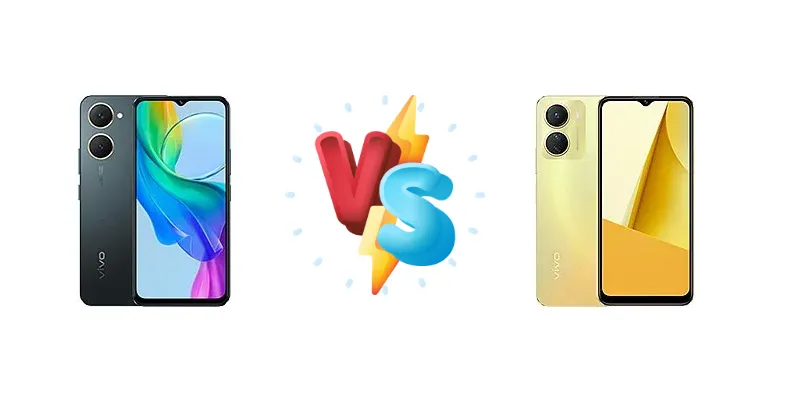
The vivo Y18t and Y16 represent vivo’s commitment to the entry-level smartphone market. While both devices aim to deliver essential functionality at an affordable price, they diverge significantly in their core processing power and charging capabilities. This comparison dissects these differences to determine which phone offers the best value for your money.
🏆 Quick Verdict
For most users, the vivo Y18t is the superior choice. Its Unisoc T612 chipset, featuring Cortex-A75 cores, provides a noticeable performance boost over the Helio P35 in the Y16. While the Y16 is more affordable, the Y18t’s faster charging and improved processing justify the slight price premium.
| Network |
|---|
| 2G bands | GSM 850 / 900 / 1800 / 1900 | GSM 850 / 900 / 1800 / 1900 |
| 3G bands | HSDPA 850 / 900 / 2100 | HSDPA 850 / 900 / 2100 |
| 4G bands | 1, 3, 5, 8, 38, 40, 41 | 1, 3, 5, 8, 40 |
| Speed | HSPA, LTE | HSPA, LTE |
| Technology | GSM / HSPA / LTE | GSM / HSPA / LTE |
| Launch |
|---|
| Announced | 2024, November 12 | 2022, September 01 |
| Status | Available. Released 2024, November 12 | Available. Released 2022, September 01 |
| Body |
|---|
| Build | Glass front, plastic frame, plastic back | Glass front, plastic frame, plastic back |
| Dimensions | 163.6 x 75.6 x 8.4 mm (6.44 x 2.98 x 0.33 in) | 164 x 75.6 x 8.2 mm (6.46 x 2.98 x 0.32 in) |
| SIM | Nano-SIM + Nano-SIM | Nano-SIM + Nano-SIM |
| Weight | 185 g (6.53 oz) | 184 g (6.49 oz) |
| | - | Splashproof |
| Display |
|---|
| Resolution | 720 x 1612 pixels, 20:9 ratio (~269 ppi density) | 720 x 1600 pixels, 20:9 ratio (~270 ppi density) |
| Size | 6.56 inches, 103.4 cm2 (~83.6% screen-to-body ratio) | 6.51 inches, 102.3 cm2 (~82.5% screen-to-body ratio) |
| Type | IPS LCD, 90Hz, 840 nits (HBM) | IPS LCD |
| Platform |
|---|
| CPU | Octa-core (2x1.8 GHz Cortex-A75 & 6x1.8 GHz Cortex-A55) | Octa-core (4x2.3 GHz Cortex-A53 & 4x1.8 GHz Cortex-A53) |
| Chipset | Unisoc T612 (12 nm) | Mediatek MT6765 Helio P35 (12 nm) |
| GPU | Mali-G57 MP1 | PowerVR GE8320 |
| OS | Android 14, Funtouch 14 | Android 12, Funtouch 12 |
| Memory |
|---|
| Card slot | microSDXC (dedicated slot) | microSDXC (dedicated slot) |
| Internal | 128GB 4GB RAM | 32GB 2GB RAM, 32GB 3GB RAM, 64GB 3GB RAM, 64GB 4GB RAM, 128GB 4GB RAM |
| Main Camera |
|---|
| Dual | - | 13 MP, f/2.2, (wide), PDAF
2 MP (macro) |
| Features | LED flash, panorama | LED flash |
| Single | 50 MP, f/1.8, (wide), PDAF
Auxiliary lens | 5 MP, f/2.2, (wide) |
| Video | 1080p@30fps | 1080p@30fps |
| Selfie camera |
|---|
| Single | 8 MP, f/2.0, (wide) | 5 MP, f/2.2, (wide) |
| Video | Yes | Yes |
| Sound |
|---|
| 3.5mm jack | - | Yes |
| 35mm jack | Yes | Yes |
| Loudspeaker | Yes | Yes |
| Comms |
|---|
| Bluetooth | 5.2, A2DP, LE | 5.0, A2DP, LE |
| NFC | No | No |
| Positioning | GPS, GALILEO, GLONASS, BDS, QZSS | GPS, GLONASS, GALILEO, BDS |
| Radio | FM radio | FM radio |
| USB | USB Type-C 2.0, OTG | USB Type-C, OTG |
| WLAN | Wi-Fi 802.11 a/b/g/n/ac, dual-band | Wi-Fi 802.11 a/b/g/n/ac, dual-band |
| Features |
|---|
| Sensors | Accelerometer, proximity, compass | Fingerprint (side-mounted), accelerometer, proximity, compass |
| Battery |
|---|
| Charging | 15W wired | 10W wired |
| Type | Li-Ion 5000 mAh | 5000 mAh |
| Misc |
|---|
| Colors | Space Black, Gem Green | Drizzling Gold, Stellar Black |
| Models | - | V2204, V2214 |
| Price | About 110 EUR | About 120 EUR |
vivo Y18t
- Faster processor for smoother performance
- 15W fast charging for quicker top-ups
- More modern CPU architecture (Cortex-A75)
- Potentially slightly higher price
- May not have significant camera improvements
vivo Y16
- Lower price point for budget-conscious buyers
- Functional for basic smartphone tasks
- Decent battery life (estimated)
- Slower processor leading to lag and stutter
- 10W slow charging
- Older CPU architecture (Cortex-A53)
Display Comparison
Both the Y18t and Y16 likely feature LCD panels, typical for this price segment. Specific details like resolution and peak brightness are not provided, but the focus here is on internal performance. The absence of information regarding refresh rates suggests both devices operate at the standard 60Hz. Bezels are expected to be relatively substantial on both models, contributing to a more utilitarian aesthetic.
Camera Comparison
Without detailed sensor information, a direct camera comparison is difficult. However, it’s safe to assume both phones feature basic camera setups geared towards casual photography. The absence of Optical Image Stabilization (OIS) on either device suggests image stabilization will rely on software algorithms. The Y16’s camera performance will likely be limited by the Helio P35’s image signal processor (ISP), while the Y18t benefits from the more capable ISP within the Unisoc T612. Expect similar results in good lighting conditions, but the Y18t should perform better in low-light scenarios.
Performance
The core difference lies in the chipsets. The vivo Y18t’s Unisoc T612 utilizes a more modern CPU architecture with 2x 1.8 GHz Cortex-A75 cores and 6x 1.8 GHz Cortex-A55 cores. This contrasts with the vivo Y16’s MediaTek Helio P35, which employs 4x 2.3 GHz Cortex-A53 cores and 4x 1.8 GHz Cortex-A53 cores. The Cortex-A75 cores in the Y18t offer significantly higher single-core performance, translating to snappier app launches and a more responsive user experience. While the Helio P35’s higher clock speed on the A53 cores might offer a slight advantage in sustained multi-threaded tasks, the architectural advantage of the Y18t’s chipset is more impactful for everyday use. The Y18t will handle multitasking and moderately demanding apps with greater ease.
Battery Life
Battery capacity is not specified for either device, but both are likely equipped with batteries in the 4000-5000 mAh range, common for this segment. The key difference is charging speed: the Y18t supports 15W wired charging, while the Y16 is limited to 10W. This 50% increase in charging wattage translates to significantly faster top-up times for the Y18t. Users who frequently find themselves needing to quickly recharge their phone will greatly benefit from the Y18t’s faster charging capability.
Buying Guide
Buy the vivo Y18t if you prioritize smoother multitasking, faster app loading times, and quicker charging. This phone is ideal for users who frequently use social media, stream videos, or play casual games. Buy the vivo Y16 if your primary needs are basic communication – calls, texts, and light web browsing – and you are on a very tight budget. The Y16 is a functional device for those who prioritize affordability above all else.
Frequently Asked Questions
❓ Will the Unisoc T612 in the Y18t handle popular apps like Facebook and WhatsApp smoothly?
Yes, the Unisoc T612’s Cortex-A75 cores provide ample processing power for smooth operation of social media apps like Facebook and WhatsApp. You should experience minimal lag or stuttering during everyday use.
❓ How long will it take to fully charge the vivo Y18t with the 15W charger compared to the Y16?
While exact charging times depend on battery capacity (which isn't specified), the Y18t’s 15W charging will likely take around 2-2.5 hours for a full charge, whereas the Y16’s 10W charging could take 3-3.5 hours. This is a significant difference for users who need to quickly recharge their device.
❓ Is the Helio P35 in the Y16 sufficient for playing basic mobile games?
The Helio P35 can handle less demanding mobile games, but you may experience lower frame rates and longer loading times compared to the Y18t. More graphically intensive games may not run smoothly or may require significant graphics settings reductions.
❓ Does the Y18t offer any noticeable improvements in multitasking compared to the Y16?
Yes, the Y18t’s more powerful processor and modern architecture allow for significantly smoother multitasking. You’ll be able to switch between apps more quickly and run more apps simultaneously without experiencing slowdowns.