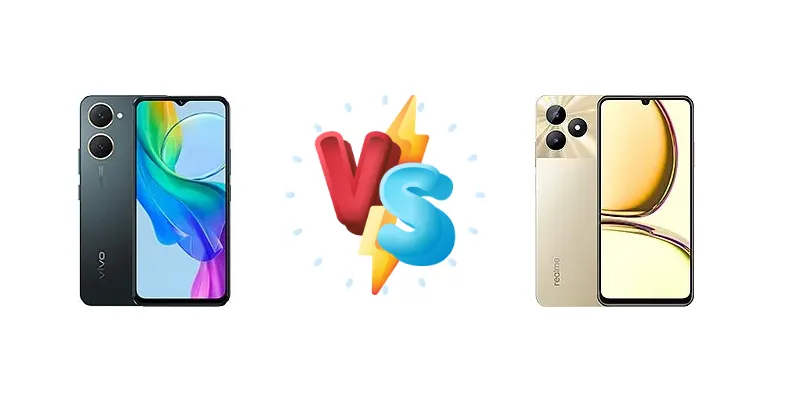
The sub-$150 smartphone market is fiercely competitive, and the vivo Y18t and Realme C53 (India) are two recent entrants vying for dominance. Both devices leverage the Unisoc T612 chipset, but subtle differences in charging speed and potential software optimizations could sway your decision. This comparison dissects these phones to reveal which offers the best value for budget-conscious consumers.
🏆 Quick Verdict
For the average user prioritizing slightly faster charging and potential software refinements, the Realme C53 (India) emerges as the winner. While both phones share the same Unisoc T612 chipset, the 18W charging offers a tangible benefit over the vivo Y18t’s 15W, potentially reducing downtime for those frequently on the go.
| Network |
|---|
| 2G bands | GSM 850 / 900 / 1800 / 1900 | GSM 850 / 900 / 1800 / 1900 |
| 3G bands | HSDPA 850 / 900 / 2100 | HSDPA 850 / 900 / 2100 |
| 4G bands | 1, 3, 5, 8, 38, 40, 41 | 1, 3, 5, 8, 38, 40, 41 |
| Speed | HSPA, LTE | HSPA, LTE |
| Technology | GSM / HSPA / LTE | GSM / HSPA / LTE |
| Launch |
|---|
| Announced | 2024, November 12 | 2023, July 19 |
| Status | Available. Released 2024, November 12 | Available. Released 2023, July 26 |
| Body |
|---|
| Build | Glass front, plastic frame, plastic back | Glass front, plastic frame, plastic back |
| Dimensions | 163.6 x 75.6 x 8.4 mm (6.44 x 2.98 x 0.33 in) | 167.2 x 76.7 x 8 mm (6.58 x 3.02 x 0.31 in) |
| SIM | Nano-SIM + Nano-SIM | Nano-SIM + Nano-SIM |
| Weight | 185 g (6.53 oz) | 186 g (6.56 oz) |
| Display |
|---|
| Resolution | 720 x 1612 pixels, 20:9 ratio (~269 ppi density) | 1080 x 2400 pixels, 20:9 ratio (~390 ppi density) |
| Size | 6.56 inches, 103.4 cm2 (~83.6% screen-to-body ratio) | 6.74 inches, 109.7 cm2 (~85.5% screen-to-body ratio) |
| Type | IPS LCD, 90Hz, 840 nits (HBM) | IPS LCD, 90Hz, 560 nits (peak) |
| Platform |
|---|
| CPU | Octa-core (2x1.8 GHz Cortex-A75 & 6x1.8 GHz Cortex-A55) | Octa-core (2x1.8 GHz Cortex-A75 & 6x1.8 GHz Cortex-A55) |
| Chipset | Unisoc T612 (12 nm) | Unisoc Tiger T612 (12 nm) |
| GPU | Mali-G57 MP1 | Mali-G57 |
| OS | Android 14, Funtouch 14 | Android 13, Realme UI |
| Memory |
|---|
| Card slot | microSDXC (dedicated slot) | microSDXC (dedicated slot) |
| Internal | 128GB 4GB RAM | 64GB 6GB RAM, 128GB 4GB RAM, 128GB 6GB RAM |
| Main Camera |
|---|
| Dual | - | 108 MP, (wide), PDAF
Auxiliary lens |
| Features | LED flash, panorama | LED flash, HDR, panorama |
| Single | 50 MP, f/1.8, (wide), PDAF
Auxiliary lens | - |
| Video | 1080p@30fps | 1080p@30fps |
| Selfie camera |
|---|
| Features | - | HDR |
| Single | 8 MP, f/2.0, (wide) | 8 MP, (wide) |
| Video | Yes | 720p@30fps |
| Sound |
|---|
| 35mm jack | Yes | Yes |
| Loudspeaker | Yes | Yes |
| Comms |
|---|
| Bluetooth | 5.2, A2DP, LE | 5.0, A2DP, LE |
| NFC | No | No |
| Positioning | GPS, GALILEO, GLONASS, BDS, QZSS | GPS, GLONASS, GALILEO |
| Radio | FM radio | Unspecified |
| USB | USB Type-C 2.0, OTG | USB Type-C 2.0 |
| WLAN | Wi-Fi 802.11 a/b/g/n/ac, dual-band | Wi-Fi 802.11 a/b/g/n/ac, dual-band |
| Features |
|---|
| Sensors | Accelerometer, proximity, compass | Fingerprint (side-mounted), accelerometer, gyro, proximity, compass |
| Battery |
|---|
| Charging | 15W wired | 18W wired |
| Type | Li-Ion 5000 mAh | 5000 mAh |
| Misc |
|---|
| Colors | Space Black, Gem Green | Gold, Black |
| Models | - | RMX3762 |
| Price | About 110 EUR | About 110 EUR |
vivo Y18t
- Potentially cleaner software experience (depending on user preference)
- Reliable Unisoc T612 performance for basic tasks
- Likely similar battery life to the Realme C53
- Slower 15W charging
- Limited detailed specifications available
- Potential for less optimized software
Realme C53 (India)
- Faster 18W charging for quicker top-ups
- Realme UI offers a feature-rich experience
- Potentially better sustained performance due to software optimizations
- Realme UI can be perceived as bloated by some users
- Limited detailed specifications available
- Similar Unisoc T612 performance to the vivo Y18t
Display Comparison
Neither vivo nor Realme provide detailed display specifications beyond the basic panel type. Given the price point, both likely utilize IPS LCD panels. The absence of high refresh rates or advanced features like LTPO is expected. The real-world impact will be similar viewing angles and color reproduction, but without detailed brightness nits data, it's difficult to determine which offers better outdoor visibility. Bezels are likely comparable, reflecting the budget nature of both devices.
Camera Comparison
Camera details are sparse for both devices. It’s safe to assume both will feature a primary camera and potentially a depth sensor. Without knowing sensor sizes or lens apertures, a direct comparison is impossible. The image processing algorithms employed by vivo and Realme will significantly impact image quality, with Realme often favoring more vibrant, saturated colors. The absence of Optical Image Stabilization (OIS) is expected at this price point, meaning low-light performance will be limited. Any secondary cameras (often 2MP macro lenses) are unlikely to offer significant value.
Performance
Both the vivo Y18t and Realme C53 (India) are powered by the Unisoc Tiger T612 (12 nm) chipset, featuring an octa-core CPU configuration with 2x1.8 GHz Cortex-A75 and 6x1.8 GHz Cortex-A55 cores. This means CPU performance will be virtually identical. The GPU performance will also be the same. However, Realme’s software optimizations within Realme UI *could* lead to slightly better sustained performance under load, though this is speculative without benchmark data. RAM configurations are not specified, but the choice of LPDDR4X or LPDDR5 will impact multitasking responsiveness, with LPDDR5 being preferable. Thermal management will likely be passive, relying on the phone’s chassis to dissipate heat, potentially leading to throttling during extended gaming sessions.
Battery Life
Battery capacity isn’t specified, but both phones likely house a 5000mAh battery, a common capacity in this segment. The key difference lies in charging speed: the Realme C53 (India) supports 18W wired charging, while the vivo Y18t is limited to 15W. This translates to a faster 0-100% charge time for the Realme C53, potentially shaving off 30-60 minutes. While 15W is adequate for overnight charging, the 18W support on the Realme C53 provides more flexibility for quick top-ups throughout the day.
Buying Guide
Buy the vivo Y18t if you prioritize a potentially cleaner software experience and are less concerned with rapid charging. It’s a solid choice for users who primarily use their phone for basic tasks like calls, messaging, and light social media. Buy the Realme C53 (India) if you value faster charging speeds and are comfortable with Realme UI, which often includes features geared towards younger, more active users. This phone is better suited for those who stream videos, play casual games, and need to quickly top up their battery.
Frequently Asked Questions
❓ Will the Unisoc T612 handle popular games like PUBG Mobile or Call of Duty Mobile?
The Unisoc T612 can run PUBG Mobile and Call of Duty Mobile, but expect to play at lower graphics settings (Medium or Low) and frame rates (30fps) for a smooth experience. Sustained performance may be limited due to thermal throttling, so extended gaming sessions could result in frame drops.
❓ Does the Realme C53 (India) support VoLTE on all Indian carriers?
Realme typically ensures VoLTE compatibility with major Indian carriers. However, it's always best to check Realme's official website or contact your carrier to confirm VoLTE support for your specific SIM card and region, as carrier compatibility can vary.
❓ Is the software on either phone heavily laden with bloatware?
Both vivo and Realme are known to pre-install some bloatware on their devices. Realme UI generally has more pre-installed apps than stock Android, while vivo’s Funtouch OS can also include a fair amount of pre-loaded software. The amount of bloatware can vary depending on the region and carrier.
❓ What type of charging port do these phones use – USB-C or Micro-USB?
Given the current market trends and the price point, both the vivo Y18t and Realme C53 (India) are highly likely to use a USB-C port for charging and data transfer. This is a significant advantage over older Micro-USB standards, offering faster data speeds and reversible connectivity.