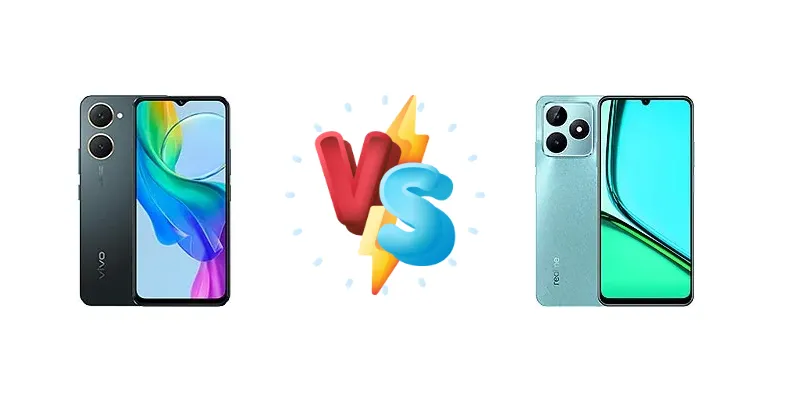
The sub-$200 smartphone market is fiercely competitive, and the vivo Y18t and Realme C51s are two contenders vying for your attention. Both devices leverage the Unisoc T612 chipset, but diverge significantly in charging capabilities and overall user experience. This comparison dissects these differences to determine which phone delivers the best value.
🏆 Quick Verdict
For most users, the Realme C51s emerges as the superior choice. Its 33W fast charging, capable of delivering a 0-50% charge in just 28 minutes, significantly outperforms the vivo Y18t’s slower 15W charging. While both phones share the same processor, the convenience of faster refueling makes the C51s a more practical daily driver.
| Network |
|---|
| 2G bands | GSM 850 / 900 / 1800 / 1900 | GSM 850 / 900 / 1800 / 1900 |
| 3G bands | HSDPA 850 / 900 / 2100 | HSDPA 900 / 2100 |
| 4G bands | 1, 3, 5, 8, 38, 40, 41 | 1, 3, 5, 8, 38, 40 |
| Speed | HSPA, LTE | HSPA, LTE |
| Technology | GSM / HSPA / LTE | GSM / HSPA / LTE |
| Launch |
|---|
| Announced | 2024, November 12 | 2024, March 15 |
| Status | Available. Released 2024, November 12 | Available. Released 2024, March 15 |
| Body |
|---|
| Build | Glass front, plastic frame, plastic back | Glass front, plastic frame, plastic back |
| Dimensions | 163.6 x 75.6 x 8.4 mm (6.44 x 2.98 x 0.33 in) | 167.2 x 76.7 x 7.5 mm (6.58 x 3.02 x 0.30 in) |
| SIM | Nano-SIM + Nano-SIM | Nano-SIM + Nano-SIM |
| Weight | 185 g (6.53 oz) | 182 g (6.42 oz) |
| Display |
|---|
| Resolution | 720 x 1612 pixels, 20:9 ratio (~269 ppi density) | 720 x 1600 pixels, 20:9 ratio (~260 ppi density) |
| Size | 6.56 inches, 103.4 cm2 (~83.6% screen-to-body ratio) | 6.74 inches, 109.7 cm2 (~85.5% screen-to-body ratio) |
| Type | IPS LCD, 90Hz, 840 nits (HBM) | IPS LCD, 90Hz, 560 nits (peak) |
| Platform |
|---|
| CPU | Octa-core (2x1.8 GHz Cortex-A75 & 6x1.8 GHz Cortex-A55) | Octa-core (2x1.8 GHz Cortex-A75 & 6x1.8 GHz Cortex-A55) |
| Chipset | Unisoc T612 (12 nm) | Unisoc Tiger T612 (12 nm) |
| GPU | Mali-G57 MP1 | Mali-G57 |
| OS | Android 14, Funtouch 14 | Android 13, Realme UI |
| Memory |
|---|
| Card slot | microSDXC (dedicated slot) | microSDXC (dedicated slot) |
| Internal | 128GB 4GB RAM | 128GB 6GB RAM |
| Main Camera |
|---|
| Features | LED flash, panorama | LED flash, HDR, panorama |
| Single | 50 MP, f/1.8, (wide), PDAF
Auxiliary lens | 50 MP, f/1.8, 27mm (wide), 1/2.76", 0.64µm, PDAF
Auxiliary lens |
| Video | 1080p@30fps | 1080p@30fps |
| Selfie camera |
|---|
| Features | - | HDR |
| Single | 8 MP, f/2.0, (wide) | 5 MP, f/2.2, 28mm (wide), 1/5.0", 1.12µm |
| Video | Yes | 720p@30fps |
| Sound |
|---|
| 35mm jack | Yes | Yes |
| Loudspeaker | Yes | Yes |
| Comms |
|---|
| Bluetooth | 5.2, A2DP, LE | 5.0, A2DP, LE |
| NFC | No | Yes, 360˚ (market/region dependent) |
| Positioning | GPS, GALILEO, GLONASS, BDS, QZSS | GPS, GLONASS, GALILEO |
| Radio | FM radio | Unspecified |
| USB | USB Type-C 2.0, OTG | USB Type-C |
| WLAN | Wi-Fi 802.11 a/b/g/n/ac, dual-band | Wi-Fi 802.11 a/b/g/n/ac, dual-band |
| Features |
|---|
| Sensors | Accelerometer, proximity, compass | Fingerprint (side-mounted), accelerometer, gyro, proximity, compass |
| Battery |
|---|
| Charging | 15W wired | 33W wired, 0-50% in 28 min |
| Type | Li-Ion 5000 mAh | 5000 mAh |
| Misc |
|---|
| Colors | Space Black, Gem Green | Shiny Green, Mighty Black |
| Models | - | RMX3765 |
| Price | About 110 EUR | About 100 EUR |
vivo Y18t
- Potentially simpler software experience (vivo's Funtouch OS is often less feature-rich)
- May offer a more understated design aesthetic
- Competitive price point
- Significantly slower 15W charging
- Unspecified battery capacity
- Likely limited camera performance
Realme C51s
- 33W fast charging (0-50% in 28 minutes)
- Faster charging provides greater convenience
- Competitive price point
- Realme UI can be perceived as bloated by some users
- Unspecified battery capacity
- Likely limited camera performance
Display Comparison
Neither vivo nor Realme provide detailed display specifications beyond the basic panel type. Given the price point, both likely utilize LCD panels. The absence of information regarding peak brightness, color gamut coverage, or refresh rates suggests a focus on cost optimization. Bezels are expected to be relatively substantial on both devices, typical for this segment. Color accuracy is likely to be standard, prioritizing vibrancy over absolute fidelity.
Camera Comparison
Camera details are sparse. Both phones likely feature a multi-camera setup, but the primary sensor resolution is not specified. The inclusion of a 2MP macro camera on either device is largely a marketing tactic, offering limited practical benefit due to the low resolution and lack of optical image stabilization (OIS). Image processing will likely prioritize scene recognition and software enhancements over raw image quality. Expect acceptable results in well-lit conditions, but performance will degrade significantly in low light.
Performance
Both the vivo Y18t and Realme C51s are powered by the Unisoc Tiger T612 (12nm). This chipset features an octa-core configuration with 2x 1.8 GHz Cortex-A75 cores and 6x 1.8 GHz Cortex-A55 cores. Performance will be largely identical for everyday tasks like browsing, social media, and light multitasking. The 12nm process node suggests moderate thermal efficiency; sustained gaming at high settings may lead to some throttling. RAM configurations are not specified, but the performance will be heavily influenced by the amount of RAM and its speed (LPDDR4X is likely).
Battery Life
Battery capacity is not specified for either device. However, the key differentiator is charging speed. The Realme C51s boasts 33W wired charging, capable of reaching 50% charge in just 28 minutes. This is a significant advantage over the vivo Y18t’s 15W charging. While a larger battery capacity on the Y18t *could* offset the slower charging, the convenience of the C51s’ faster charging is likely to be more valuable for most users. The 33W charging suggests the Realme C51s is designed for users who need to quickly top up their battery throughout the day.
Buying Guide
Buy the vivo Y18t if you prioritize a potentially simpler software experience and are less concerned with rapid charging. It’s a solid option for users who primarily use their phone for basic tasks and don’t mind topping up overnight. Buy the Realme C51s if you value convenience and need a phone that can quickly regain battery life during short breaks, making it ideal for users on the go or those who frequently use power-intensive apps.
Frequently Asked Questions
❓ Does the Unisoc T612 chipset in either phone struggle with demanding games like PUBG Mobile?
The Unisoc T612 is an entry-level chipset. While it can run PUBG Mobile, you'll likely need to lower the graphics settings to medium or low and accept frame rate drops during intense action. It's not designed for high-end gaming.
❓ How does the 33W charging on the Realme C51s compare to other fast charging standards?
33W is a respectable fast charging speed for this price range. It's faster than the 15W charging on the vivo Y18t and comparable to some mid-range phones. While not as fast as 65W or 120W charging found on more expensive devices, it provides a significant convenience boost.
❓ Are there any known overheating issues with the Unisoc T612 chipset in these phones?
The Unisoc T612, being a 12nm chip, can experience some thermal throttling during prolonged intensive tasks like gaming. However, neither phone is expected to overheat to a dangerous level. Managing expectations regarding sustained performance is key.
❓ Is the lack of detailed camera specifications a cause for concern?
Yes, it suggests that camera performance is not a primary focus for either device. Expect acceptable results in good lighting conditions, but don't anticipate flagship-level image quality. The 2MP macro camera is unlikely to be particularly useful.