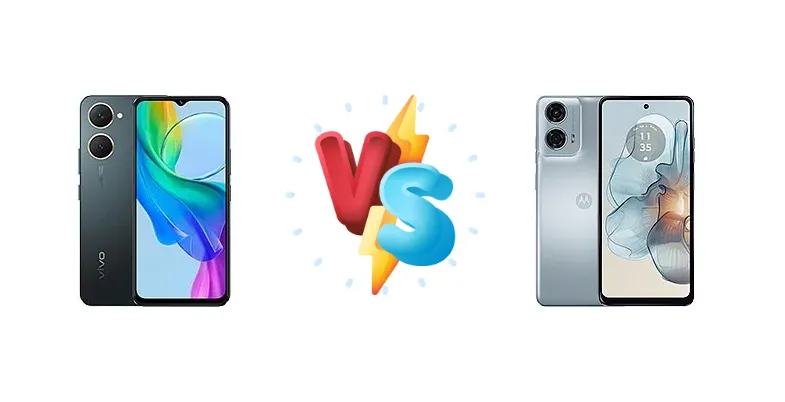
The sub-$200 smartphone market is fiercely competitive. The vivo Y18t and Motorola Moto G24 Power both aim to deliver essential features at an accessible price point, but they take different approaches. The Y18t relies on the Unisoc T612, while the Moto G24 Power opts for the MediaTek Helio G85. This comparison dissects their key differences to help you choose the right device.
🏆 Quick Verdict
For most users, the Motorola Moto G24 Power emerges as the better choice. Its Helio G85 chipset offers a noticeable performance edge over the Y18t’s Unisoc T612, and the significantly faster 30W charging dramatically improves usability. While the Y18t is a capable device, the G24 Power provides more value for the money.
| Network |
|---|
| 2G bands | GSM 850 / 900 / 1800 / 1900 | GSM 850 / 900 / 1800 / 1900 |
| 3G bands | HSDPA 850 / 900 / 2100 | HSDPA 850 / 900 / 1900 / 2100 |
| 4G bands | 1, 3, 5, 8, 38, 40, 41 | 1, 2, 3, 5, 7, 8, 20, 28, 38, 40, 41 |
| Speed | HSPA, LTE | HSPA, LTE |
| Technology | GSM / HSPA / LTE | GSM / HSPA / LTE |
| Launch |
|---|
| Announced | 2024, November 12 | 2024, January 30 |
| Status | Available. Released 2024, November 12 | Available. Released 2024, February 07 |
| Body |
|---|
| Build | Glass front, plastic frame, plastic back | Glass front, plastic back, plastic frame |
| Dimensions | 163.6 x 75.6 x 8.4 mm (6.44 x 2.98 x 0.33 in) | 163.5 x 74.5 x 9 mm (6.44 x 2.93 x 0.35 in) |
| SIM | Nano-SIM + Nano-SIM | Nano-SIM + Nano-SIM |
| Weight | 185 g (6.53 oz) | 197 g (6.95 oz) |
| Display |
|---|
| Resolution | 720 x 1612 pixels, 20:9 ratio (~269 ppi density) | 720 x 1612 pixels, 20:9 ratio (~269 ppi density) |
| Size | 6.56 inches, 103.4 cm2 (~83.6% screen-to-body ratio) | 6.56 inches, 103.4 cm2 (~84.9% screen-to-body ratio) |
| Type | IPS LCD, 90Hz, 840 nits (HBM) | IPS LCD, 90Hz, 537 nits (peak) |
| Platform |
|---|
| CPU | Octa-core (2x1.8 GHz Cortex-A75 & 6x1.8 GHz Cortex-A55) | Octa-core (2x2.0 GHz Cortex-A75 & 6x1.7 GHz Cortex-A55) |
| Chipset | Unisoc T612 (12 nm) | Mediatek MT6769Z Helio G85 (12 nm) |
| GPU | Mali-G57 MP1 | Mali-G52 MC2 |
| OS | Android 14, Funtouch 14 | Android 14 |
| Memory |
|---|
| Card slot | microSDXC (dedicated slot) | microSDXC (dedicated slot) |
| Internal | 128GB 4GB RAM | 128GB 4GB RAM, 128GB 8GB RAM, 256GB 4GB RAM, 256GB 8GB RAM |
| Main Camera |
|---|
| Dual | - | 50 MP, f/1.8 (wide), 0.64µm, PDAF
2 MP (macro) |
| Features | LED flash, panorama | LED flash, HDR, panorama |
| Single | 50 MP, f/1.8, (wide), PDAF
Auxiliary lens | - |
| Video | 1080p@30fps | 1080p@30fps |
| Selfie camera |
|---|
| Single | 8 MP, f/2.0, (wide) | 8 MP, f/2.0, (wide), 1.12µm - International version
16 MP, f/2.5, (wide), 1.0µm - India version |
| Video | Yes | 1080p@30fps |
| Sound |
|---|
| 35mm jack | Yes | Yes |
| Loudspeaker | Yes | Yes, with stereo speakers |
| Comms |
|---|
| Bluetooth | 5.2, A2DP, LE | 5.0, A2DP, LE |
| NFC | No | Yes (market/region dependent) |
| Positioning | GPS, GALILEO, GLONASS, BDS, QZSS | GPS, GALILEO, GLONASS |
| Radio | FM radio | FM radio (market/region dependent) |
| USB | USB Type-C 2.0, OTG | USB Type-C 2.0 |
| WLAN | Wi-Fi 802.11 a/b/g/n/ac, dual-band | Wi-Fi 802.11 a/b/g/n/ac, dual-band |
| Features |
|---|
| Sensors | Accelerometer, proximity, compass | Fingerprint (side-mounted), accelerometer, gyro, proximity, compass |
| Battery |
|---|
| Charging | 15W wired | 30W wired |
| Type | Li-Ion 5000 mAh | 6000 mAh |
| Misc |
|---|
| Colors | Space Black, Gem Green | Glacier Blue, Ink Blue |
| Price | About 110 EUR | € 132.29 |
vivo Y18t
- Potentially more efficient chipset for longer standby time.
- Minimalist software experience (likely).
- Lower price point (potentially).
- Slower processor compared to the Helio G85.
- Significantly slower 15W charging.
- Likely less capable GPU for gaming.
Motorola Moto G24 Power
- Faster MediaTek Helio G85 processor.
- Significantly faster 30W charging.
- Better GPU performance for gaming and video playback.
- Potentially slightly lower standby battery life.
- Motorola’s software can include bloatware.
- May be slightly more expensive.
Display Comparison
Neither device boasts a standout display. Both utilize 12nm chipsets, suggesting similar power constraints impacting display capabilities. While specific display specs (resolution, panel type) are missing, the focus here is on performance. The absence of high refresh rates on either device indicates a cost-saving measure, prioritizing battery life over visual fluidity. Expect standard LCD panels with adequate, but not exceptional, color accuracy.
Camera Comparison
Without detailed camera specifications, a direct comparison is difficult. However, given the price point, both devices likely feature similar sensor configurations, potentially relying heavily on software processing. The absence of Optical Image Stabilization (OIS) on either device suggests image stabilization will be primarily digital, potentially resulting in softer images in low-light conditions. The focus should be on the main sensor's megapixel count and aperture, but without that data, it's reasonable to assume similar image quality. The 2MP macro cameras commonly found in this segment are unlikely to provide significant photographic value.
Performance
The Motorola Moto G24 Power holds a clear advantage in performance. Its MediaTek Helio G85, with a slightly higher clock speed (2.0 GHz vs 1.8 GHz on the Y18t’s Cortex-A75 cores), delivers a measurable boost in CPU performance. Both chipsets utilize the same Cortex-A75 and A55 core configuration, but the G85’s higher clock speed and potentially more efficient GPU translate to smoother multitasking and better gaming performance. The Unisoc T612 is adequate for everyday tasks, but will likely struggle with graphically intensive games or demanding applications. The G85’s GPU is also likely to offer a better experience with video playback and editing.
Battery Life
The Motorola Moto G24 Power’s 30W charging is a game-changer in this price bracket. While the Y18t’s 15W charging is sufficient, it’s significantly slower. This means the G24 Power can replenish its battery much faster, reducing downtime. Although the exact battery capacity of both devices is unknown, the faster charging speed of the G24 Power effectively mitigates any potential capacity disadvantage. A full charge on the Y18t could take over two hours, while the G24 Power could potentially reach 100% in under an hour, a crucial benefit for users who need quick top-ups.
Buying Guide
Buy the vivo Y18t if you prioritize a minimalist software experience and are primarily focused on basic tasks like calling, texting, and light social media use. Its efficiency might translate to slightly better standby battery life. Buy the Motorola Moto G24 Power if you want a phone that can handle more demanding apps, occasional gaming, and benefits from significantly faster charging speeds, making it ideal for users who are always on the go.
Frequently Asked Questions
❓ Will the Motorola Moto G24 Power’s Helio G85 overheat during prolonged gaming sessions?
The Helio G85 is a relatively efficient chipset. While some heat generation is inevitable during gaming, the G85 is generally well-managed. Motorola’s software likely includes thermal throttling mechanisms to prevent overheating and maintain stable performance. However, extended gaming at maximum settings may still result in some performance reduction.
❓ Is the 15W charging on the vivo Y18t slow enough to be a major inconvenience?
Yes, 15W charging is noticeably slower than the 30W charging on the Moto G24 Power. Expect a full charge to take over two hours, which can be frustrating for users who need a quick power boost. If you frequently find yourself needing to charge your phone throughout the day, the Y18t’s slower charging will be a significant drawback.
❓ Can the Motorola Moto G24 Power handle popular games like PUBG Mobile or Call of Duty Mobile?
The Helio G85 in the Moto G24 Power is capable of running PUBG Mobile and Call of Duty Mobile, but you’ll likely need to adjust the graphics settings to medium or low to achieve a smooth and consistent frame rate. Expect playable performance, but don’t anticipate the highest graphical fidelity.