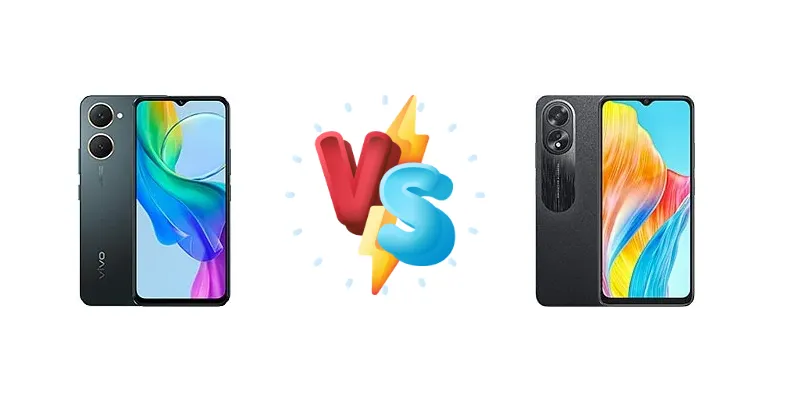
The sub-$150 smartphone market is fiercely competitive. Both the vivo Y18i and Oppo A38 aim to deliver essential features at an accessible price point, but they take different approaches. The Y18i prioritizes a balance of efficiency with its Unisoc chipset, while the A38 leans into slightly more performance with a MediaTek Helio G85 and significantly faster charging.
🏆 Quick Verdict
For most users, the Oppo A38 is the better choice. Its 33W charging, capable of a 50% charge in just 30 minutes, offers a significant convenience advantage over the vivo Y18i’s slower 15W charging. While the performance difference isn't massive, the Helio G85 provides a slight edge in demanding tasks.
| Network |
|---|
| 2G bands | GSM 850 / 900 / 1800 / 1900 | GSM 850 / 900 / 1800 / 1900 |
| 3G bands | HSDPA 850 / 900 / 2100 | HSDPA 850 / 900 / 1700(AWS) / 1900 / 2100 - version 1 |
| 4G bands | 1, 3, 5, 8, 38, 40, 41 | 1, 2, 3, 4, 5, 7, 8, 12, 13, 17, 18, 19, 26, 28, 38, 40, 41, 66 - version 1 |
| Speed | HSPA, LTE | HSPA, LTE |
| Technology | GSM / HSPA / LTE | GSM / HSPA / LTE |
| Launch |
|---|
| Announced | 2024, August 23 | 2023, September 04 |
| Status | Available. Released 2024, August 23 | Available. Released 2023, September |
| Body |
|---|
| Build | Glass front, plastic frame, plastic back | - |
| Dimensions | 163.6 x 75.6 x 8.4 mm (6.44 x 2.98 x 0.33 in) | 163.7 x 75 x 8.2 mm (6.44 x 2.95 x 0.32 in) |
| SIM | Nano-SIM + Nano-SIM | Nano-SIM + Nano-SIM |
| Weight | 185 g (6.53 oz) | 190 g (6.70 oz) |
| Display |
|---|
| Resolution | 720 x 1612 pixels, 20:9 ratio (~269 ppi density) | 720 x 1612 pixels, 20:9 ratio (~269 ppi density) |
| Size | 6.56 inches, 103.4 cm2 (~83.6% screen-to-body ratio) | 6.56 inches, 103.4 cm2 (~84.2% screen-to-body ratio) |
| Type | IPS LCD, 90Hz, 528 nits (HBM) | IPS LCD, 90Hz, 720 nits (peak) |
| Platform |
|---|
| CPU | Octa-core (2x1.8 GHz Cortex-A75 & 6x1.8 GHz Cortex-A55) | Octa-core (2x2.0 GHz Cortex-A75 & 6x1.8 GHz Cortex-A55) |
| Chipset | Unisoc T612 (12 nm) | Mediatek MT6769 Helio G85 (12 nm) |
| GPU | Mali-G57 MP1 | Mali-G52 MC2 |
| OS | Android 14, Funtouch 14 | Android 13, upgradable to Android 15, ColorOS 15 |
| Memory |
|---|
| Card slot | microSDXC (dedicated slot) | microSDXC |
| Internal | 64GB 4GB RAM | 128GB 4GB RAM, 128GB 6GB RAM |
| Main Camera |
|---|
| Dual | - | 50 MP, f/1.8, (wide), PDAF
Auxiliary lens |
| Features | LED flash, panorama | LED flash, HDR, panorama |
| Single | 13 MP, f/2.2, (wide), PDAF
Auxiliary lens | - |
| Video | 1080p@30fps | 1080p@30fps |
| Selfie camera |
|---|
| Single | 5 MP, f/2.2, (wide) | 5 MP, f/2.2, (wide) |
| Video | Yes | 1080p@30fps |
| Sound |
|---|
| 35mm jack | Yes | Yes |
| Loudspeaker | Yes | Yes |
| Comms |
|---|
| Bluetooth | 5.0, A2DP, LE | 5.3, A2DP, LE, aptX HD |
| NFC | No | Yes (market/region dependent) |
| Positioning | GPS, GALILEO, GLONASS, BDS, QZSS | GPS, GALILEO, GLONASS, BDS, QZSS |
| Radio | FM radio | No |
| USB | USB Type-C 2.0, OTG | USB Type-C 2.0, OTG |
| WLAN | Wi-Fi 802.11 a/b/g/n/ac, dual-band | Wi-Fi 802.11 a/b/g/n/ac, dual-band |
| Features |
|---|
| Sensors | Accelerometer, proximity | Fingerprint (side-mounted), accelerometer, proximity, compass |
| Battery |
|---|
| Charging | 15W wired | 33W wired, PD, 50% in 30 min |
| Type | Li-Ion 5000 mAh | Li-Po 5000 mAh |
| Misc |
|---|
| Colors | Space Black, Gem Green | Glowing Black, Glowing Gold |
| Models | V2414 | CPH2579 |
| Price | About 90 EUR | € 159.99 / ₹ 10,790 |
| SAR | 0.69 W/kg (head) | - |
vivo Y18i
- Potentially better battery efficiency due to Unisoc T612's optimization.
- Competitive price point.
- Reliable performance for basic tasks.
- Slow 15W charging.
- Less powerful chipset compared to the Oppo A38.
Oppo A38
- Faster 33W charging with PD support.
- Slightly more powerful MediaTek Helio G85 chipset.
- Potentially better image processing.
- May experience slightly faster battery drain due to the more powerful chipset.
- Potentially slightly higher price.
Display Comparison
Neither device boasts a standout display. Both likely utilize LCD panels, common in this price bracket. Without specific brightness data, it's reasonable to assume both offer adequate visibility indoors, but may struggle in direct sunlight. The focus here isn't on display quality, but rather on core functionality and battery conservation.
Camera Comparison
Camera performance is likely to be similar, relying heavily on software processing. Both devices likely feature a primary camera and depth sensor, with the Oppo A38 potentially offering slightly better image quality due to MediaTek’s image signal processor (ISP). The absence of detailed sensor information suggests both utilize budget sensors, and the inclusion of a 2MP macro lens on either device is largely for marketing purposes and offers limited practical benefit. Expect acceptable results in good lighting conditions, but struggles in low light.
Performance
The core difference lies in the chipsets. The Oppo A38’s MediaTek Helio G85, with its 2.0 GHz Cortex-A75 cores, offers a modest clock speed advantage over the vivo Y18i’s Unisoc T612 (1.8 GHz Cortex-A75). While both utilize the same core architecture, the higher clock speed translates to slightly snappier performance in applications and a small uplift in gaming. However, the Unisoc T612’s 12nm process is optimized for efficiency, potentially mitigating the performance gap in sustained workloads. Both phones likely pair their chipsets with 4GB of RAM, limiting multitasking capabilities.
Battery Life
While battery capacity isn't specified, both devices likely house a 5000mAh battery, standard for this segment. The critical difference is charging speed. The Oppo A38’s 33W charging with PD support is a significant advantage, allowing for a 50% charge in just 30 minutes. The vivo Y18i’s 15W charging is considerably slower, requiring significantly more time to reach a full charge. This difference impacts daily usability, especially for users who frequently need to top up their battery.
Buying Guide
Buy the vivo Y18i if you prioritize long-term efficiency and are less concerned with quick top-ups. Its Unisoc T612 chipset is optimized for power efficiency, potentially leading to slightly better battery life during moderate use. Buy the Oppo A38 if you value faster charging and a small performance boost for gaming or multitasking. The 33W charging is a game-changer for users who dislike being tethered to a wall for extended periods.
Frequently Asked Questions
❓ Will the Oppo A38's Helio G85 handle popular games like PUBG Mobile smoothly?
The Helio G85 is capable of running PUBG Mobile at medium settings with acceptable frame rates. However, don't expect a high-end gaming experience. Lowering graphics settings will be necessary for smoother gameplay, and sustained performance may be limited by thermal throttling.
❓ How long does it *really* take to fully charge the vivo Y18i with its 15W charger?
Expect a full charge from 0% to 100% on the vivo Y18i to take approximately 2.5 to 3 hours with the included 15W charger. This is significantly slower than the Oppo A38, making it less convenient for users who need a quick power boost.
❓ Is the camera on either phone good enough for casual social media use?
Yes, both phones are adequate for casual social media photography in good lighting conditions. However, don't expect professional-quality results. The image processing will likely smooth out details and may struggle with dynamic range. Avoid using the 2MP macro lens, as its image quality will be significantly lower.
❓ Does the Oppo A38 support reverse charging to charge other devices?
Based on available information, the Oppo A38 does not explicitly advertise reverse charging capabilities. It's unlikely to support this feature, as it's uncommon in this price segment.