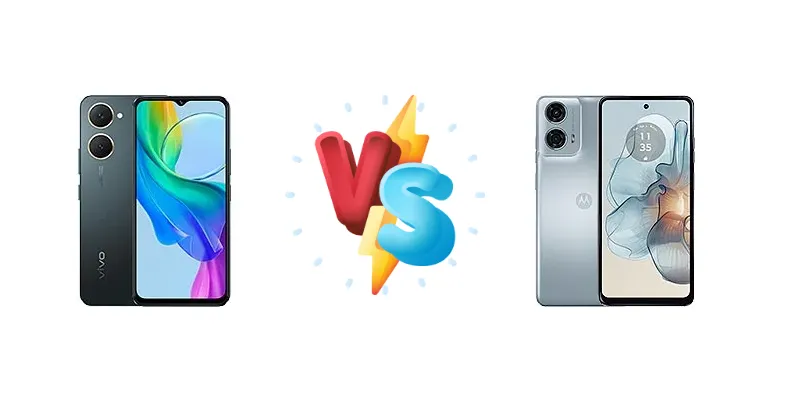
The sub-$150 smartphone market is fiercely competitive. The vivo Y18i and Motorola Moto G24 Power both aim to deliver essential features at an accessible price point, but they take different approaches. The Y18i focuses on a streamlined experience with a Unisoc chipset, while the Moto G24 Power prioritizes faster charging and a slightly more powerful MediaTek processor. This comparison will dissect their key differences to help you choose the right device.
🏆 Quick Verdict
For the average user prioritizing quick top-ups and a bit more processing headroom, the Motorola Moto G24 Power is the better choice. Its 30W charging significantly reduces downtime, and the Helio G85 offers a noticeable performance edge over the Unisoc T612, making it more suitable for casual gaming and multitasking.
| Network |
|---|
| 2G bands | GSM 850 / 900 / 1800 / 1900 | GSM 850 / 900 / 1800 / 1900 |
| 3G bands | HSDPA 850 / 900 / 2100 | HSDPA 850 / 900 / 1900 / 2100 |
| 4G bands | 1, 3, 5, 8, 38, 40, 41 | 1, 2, 3, 5, 7, 8, 20, 28, 38, 40, 41 |
| Speed | HSPA, LTE | HSPA, LTE |
| Technology | GSM / HSPA / LTE | GSM / HSPA / LTE |
| Launch |
|---|
| Announced | 2024, August 23 | 2024, January 30 |
| Status | Available. Released 2024, August 23 | Available. Released 2024, February 07 |
| Body |
|---|
| Build | Glass front, plastic frame, plastic back | Glass front, plastic back, plastic frame |
| Dimensions | 163.6 x 75.6 x 8.4 mm (6.44 x 2.98 x 0.33 in) | 163.5 x 74.5 x 9 mm (6.44 x 2.93 x 0.35 in) |
| SIM | Nano-SIM + Nano-SIM | Nano-SIM + Nano-SIM |
| Weight | 185 g (6.53 oz) | 197 g (6.95 oz) |
| Display |
|---|
| Resolution | 720 x 1612 pixels, 20:9 ratio (~269 ppi density) | 720 x 1612 pixels, 20:9 ratio (~269 ppi density) |
| Size | 6.56 inches, 103.4 cm2 (~83.6% screen-to-body ratio) | 6.56 inches, 103.4 cm2 (~84.9% screen-to-body ratio) |
| Type | IPS LCD, 90Hz, 528 nits (HBM) | IPS LCD, 90Hz, 537 nits (peak) |
| Platform |
|---|
| CPU | Octa-core (2x1.8 GHz Cortex-A75 & 6x1.8 GHz Cortex-A55) | Octa-core (2x2.0 GHz Cortex-A75 & 6x1.7 GHz Cortex-A55) |
| Chipset | Unisoc T612 (12 nm) | Mediatek MT6769Z Helio G85 (12 nm) |
| GPU | Mali-G57 MP1 | Mali-G52 MC2 |
| OS | Android 14, Funtouch 14 | Android 14 |
| Memory |
|---|
| Card slot | microSDXC (dedicated slot) | microSDXC (dedicated slot) |
| Internal | 64GB 4GB RAM | 128GB 4GB RAM, 128GB 8GB RAM, 256GB 4GB RAM, 256GB 8GB RAM |
| Main Camera |
|---|
| Dual | - | 50 MP, f/1.8 (wide), 0.64µm, PDAF
2 MP (macro) |
| Features | LED flash, panorama | LED flash, HDR, panorama |
| Single | 13 MP, f/2.2, (wide), PDAF
Auxiliary lens | - |
| Video | 1080p@30fps | 1080p@30fps |
| Selfie camera |
|---|
| Single | 5 MP, f/2.2, (wide) | 8 MP, f/2.0, (wide), 1.12µm - International version
16 MP, f/2.5, (wide), 1.0µm - India version |
| Video | Yes | 1080p@30fps |
| Sound |
|---|
| 35mm jack | Yes | Yes |
| Loudspeaker | Yes | Yes, with stereo speakers |
| Comms |
|---|
| Bluetooth | 5.0, A2DP, LE | 5.0, A2DP, LE |
| NFC | No | Yes (market/region dependent) |
| Positioning | GPS, GALILEO, GLONASS, BDS, QZSS | GPS, GALILEO, GLONASS |
| Radio | FM radio | FM radio (market/region dependent) |
| USB | USB Type-C 2.0, OTG | USB Type-C 2.0 |
| WLAN | Wi-Fi 802.11 a/b/g/n/ac, dual-band | Wi-Fi 802.11 a/b/g/n/ac, dual-band |
| Features |
|---|
| Sensors | Accelerometer, proximity | Fingerprint (side-mounted), accelerometer, gyro, proximity, compass |
| Battery |
|---|
| Charging | 15W wired | 30W wired |
| Type | Li-Ion 5000 mAh | 6000 mAh |
| Misc |
|---|
| Colors | Space Black, Gem Green | Glacier Blue, Ink Blue |
| Models | V2414 | - |
| Price | About 90 EUR | € 132.29 |
| SAR | 0.69 W/kg (head) | - |
vivo Y18i
- Potentially more stable software experience (depending on vivo’s skin)
- Simple and straightforward user interface
- Lower price point (potentially)
- Slower charging speed (15W)
- Less powerful processor (Unisoc T612)
- Limited gaming performance
Motorola Moto G24 Power
- Faster charging (30W)
- More powerful processor (Helio G85)
- Better multitasking capabilities
- Motorola’s software can be bloated with pre-installed apps
- Potential for more aggressive background app management
Display Comparison
Neither device boasts a standout display. Both likely utilize LCD panels, common in this price bracket. While specific details like peak brightness and color gamut coverage are unavailable, the focus here is on functionality over fidelity. Bezels are expected to be noticeable on both, and we anticipate similar viewing angles. The absence of high refresh rates is standard for this segment.
Camera Comparison
Camera performance is likely to be similar, relying heavily on software processing. Without detailed sensor information, it’s difficult to make definitive claims. However, the G85’s image signal processor (ISP) is generally more capable than the one found in the T612, potentially leading to better dynamic range and noise reduction. Expect both phones to struggle in low-light conditions. The inclusion of a 2MP macro lens on both devices is largely a marketing tactic, offering limited practical benefit due to the small sensor size and lack of autofocus.
Performance
The core difference lies in the chipsets. The Motorola Moto G24 Power’s MediaTek Helio G85 (12nm) has a slight clock speed advantage in its Cortex-A75 cores (2.0 GHz vs 1.8 GHz on the vivo Y18i’s Unisoc T612). This, combined with potentially more optimized GPU drivers, translates to a smoother experience in graphically demanding tasks. While both use the same Cortex-A75/A55 architecture, the G85’s higher clock speeds and potentially more efficient design will result in faster app loading times and better multitasking. The Y18i’s Unisoc T612 is still capable for everyday tasks, but will show its limitations more readily under sustained load.
Battery Life
The Motorola Moto G24 Power’s 30W charging is a significant advantage. While battery capacity isn’t specified, the faster charging will drastically reduce the time spent tethered to a wall outlet. The vivo Y18i’s 15W charging is comparatively slow, requiring considerably longer to reach a full charge. This difference is crucial for users who frequently need to top up their battery throughout the day. The actual battery life will depend on usage patterns, but the G24 Power’s faster charging provides a more convenient experience.
Buying Guide
Buy the vivo Y18i if you prioritize simplicity and a consistently stable, if less powerful, experience. It’s ideal for users who primarily need a phone for calls, messaging, and light social media use. Buy the Motorola Moto G24 Power if you value faster charging speeds and a slightly more responsive user experience, particularly if you frequently find yourself needing to quickly replenish the battery or enjoy occasional gaming sessions.
Frequently Asked Questions
❓ Will the Motorola Moto G24 Power get noticeably warmer during extended gaming sessions compared to the vivo Y18i?
The Helio G85 is a more powerful chip, and therefore will generate more heat under load. While Motorola likely implements thermal throttling, you can expect some degree of warming during prolonged gaming. The Y18i’s Unisoc T612 will run cooler, but at the cost of performance.
❓ Does the 30W charging on the Moto G24 Power require a specific charger, or does it come with one in the box?
Motorola typically includes a charger in the box, but it's crucial to verify this with the retailer. Using a lower wattage charger will significantly increase charging times. To take full advantage of the 30W charging, ensure you're using a compatible power adapter.
❓ How does the software experience differ between the two phones, and which one is likely to receive more updates?
The vivo Y18i likely runs Funtouch OS, known for its customization options but also potential for bloatware. The Moto G24 Power runs a near-stock Android experience with Motorola’s additions, which is generally cleaner. Motorola’s update commitment is typically better than vivo’s in this price segment, meaning the G24 Power is more likely to receive security patches and potentially even a major Android version update.