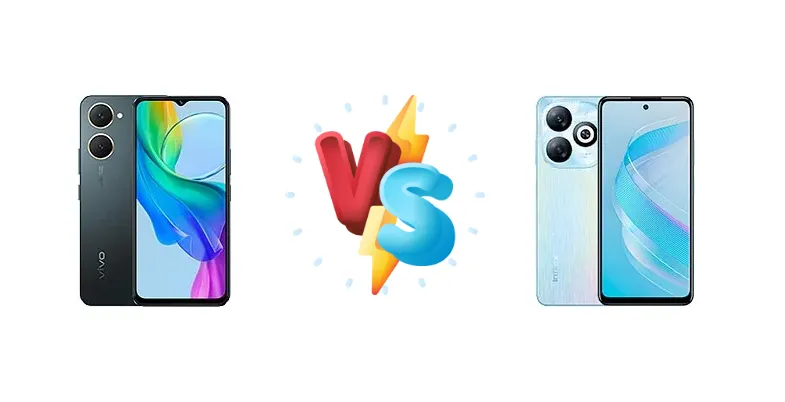
The sub-$150 smartphone market is fiercely competitive. Both the vivo Y18i and the Infinix Smart 8 Pro aim to deliver essential smartphone functionality at an accessible price point. However, they take different approaches to achieving this, with the Y18i leveraging a Unisoc chipset and the Smart 8 Pro opting for MediaTek. This comparison dissects their key specifications to determine which device offers the best value for budget-conscious consumers.
🏆 Quick Verdict
For the average user prioritizing consistent performance in everyday tasks, the vivo Y18i emerges as the better choice. Its Unisoc T612 chipset, featuring Cortex-A75 cores, provides a noticeable advantage in responsiveness compared to the Infinix Smart 8 Pro’s Helio G36, despite the latter’s higher clock speed on its less efficient cores. While the Smart 8 Pro offers reverse wired charging, the Y18i’s slightly more refined processor experience makes it the winner.
| Network |
|---|
| 2G bands | GSM 850 / 900 / 1800 / 1900 | GSM 850 / 900 / 1800 / 1900 |
| 3G bands | HSDPA 850 / 900 / 2100 | HSDPA 850 / 900 / 1700(AWS) / 1900 / 2100 |
| 4G bands | 1, 3, 5, 8, 38, 40, 41 | 1, 2, 3, 4, 5, 7, 8, 20, 28, 38, 41, 40 |
| Speed | HSPA, LTE | HSPA, LTE |
| Technology | GSM / HSPA / LTE | GSM / HSPA / LTE |
| Launch |
|---|
| Announced | 2024, August 23 | 2024, January 29 |
| Status | Available. Released 2024, August 23 | Available. Released 2024, February |
| Body |
|---|
| Build | Glass front, plastic frame, plastic back | Glass front, plastic back, plastic frame |
| Dimensions | 163.6 x 75.6 x 8.4 mm (6.44 x 2.98 x 0.33 in) | 163.6 x 75.6 x 8.5 mm (6.44 x 2.98 x 0.33 in) |
| SIM | Nano-SIM + Nano-SIM | Nano-SIM + Nano-SIM |
| Weight | 185 g (6.53 oz) | 189 g (6.67 oz) |
| Display |
|---|
| Resolution | 720 x 1612 pixels, 20:9 ratio (~269 ppi density) | 720 x 1612 pixels, 20:9 ratio (~267 ppi density) |
| Size | 6.56 inches, 103.4 cm2 (~83.6% screen-to-body ratio) | 6.6 inches, 104.6 cm2 (~84.6% screen-to-body ratio) |
| Type | IPS LCD, 90Hz, 528 nits (HBM) | IPS LCD, 90Hz, 500 nits (peak) |
| Platform |
|---|
| CPU | Octa-core (2x1.8 GHz Cortex-A75 & 6x1.8 GHz Cortex-A55) | Octa-core (4x2.2 GHz Cortex-A53 & 4x1.6 GHz Cortex-A53) |
| Chipset | Unisoc T612 (12 nm) | Mediatek Helio G36 (12 nm) |
| GPU | Mali-G57 MP1 | PowerVR GE8320 |
| OS | Android 14, Funtouch 14 | Android 13 (Go edition), XOS 13 |
| Memory |
|---|
| Card slot | microSDXC (dedicated slot) | microSDXC (dedicated slot) |
| Internal | 64GB 4GB RAM | 64GB 4GB RAM, 128GB 8GB RAM, 256GB 4GB RAM |
| Main Camera |
|---|
| Features | LED flash, panorama | Ring-LED flash, HDR, panorama |
| Single | 13 MP, f/2.2, (wide), PDAF
Auxiliary lens | 50 MP, f/1.9, (wide), AF
Auxiliary lens |
| Video | 1080p@30fps | 1080p@30fps |
| Selfie camera |
|---|
| Single | 5 MP, f/2.2, (wide) | 8 MP, f/2.0, (wide) |
| Video | Yes | Yes |
| Sound |
|---|
| 35mm jack | Yes | Yes |
| Loudspeaker | Yes | Yes |
| Comms |
|---|
| Bluetooth | 5.0, A2DP, LE | 5.0, A2DP, LE |
| NFC | No | No |
| Positioning | GPS, GALILEO, GLONASS, BDS, QZSS | GPS |
| Radio | FM radio | FM radio |
| USB | USB Type-C 2.0, OTG | USB Type-C 2.0, OTG |
| WLAN | Wi-Fi 802.11 a/b/g/n/ac, dual-band | Wi-Fi 802.11 a/b/g/n/ac, dual-band |
| Features |
|---|
| Sensors | Accelerometer, proximity | Fingerprint (side-mounted), accelerometer, gyro, proximity, compass |
| Battery |
|---|
| Charging | 15W wired | 10W wired
Reverse wired |
| Type | Li-Ion 5000 mAh | 5000 mAh |
| Misc |
|---|
| Colors | Space Black, Gem Green | Rainbow Blue, Galaxy White, Shiny Gold, Timber Black |
| Models | V2414 | X6525B |
| Price | About 90 EUR | About 100 EUR |
| SAR | 0.69 W/kg (head) | - |
vivo Y18i
- More responsive processor due to Cortex-A75 cores
- Faster 15W wired charging
- Potentially better image processing
- Lacks reverse wired charging
- Display specs are likely basic
Infinix Smart 8 Pro
- Reverse wired charging for accessories
- Potentially larger battery capacity
- Competitive price point
- Less efficient processor architecture (Cortex-A53)
- Slower 10W wired charging
Display Comparison
Neither device boasts a standout display. Both utilize 12nm chipsets, suggesting similar power constraints impacting display capabilities. While specific display specs (resolution, panel type) are missing, the focus here is on performance. The absence of high refresh rates or advanced features like LTPO on either device is typical for this price bracket. Bezels are likely to be substantial on both, and color accuracy will be adequate but not exceptional. The display experience will likely be similar on both devices, serving primarily for content consumption and basic interaction.
Camera Comparison
Both phones likely feature basic camera setups geared towards casual photography. Without specific sensor details, it’s safe to assume both will rely on primary sensors with modest resolutions. The Infinix Smart 8 Pro’s inclusion of reverse wired charging suggests a larger battery, potentially allowing for more sophisticated image processing. However, the Y18i’s processor might offer slightly better image signal processing (ISP) capabilities. The presence of a 2MP macro camera on either device is largely a marketing gimmick and shouldn’t be a deciding factor. Expect acceptable image quality in good lighting conditions, but struggles in low light.
Performance
The core difference lies in the chipset architecture. The vivo Y18i’s Unisoc T612 features two Cortex-A75 cores clocked at 1.8 GHz, paired with six Cortex-A55 cores. This configuration provides a performance boost in single-core tasks and better overall responsiveness compared to the Infinix Smart 8 Pro’s MediaTek Helio G36. The G36 utilizes four Cortex-A53 cores at 2.2 GHz and another four at 1.6 GHz. While the higher clock speed *sounds* better, the A53 architecture is less efficient and offers lower IPC (Instructions Per Clock) than the A75. This translates to the Y18i handling app launches and multitasking more fluidly. The 12nm process node is shared, so thermal throttling shouldn't be a major concern for either, but the Y18i will likely maintain performance for longer under sustained load.
Battery Life
The Infinix Smart 8 Pro’s 10W charging is slower than the vivo Y18i’s 15W charging. While the Smart 8 Pro offers reverse wired charging – a useful feature for topping up accessories – the Y18i will reach a full charge faster. The actual battery capacity is unknown for both, but the inclusion of reverse charging on the Smart 8 Pro suggests a slightly larger capacity to accommodate power output. However, the faster charging speed of the Y18i will likely result in less time tethered to a wall socket for most users.
Buying Guide
Buy the vivo Y18i if you need a phone that feels responsive during daily use, such as browsing, social media, and light multitasking. Its processor architecture is better suited for handling these tasks smoothly. Buy the Infinix Smart 8 Pro if you prioritize having the flexibility of reverse wired charging to top up accessories, and are willing to accept slightly less consistent performance in exchange. It's a good option for users who frequently share power with friends or use wireless earbuds.
Frequently Asked Questions
❓ Will the Helio G36 in the Infinix Smart 8 Pro struggle with popular apps like WhatsApp and Facebook?
While the Helio G36 can run these apps, you might experience occasional lag or slowdowns when multitasking or switching between apps quickly. The Unisoc T612 in the vivo Y18i offers a smoother experience for these common tasks due to its more efficient processor cores.
❓ How long will it take to fully charge the vivo Y18i with the 15W charger?
Assuming a typical battery capacity of around 5000mAh (common in this segment), the vivo Y18i should fully charge from 0% to 100% in approximately 2.5 to 3 hours. This is significantly faster than the Infinix Smart 8 Pro’s 10W charging.
❓ Is the reverse wired charging on the Infinix Smart 8 Pro useful for charging a smartwatch?
Yes, the reverse wired charging can be used to top up accessories like smartwatches or wireless earbuds. However, the charging speed will be slow, and it will drain the phone’s battery considerably. It’s best suited for emergency situations rather than regular charging.
❓ Can either of these phones handle basic mobile gaming like PUBG Mobile or Call of Duty Mobile?
Both phones can *run* these games, but you’ll need to lower the graphics settings to the lowest possible levels and accept lower frame rates. The Helio G36 has a slight edge in GPU performance, but neither chipset is designed for demanding gaming experiences.