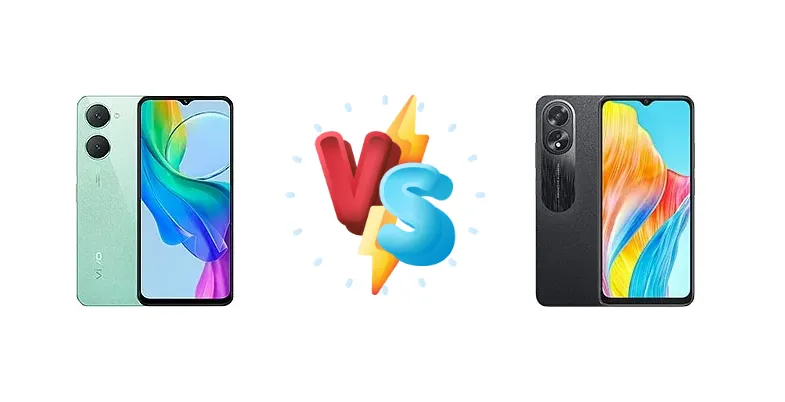
The vivo Y18e and Oppo A38 represent a fiercely competitive segment of the smartphone market – the sub-$150 arena. Both devices center around the Mediatek Helio G85 chipset, suggesting similar performance on paper. However, a critical difference in charging technology and subtle variations in design and features necessitate a deeper dive to determine which phone offers the best value.
🏆 Quick Verdict
For most users, the Oppo A38 is the superior choice. While both phones share the same Helio G85 processor, the A38’s 33W fast charging, capable of delivering a 50% charge in just 30 minutes, significantly improves usability and reduces downtime compared to the Y18e’s slower 15W charging.
| Network |
|---|
| 2G bands | GSM 850 / 900 / 1800 / 1900 | GSM 850 / 900 / 1800 / 1900 |
| 3G bands | HSDPA 850 / 900 / 2100 | HSDPA 850 / 900 / 1700(AWS) / 1900 / 2100 - version 1 |
| 4G bands | 1, 3, 5, 8, 38, 40, 41 | 1, 2, 3, 4, 5, 7, 8, 12, 13, 17, 18, 19, 26, 28, 38, 40, 41, 66 - version 1 |
| Speed | HSPA, LTE | HSPA, LTE |
| Technology | GSM / HSPA / LTE | GSM / HSPA / LTE |
| Launch |
|---|
| Announced | 2024, April 29 | 2023, September 04 |
| Status | Available. Released 2024, May | Available. Released 2023, September |
| Body |
|---|
| Build | Glass front, plastic frame, plastic back | - |
| Dimensions | 163.6 x 75.6 x 8.4 mm (6.44 x 2.98 x 0.33 in) | 163.7 x 75 x 8.2 mm (6.44 x 2.95 x 0.32 in) |
| SIM | Nano-SIM + Nano-SIM | Nano-SIM + Nano-SIM |
| Weight | 185 g (6.53 oz) | 190 g (6.70 oz) |
| Display |
|---|
| Resolution | 720 x 1612 pixels, 20:9 ratio (~269 ppi density) | 720 x 1612 pixels, 20:9 ratio (~269 ppi density) |
| Size | 6.56 inches, 103.4 cm2 (~83.6% screen-to-body ratio) | 6.56 inches, 103.4 cm2 (~84.2% screen-to-body ratio) |
| Type | IPS LCD, 90Hz, 528 nits (HBM) | IPS LCD, 90Hz, 720 nits (peak) |
| Platform |
|---|
| CPU | Octa-core (2x2.0 GHz Cortex-A75 & 6x1.8 GHz Cortex-A55) | Octa-core (2x2.0 GHz Cortex-A75 & 6x1.8 GHz Cortex-A55) |
| Chipset | Mediatek Helio G85 (12 nm) | Mediatek MT6769 Helio G85 (12 nm) |
| GPU | Mali-G52 MC2 | Mali-G52 MC2 |
| OS | Android 14, Funtouch 14 | Android 13, upgradable to Android 15, ColorOS 15 |
| Memory |
|---|
| Card slot | microSDXC (dedicated slot) | microSDXC |
| Internal | 64GB 4GB RAM | 128GB 4GB RAM, 128GB 6GB RAM |
| Main Camera |
|---|
| Dual | - | 50 MP, f/1.8, (wide), PDAF
Auxiliary lens |
| Features | LED flash, panorama | LED flash, HDR, panorama |
| Single | 13 MP, f/2.2, (wide), PDAF
Auxiliary lens | - |
| Video | 1080p@30fps | 1080p@30fps |
| Selfie camera |
|---|
| Single | 5 MP, f/2.2, (wide) | 5 MP, f/2.2, (wide) |
| Video | Yes | 1080p@30fps |
| Sound |
|---|
| 35mm jack | Yes | Yes |
| Loudspeaker | Yes | Yes |
| Comms |
|---|
| Bluetooth | 5.0, A2DP, LE | 5.3, A2DP, LE, aptX HD |
| NFC | No | Yes (market/region dependent) |
| Positioning | GPS, GALILEO, GLONASS, BDS, QZSS | GPS, GALILEO, GLONASS, BDS, QZSS |
| Radio | FM radio | No |
| USB | USB Type-C 2.0, OTG | USB Type-C 2.0, OTG |
| WLAN | Wi-Fi 802.11 a/b/g/n/ac, dual-band | Wi-Fi 802.11 a/b/g/n/ac, dual-band |
| Features |
|---|
| Sensors | Accelerometer, proximity, compass | Fingerprint (side-mounted), accelerometer, proximity, compass |
| Battery |
|---|
| Charging | 15W wired | 33W wired, PD, 50% in 30 min |
| Type | Li-Ion 5000 mAh | Li-Po 5000 mAh |
| Misc |
|---|
| Colors | Space Black, Gem Green | Glowing Black, Glowing Gold |
| Models | V2350 | CPH2579 |
| Price | - | € 159.99 / ₹ 10,790 |
| SAR | 0.98 W/kg (head) 0.84 W/kg (body) | - |
vivo Y18e
- Potentially lower price point
- Functional for basic smartphone tasks
- Reliable Mediatek Helio G85 performance
- Slow 15W charging
- Likely limited battery capacity
- Basic camera system
Oppo A38
- 33W fast charging with PD support
- 50% charge in 30 minutes
- More convenient for on-the-go users
- May be slightly more expensive
- Similar camera performance to Y18e
- Relies on the same Helio G85 chipset
Display Comparison
Neither vivo nor Oppo provide detailed display specifications beyond the basic panel type. Given the price point, both likely utilize LCD panels. The absence of information regarding peak brightness, color gamut coverage, or refresh rates suggests a focus on cost optimization. Bezels are expected to be relatively substantial on both devices, typical for this segment. Color accuracy is likely to be standard, prioritizing power efficiency over professional-grade color reproduction.
Camera Comparison
Camera details are sparse for both devices. While both likely feature a multi-camera setup, the emphasis is likely on the main sensor. Without specific sensor size or aperture information, it’s difficult to assess image quality. The inclusion of a 2MP macro camera on both is largely a marketing tactic, offering limited practical benefit due to the low resolution and fixed focus. Image processing will likely prioritize scene optimization and basic enhancements over advanced features like HDR or night mode. Expect acceptable results in well-lit conditions, but image quality will degrade significantly in low light.
Performance
Both the vivo Y18e and Oppo A38 are powered by the Mediatek Helio G85 (12 nm) chipset, featuring an octa-core CPU configuration with 2x2.0 GHz Cortex-A75 and 6x1.8 GHz Cortex-A55 cores. This means CPU performance will be virtually identical between the two. The GPU performance will also be the same. The real-world impact is smooth performance for everyday tasks like social media, web browsing, and light gaming. However, demanding titles will require reduced graphics settings. RAM configurations are not specified, but the performance will be heavily influenced by the amount of RAM and its speed (LPDDR4X is likely). Thermal management will be adequate for typical usage, but sustained heavy loads could lead to throttling.
Battery Life
Battery capacity is not specified for either device. However, the key differentiator is charging speed. The Oppo A38 boasts 33W wired charging with PD support, claiming a 50% charge in 30 minutes. This is a significant advantage over the vivo Y18e’s 15W charging. While a larger battery capacity on the Y18e might offer slightly longer overall runtime, the A38’s faster charging mitigates the inconvenience of needing to charge for extended periods. The faster charging is a practical benefit for users who need to quickly top up their battery throughout the day.
Buying Guide
Buy the vivo Y18e if your primary concern is minimizing upfront cost and you aren’t heavily reliant on quick top-ups throughout the day. It’s a functional device for basic tasks. Buy the Oppo A38 if you value convenience and faster charging; the 33W capability is a substantial benefit for users who frequently find themselves needing to quickly replenish their battery, making it ideal for those on the go or with limited access to charging outlets.
Frequently Asked Questions
❓ Will the Oppo A38’s 33W charging work with any USB-C charger, or do I need a specific adapter?
The Oppo A38 supports USB Power Delivery (PD), meaning it will work with any USB-C charger that supports the PD protocol. However, to achieve the full 33W charging speed, you’ll need a PD-compatible charger rated for at least 33W. Using a lower wattage charger will still charge the phone, but at a slower rate.
❓ Is the Helio G85 chipset in these phones capable of running popular games like PUBG Mobile or Call of Duty Mobile?
The Helio G85 can run PUBG Mobile and Call of Duty Mobile, but you’ll likely need to lower the graphics settings to medium or low to maintain a stable frame rate. Expect some occasional stuttering during intense gameplay. These phones are best suited for casual gaming rather than demanding, high-graphics experiences.
❓ How does the software experience differ between vivo’s Funtouch OS and Oppo’s ColorOS?
Both Funtouch OS (vivo) and ColorOS (Oppo) are based on Android, but they offer distinct user interfaces and features. ColorOS is generally considered to be closer to stock Android, with a cleaner and more streamlined design. Funtouch OS has historically been more heavily customized, but recent versions have become more refined. The choice between the two is largely a matter of personal preference.