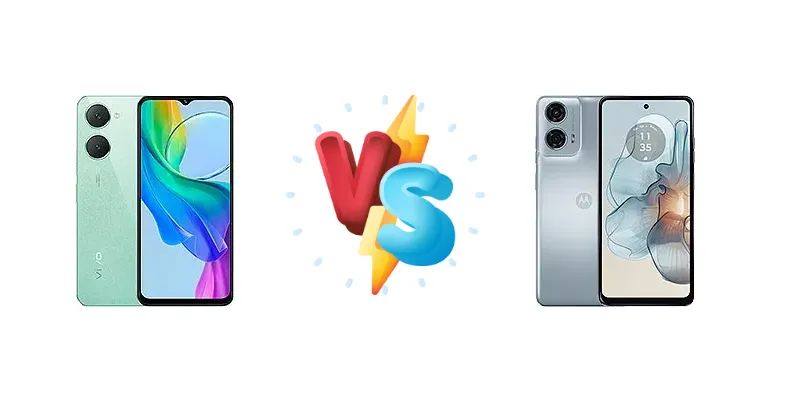
Both the vivo Y18e and Motorola Moto G24 Power target the ultra-budget smartphone market, but they take slightly different approaches. The Y18e prioritizes a clean software experience and a streamlined design, while the G24 Power emphasizes rapid charging capabilities. This comparison dissects their similarities and differences to determine which device offers the best value.
🏆 Quick Verdict
For most users, the Motorola Moto G24 Power is the better choice. While both phones share the same Helio G85 chipset, the G24 Power’s 30W charging significantly reduces downtime, making it ideal for users who rely heavily on their phones throughout the day. The vivo Y18e remains a viable option for those prioritizing simplicity.
| Network |
|---|
| 2G bands | GSM 850 / 900 / 1800 / 1900 | GSM 850 / 900 / 1800 / 1900 |
| 3G bands | HSDPA 850 / 900 / 2100 | HSDPA 850 / 900 / 1900 / 2100 |
| 4G bands | 1, 3, 5, 8, 38, 40, 41 | 1, 2, 3, 5, 7, 8, 20, 28, 38, 40, 41 |
| Speed | HSPA, LTE | HSPA, LTE |
| Technology | GSM / HSPA / LTE | GSM / HSPA / LTE |
| Launch |
|---|
| Announced | 2024, April 29 | 2024, January 30 |
| Status | Available. Released 2024, May | Available. Released 2024, February 07 |
| Body |
|---|
| Build | Glass front, plastic frame, plastic back | Glass front, plastic back, plastic frame |
| Dimensions | 163.6 x 75.6 x 8.4 mm (6.44 x 2.98 x 0.33 in) | 163.5 x 74.5 x 9 mm (6.44 x 2.93 x 0.35 in) |
| SIM | Nano-SIM + Nano-SIM | Nano-SIM + Nano-SIM |
| Weight | 185 g (6.53 oz) | 197 g (6.95 oz) |
| Display |
|---|
| Resolution | 720 x 1612 pixels, 20:9 ratio (~269 ppi density) | 720 x 1612 pixels, 20:9 ratio (~269 ppi density) |
| Size | 6.56 inches, 103.4 cm2 (~83.6% screen-to-body ratio) | 6.56 inches, 103.4 cm2 (~84.9% screen-to-body ratio) |
| Type | IPS LCD, 90Hz, 528 nits (HBM) | IPS LCD, 90Hz, 537 nits (peak) |
| Platform |
|---|
| CPU | Octa-core (2x2.0 GHz Cortex-A75 & 6x1.8 GHz Cortex-A55) | Octa-core (2x2.0 GHz Cortex-A75 & 6x1.7 GHz Cortex-A55) |
| Chipset | Mediatek Helio G85 (12 nm) | Mediatek MT6769Z Helio G85 (12 nm) |
| GPU | Mali-G52 MC2 | Mali-G52 MC2 |
| OS | Android 14, Funtouch 14 | Android 14 |
| Memory |
|---|
| Card slot | microSDXC (dedicated slot) | microSDXC (dedicated slot) |
| Internal | 64GB 4GB RAM | 128GB 4GB RAM, 128GB 8GB RAM, 256GB 4GB RAM, 256GB 8GB RAM |
| Main Camera |
|---|
| Dual | - | 50 MP, f/1.8 (wide), 0.64µm, PDAF
2 MP (macro) |
| Features | LED flash, panorama | LED flash, HDR, panorama |
| Single | 13 MP, f/2.2, (wide), PDAF
Auxiliary lens | - |
| Video | 1080p@30fps | 1080p@30fps |
| Selfie camera |
|---|
| Single | 5 MP, f/2.2, (wide) | 8 MP, f/2.0, (wide), 1.12µm - International version
16 MP, f/2.5, (wide), 1.0µm - India version |
| Video | Yes | 1080p@30fps |
| Sound |
|---|
| 35mm jack | Yes | Yes |
| Loudspeaker | Yes | Yes, with stereo speakers |
| Comms |
|---|
| Bluetooth | 5.0, A2DP, LE | 5.0, A2DP, LE |
| NFC | No | Yes (market/region dependent) |
| Positioning | GPS, GALILEO, GLONASS, BDS, QZSS | GPS, GALILEO, GLONASS |
| Radio | FM radio | FM radio (market/region dependent) |
| USB | USB Type-C 2.0, OTG | USB Type-C 2.0 |
| WLAN | Wi-Fi 802.11 a/b/g/n/ac, dual-band | Wi-Fi 802.11 a/b/g/n/ac, dual-band |
| Features |
|---|
| Sensors | Accelerometer, proximity, compass | Fingerprint (side-mounted), accelerometer, gyro, proximity, compass |
| Battery |
|---|
| Charging | 15W wired | 30W wired |
| Type | Li-Ion 5000 mAh | 6000 mAh |
| Misc |
|---|
| Colors | Space Black, Gem Green | Glacier Blue, Ink Blue |
| Models | V2350 | - |
| Price | - | € 132.29 |
| SAR | 0.98 W/kg (head) 0.84 W/kg (body) | - |
vivo Y18e
- Potentially cleaner software experience (typical of vivo)
- Streamlined design aesthetic
- Slightly higher Cortex-A55 clock speed (negligible impact)
- Significantly slower 15W charging
- Likely limited software updates
- Unspecified battery capacity
Motorola Moto G24 Power
- 30W fast charging for quicker top-ups
- Potentially more robust software support (Motorola's track record)
- Competitive pricing
- Slightly lower Cortex-A55 clock speed (negligible impact)
- May include more bloatware than the vivo Y18e
- Unspecified battery capacity
Display Comparison
Neither vivo nor Motorola provide detailed display specifications beyond the basic panel type. Given the price point, both likely utilize LCD panels. The real-world impact will be similar viewing angles and color reproduction. However, the absence of high refresh rates (90Hz or 120Hz) on either device means scrolling and animations won't feel as fluid as on more expensive phones. Bezels are expected to be noticeable on both, contributing to a less immersive viewing experience.
Camera Comparison
Camera details are sparse for both devices. Without sensor size or aperture information, it’s difficult to make definitive claims. However, given the price bracket, expect primary sensors around 13-20MP. Image processing will likely lean towards boosting saturation and contrast to create visually appealing photos, but detail and dynamic range will be limited. The inclusion of 2MP macro lenses on both phones is largely a marketing tactic, as their image quality is typically subpar. The real differentiator will be software algorithms, which are difficult to assess without extensive testing.
Performance
Both the vivo Y18e and Motorola Moto G24 Power are powered by the Mediatek Helio G85 (12nm). The CPU configuration is nearly identical – an octa-core setup with 2x2.0 GHz Cortex-A75 and 6x1.8 GHz Cortex-A55 cores. The slight difference lies in the Cortex-A55 clock speed: 1.8 GHz on the vivo Y18e versus 1.7 GHz on the Motorola. This difference is unlikely to be perceptible in everyday tasks. Performance will be adequate for basic social media, web browsing, and light gaming, but demanding titles will require reduced graphics settings. RAM configurations are not specified, but both will likely offer sufficient RAM for their target use case. Thermal throttling could become a factor during extended gaming sessions, given the 12nm process node.
Battery Life
The battery capacity isn't specified for either device, but both are likely in the 5000mAh range, typical for this price segment. The key difference is charging speed. The Motorola Moto G24 Power supports 30W wired charging, while the vivo Y18e is limited to 15W. This translates to significantly faster charging times for the Motorola – potentially reducing a full charge from over 3 hours to around 1.5-2 hours. For users who frequently find themselves with low battery, the G24 Power’s faster charging is a substantial advantage.
Buying Guide
Buy the vivo Y18e if you need a simple, straightforward Android experience with a focus on essential features and prefer a minimalist design. Buy the Motorola Moto G24 Power if you prioritize faster charging speeds, ensuring minimal interruption to your daily usage, and appreciate a slightly more feature-rich software experience.
Frequently Asked Questions
❓ Will the Motorola Moto G24 Power overheat during prolonged gaming sessions?
The Helio G85 is a relatively efficient chipset, but the 12nm process node means it can generate heat under sustained load. While the Moto G24 Power likely has basic thermal management, expect some performance throttling during extended gaming. Lowering graphics settings will mitigate this.
❓ How long will it take to fully charge the vivo Y18e with the 15W charger?
Assuming a 5000mAh battery (typical for this segment), a full charge with the 15W charger will likely take between 3 to 4 hours. This is considerably slower than the Motorola Moto G24 Power’s 30W charging.
❓ Does the Motorola Moto G24 Power support reverse wireless charging?
No, neither the Motorola Moto G24 Power nor the vivo Y18e are expected to support reverse wireless charging. This feature is typically reserved for higher-end smartphones.
❓ What version of Android do these phones ship with, and will they receive updates?
Both phones likely ship with Android 14. However, update support is a concern. Motorola generally provides at least one major Android update, while vivo’s update policy for the Y series is less consistent. Expect security patches to be infrequent.