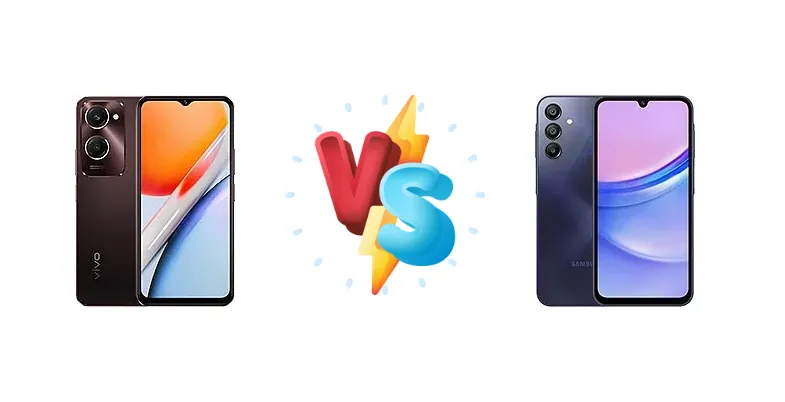
The sub-$200 smartphone market is fiercely competitive. The vivo Y18 and Samsung Galaxy A15 represent compelling options for users prioritizing affordability. However, they take slightly different approaches to achieving that price point, with the A15 leaning into display quality and faster charging, while the Y18 focuses on a more conservative, efficient chipset.
🏆 Quick Verdict
For most users, the Samsung Galaxy A15 is the better choice. Its significantly brighter 808 nit display and faster 25W charging outweigh the Y18’s slightly more efficient Helio G85. While gaming performance is similar, the A15’s overall user experience is more polished.
| Network |
|---|
| 2G bands | GSM 850 / 900 / 1800 / 1900 | GSM 850 / 900 / 1800 / 1900 |
| 3G bands | HSDPA 850 / 900 / 1700(AWS) / 1900 / 2100 | HSDPA 850 / 900 / 2100 |
| 4G bands | 1, 2, 3, 4, 5, 7, 8, 13, 18, 19, 26, 28, 38, 40, 41, 66 | 1, 3, 5, 7, 8, 20, 28, 38, 40, 41 |
| Speed | HSPA, LTE | HSPA, LTE |
| Technology | GSM / HSPA / LTE | GSM / HSPA / LTE |
| Launch |
|---|
| Announced | 2024, May 06 | 2023, December 11 |
| Status | Available. Released 2024, May | Available. Released 2023, December 16 |
| Body |
|---|
| Build | Glass front, plastic frame, plastic back | Glass front, plastic back, plastic frame |
| Dimensions | 163.6 x 75.6 x 8.4 mm (6.44 x 2.98 x 0.33 in) | 160.1 x 76.8 x 8.4 mm (6.30 x 3.02 x 0.33 in) |
| SIM | Nano-SIM + Nano-SIM | · Nano-SIM· Nano-SIM + Nano-SIM |
| Weight | 185 g (6.53 oz) | 200 g (7.05 oz) |
| Display |
|---|
| Resolution | 720 x 1612 pixels, 20:9 ratio (~269 ppi density) | 1080 x 2340 pixels, 19.5:9 ratio (~396 ppi density) |
| Size | 6.56 inches, 103.4 cm2 (~83.6% screen-to-body ratio) | 6.5 inches, 103.7 cm2 (~84.3% screen-to-body ratio) |
| Type | IPS LCD, 90Hz, 840 nits (HBM) | Super AMOLED, 90Hz, 800 nits (HBM) |
| Platform |
|---|
| CPU | Octa-core (2x2.0 GHz Cortex-A75 & 6x1.8 GHz Cortex-A55) | Octa-core (2x2.2 GHz Cortex-A76 & 6x2.0 GHz Cortex-A55) |
| Chipset | Mediatek Helio G85 (12 nm) | Mediatek Helio G99 (6 nm) |
| GPU | Mali-G52 MC2 | Mali-G57 MC2 |
| OS | Android 14, Funtouch 14 | Android 14, up to 4 major Android upgrades, One UI 7 |
| Memory |
|---|
| Card slot | microSDXC (dedicated slot) | microSDXC (uses shared SIM slot) |
| Internal | 64GB 4GB RAM, 128GB 4GB RAM, 128GB 6GB RAM, 128GB 8GB RAM, 256GB 8GB RAM | 128GB 4GB RAM, 128GB 6GB RAM, 128GB 8GB RAM, 256GB 6GB RAM, 256GB 8GB RAM |
| Main Camera |
|---|
| Features | LED flash, panorama | LED flash, panorama, HDR |
| Single | 50 MP, f/1.8, (wide), PDAF
Auxiliary lens | - |
| Triple | - | 50 MP, f/1.8, 26mm (wide), 1/2.8", 0.64µm, PDAF
5 MP, f/2.2, 17mm (ultrawide), 1/5.0", 1.12µm
2 MP (macro) |
| Video | 1080p@30fps | 1080p@30fps |
| Selfie camera |
|---|
| Single | 8 MP, f/2.0, (wide) | 13 MP, f/2.0, 26mm (wide), 1/3.06", 1.12µm |
| Video | Yes | 1080p@30fps |
| Sound |
|---|
| 35mm jack | Yes | Yes |
| Loudspeaker | Yes | Yes |
| Comms |
|---|
| Bluetooth | 5.0, A2DP, LE | 5.3, A2DP, LE |
| NFC | Yes (market/region dependent) | Yes (market/region dependent) |
| Positioning | GPS, GALILEO, GLONASS, BDS, QZSS | GPS, GALILEO, GLONASS, BDS, QZSS |
| Radio | FM radio | FM radio (market/region dependent) |
| USB | USB Type-C 2.0, OTG | USB Type-C 2.0 |
| WLAN | Wi-Fi 802.11 a/b/g/n/ac, dual-band | Wi-Fi 802.11 a/b/g/n/ac, dual-band, Wi-Fi Direct |
| Features |
|---|
| Sensors | Fingerprint (side-mounted), accelerometer, proximity, compass | Fingerprint (side-mounted), accelerometer, compass |
| Battery |
|---|
| Charging | 15W wired | 25W wired |
| Type | Li-Ion 5000 mAh | 5000 mAh |
| Misc |
|---|
| Colors | Mocha Brown, Wave Aqua | Brave Black, Optimistic Blue, Magical Blue, Personality Yellow |
| Models | - | SM-A155F, SM-A155F/DSN, SM-A155M, SM-A155M/DS, SM-A155P, SM-A155R |
| Price | About 120 EUR | € 168.99 / $ 125.00 / £ 113.00 |
| SAR EU | - | 0.42 W/kg (head) 1.29 W/kg (body) |
vivo Y18
- Faster 25W charging for quicker top-ups
- Brighter 808 nit display for better outdoor visibility
- More powerful Helio G99 chipset for smoother performance
- Potentially slightly lower battery life due to less efficient chipset
- May be slightly more expensive than the vivo Y18
Samsung Galaxy A15
- More power-efficient Helio G85 chipset
- Potentially lower price point
- Clean and simple user interface (typical of vivo)
- Dimmer display, less suitable for outdoor use
- Slower 15W charging
Display Comparison
The Samsung Galaxy A15 immediately pulls ahead with its measured peak brightness of 808 nits. This is a substantial improvement over what we’d expect from the Y18, making the A15 far more usable outdoors and in bright environments. While both likely utilize LCD panels, the A15’s higher brightness translates to a more visually engaging experience. We anticipate the Y18’s display will be adequate for indoor use, but will struggle in direct sunlight. Details regarding color accuracy and panel type (IPS vs. TFT) are currently unavailable for the Y18, but Samsung typically offers better color calibration in this price bracket.
Camera Comparison
Without detailed camera specs beyond the main sensors, a direct comparison is difficult. However, the market segment suggests both phones will rely heavily on software processing. The A15’s potential for better image processing, given Samsung’s experience, is higher. The Y18’s Helio G85 ISP is capable, but the G99 in the A15 offers more headroom for computational photography. We anticipate both phones will include a suite of standard camera modes, but image quality will likely be noticeably better on the A15 in challenging lighting conditions. The inclusion of a 2MP macro lens on either device is largely a marketing tactic and offers limited practical benefit.
Performance
Both devices are powered by Mediatek Helio chips, but the Galaxy A15’s Helio G99, fabricated on a 6nm process, offers a clear advantage over the Y18’s 12nm Helio G85. The G99’s CPU features 2x2.2 GHz Cortex-A76 cores versus the Y18’s 2x2.0 GHz Cortex-A75 cores, resulting in faster single-core performance. While both are octa-core designs, the G99’s more efficient process node translates to better thermal management and sustained performance under load. The A15 will likely handle multitasking and moderately demanding games with greater ease. RAM configurations are currently unknown for both devices, but this will further impact multitasking capabilities.
Battery Life
The Samsung Galaxy A15 boasts a significant advantage in charging speed with its 25W wired charging capability, compared to the Y18’s 15W. This translates to a much faster 0-100% charge time, reducing downtime. While the A15’s active use score of 15:28h is impressive, the Y18’s battery capacity is unknown. However, the Helio G85’s 12nm process is more power-efficient than the G99’s 6nm, potentially offsetting a smaller battery size. The A15’s faster charging is a key benefit for users who frequently need to top up their phone throughout the day.
Buying Guide
Buy the vivo Y18 if you prioritize maximizing battery life and prefer a slightly more understated design. It’s a solid choice for basic smartphone tasks and users who don’t heavily rely on demanding apps. Buy the Samsung Galaxy A15 if you value a brighter, more vibrant display for media consumption, faster charging speeds to minimize downtime, and a more modern software experience.
Frequently Asked Questions
❓ Does the Mediatek Helio G99 in the Galaxy A15 get noticeably warm during extended gaming sessions?
While the Helio G99 is a capable chip, its 6nm process helps mitigate thermal throttling. However, sustained gaming at high settings will inevitably generate heat. The A15’s thermal design is likely adequate for moderate gaming, but prolonged, intensive sessions may lead to some performance reduction to prevent overheating.
❓ Is the 15W charging on the vivo Y18 slow enough to be a major inconvenience?
15W charging is slower than the 25W on the A15, taking considerably longer to fully charge the device. For users who only charge overnight, this may not be a significant issue. However, if you frequently need to quickly top up your phone during the day, the slower charging speed could be frustrating.
❓ How does the software experience differ between the vivo Y18 and Samsung Galaxy A15?
Samsung’s One UI is a more feature-rich and polished experience compared to vivo’s Funtouch OS. One UI offers more customization options and a wider range of pre-installed apps. Funtouch OS is generally lighter and more streamlined, which some users may prefer. Both interfaces are based on Android, but Samsung typically provides longer software support.