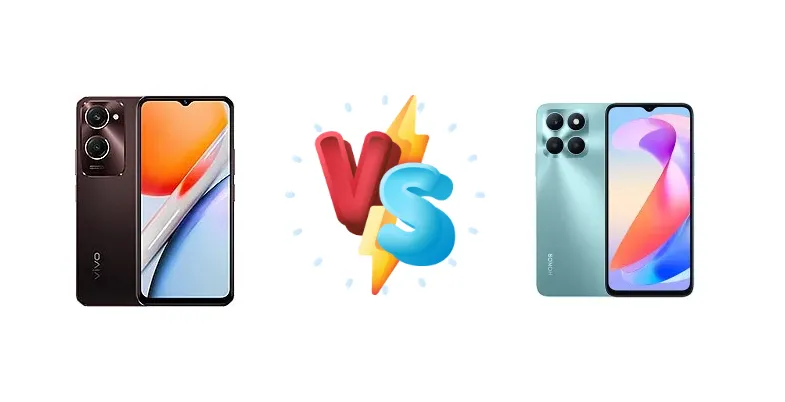
The sub-$200 smartphone market is fiercely competitive. Both the vivo Y18 and Honor X6a aim to deliver essential smartphone functionality at an accessible price point. However, they take different approaches to achieving this, primarily through variations in their chipset and charging capabilities. This comparison dissects those differences to determine which device offers the best value.
🏆 Quick Verdict
For most users, the Honor X6a emerges as the slightly better choice. Its 22.5W charging, capable of delivering a 31% charge in just 20 minutes, significantly improves usability compared to the vivo Y18’s slower 15W charging. While the Y18’s Helio G85 has a slight CPU clock speed advantage, the real-world impact is minimal for typical tasks.
| Network |
|---|
| 2G bands | GSM 850 / 900 / 1800 / 1900 | GSM 850 / 900 / 1800 / 1900 |
| 3G bands | HSDPA 850 / 900 / 1700(AWS) / 1900 / 2100 | HSDPA 850 / 900 / 1900 / 2100 |
| 4G bands | 1, 2, 3, 4, 5, 7, 8, 13, 18, 19, 26, 28, 38, 40, 41, 66 | LTE |
| Speed | HSPA, LTE | HSPA, LTE |
| Technology | GSM / HSPA / LTE | GSM / HSPA / LTE |
| Launch |
|---|
| Announced | 2024, May 06 | 2023, July 28 |
| Status | Available. Released 2024, May | Available. Released 2023, July 28 |
| Body |
|---|
| Build | Glass front, plastic frame, plastic back | - |
| Dimensions | 163.6 x 75.6 x 8.4 mm (6.44 x 2.98 x 0.33 in) | 163.3 x 75.1 x 8.4 mm (6.43 x 2.96 x 0.33 in) |
| SIM | Nano-SIM + Nano-SIM | Nano-SIM + Nano-SIM |
| Weight | 185 g (6.53 oz) | 188 g (6.63 oz) |
| Display |
|---|
| Resolution | 720 x 1612 pixels, 20:9 ratio (~269 ppi density) | 720 x 1612 pixels, 20:9 ratio (~269 ppi density) |
| Size | 6.56 inches, 103.4 cm2 (~83.6% screen-to-body ratio) | 6.56 inches, 103.4 cm2 (~84.3% screen-to-body ratio) |
| Type | IPS LCD, 90Hz, 840 nits (HBM) | TFT LCD, 90Hz |
| Platform |
|---|
| CPU | Octa-core (2x2.0 GHz Cortex-A75 & 6x1.8 GHz Cortex-A55) | Octa-core (4x2.2 GHz Cortex-A53 & 4x1.7 GHz Cortex-A53) |
| Chipset | Mediatek Helio G85 (12 nm) | Mediatek Helio G36 (12 nm) |
| GPU | Mali-G52 MC2 | PowerVR GE8320 |
| OS | Android 14, Funtouch 14 | Android 13, upgradable to Android 14, MagicOS 8 |
| Memory |
|---|
| Card slot | microSDXC (dedicated slot) | microSDXC |
| Internal | 64GB 4GB RAM, 128GB 4GB RAM, 128GB 6GB RAM, 128GB 8GB RAM, 256GB 8GB RAM | 128GB 4GB RAM, 128GB 6GB RAM, 256GB 6GB RAM |
| Main Camera |
|---|
| Features | LED flash, panorama | LED flash, HDR, panorama |
| Single | 50 MP, f/1.8, (wide), PDAF
Auxiliary lens | - |
| Triple | - | 50 MP, f/1.8, (wide), PDAF
2 MP (macro)
Auxiliary lens |
| Video | 1080p@30fps | 1080p@30fps |
| Selfie camera |
|---|
| Single | 8 MP, f/2.0, (wide) | 5 MP, f/2.2, (wide) |
| Video | Yes | 1080p@30fps |
| Sound |
|---|
| 35mm jack | Yes | Yes |
| Loudspeaker | Yes | Yes |
| Comms |
|---|
| Bluetooth | 5.0, A2DP, LE | 5.1, A2DP, LE |
| NFC | Yes (market/region dependent) | Yes |
| Positioning | GPS, GALILEO, GLONASS, BDS, QZSS | GPS, GLONASS, GALILEO, BDS |
| Radio | FM radio | No |
| USB | USB Type-C 2.0, OTG | USB Type-C 2.0, OTG |
| WLAN | Wi-Fi 802.11 a/b/g/n/ac, dual-band | Wi-Fi 802.11 a/b/g/n/ac, dual-band, Wi-Fi Direct |
| Features |
|---|
| Sensors | Fingerprint (side-mounted), accelerometer, proximity, compass | Fingerprint (side-mounted), accelerometer, proximity, gyro |
| Battery |
|---|
| Charging | 15W wired | 22.5W wired, 31% in 20 min |
| Type | Li-Ion 5000 mAh | Li-Po 5200 mAh |
| Misc |
|---|
| Colors | Mocha Brown, Wave Aqua | Cyan Lake, Midnight Black |
| Models | - | WDY-LX1, WDY-LX2 |
| Price | About 120 EUR | About 150 EUR |
vivo Y18
- Potentially better single-core performance due to Cortex-A75 cores.
- Established Helio G85 chipset with known performance characteristics.
- May appeal to users familiar with the vivo brand.
- Significantly slower 15W charging.
- Older CPU architecture compared to the G36.
- Limited information available on display quality.
Honor X6a
- Faster 22.5W charging with 31% charge in 20 minutes.
- More modern CPU architecture (Helio G36).
- Potentially better multi-threaded performance.
- Slightly lower CPU clock speeds on individual cores.
- Less established brand recognition compared to vivo.
- Limited information available on display quality.
Display Comparison
Neither vivo nor Honor provide display specifications beyond the basic panel type. Given the price point, both likely utilize LCD panels. The absence of details like peak brightness or color gamut makes a direct comparison impossible. However, the focus on processor and charging suggests display quality isn't a key differentiator. Expect standard viewing experiences on both.
Camera Comparison
Detailed camera specifications are unavailable. Given the market segment, both phones likely feature a primary camera alongside basic depth or macro sensors. Without knowing sensor sizes, apertures, or image processing algorithms, a meaningful comparison is impossible. It’s safe to assume image quality will be adequate for social media sharing but won’t rival higher-end devices. The absence of OIS on either device suggests low-light performance will be limited.
Performance
The core difference lies in the chipsets. The vivo Y18 features the Mediatek Helio G85, utilizing a combination of 2x 2.0 GHz Cortex-A75 and 6x 1.8 GHz Cortex-A55 cores. The Honor X6a employs the Helio G36, with 4x 2.2 GHz Cortex-A53 and 4x 1.7 GHz Cortex-A53 cores. While the G85’s A75 cores offer higher single-core performance, the G36’s higher clock speeds on its A53 cores provide a more consistent experience for multi-threaded tasks. The G36’s newer architecture, despite the lower core performance, may offer improved efficiency. Both chipsets are paired with similar RAM configurations, meaning the CPU difference will be the primary bottleneck.
Battery Life
Battery capacity is not specified for either device. However, the Honor X6a’s 22.5W charging capability is a significant advantage. The ability to gain 31% charge in 20 minutes is a practical benefit for users on the go. The vivo Y18’s 15W charging is considerably slower, requiring more downtime to reach a full charge. This difference in charging speed effectively mitigates any potential advantage the Y18 might have from a slightly larger battery capacity (if one exists).
Buying Guide
Buy the vivo Y18 if you prioritize a slightly more established processor architecture (Cortex-A75 cores) and are less concerned with rapid charging. This phone suits users who primarily use their device for basic communication and light social media. Buy the Honor X6a if you value faster charging speeds and a more modern, albeit less powerful, CPU core configuration. This is the better option for users who frequently find themselves needing a quick power boost throughout the day.
Frequently Asked Questions
❓ Will the Honor X6a’s 22.5W charging damage the battery over time?
While faster charging can theoretically contribute to slightly increased battery degradation over the long term, modern smartphones employ battery management systems to mitigate this effect. The convenience of faster charging generally outweighs the minimal potential impact on battery lifespan, especially for users who typically replace their phones within 2-3 years.
❓ Is the Mediatek Helio G36 in the Honor X6a powerful enough for casual gaming?
The Helio G36 is capable of handling casual gaming titles with reasonable performance. However, demanding games like PUBG Mobile or Genshin Impact will likely require reduced graphics settings and may still experience occasional frame drops. It’s best suited for less graphically intensive games and everyday tasks.
❓ Does the vivo Y18 support reverse charging?
Based on available information, the vivo Y18 does not appear to support reverse charging. This feature is typically found on higher-end devices and is unlikely to be included in a budget smartphone like the Y18.
❓ What type of storage does the Honor X6a use – eMMC or UFS?
While not explicitly stated, budget smartphones like the Honor X6a typically utilize eMMC storage to keep costs down. UFS storage is faster but more expensive. This means app loading times and file transfers may be slower on the X6a compared to phones with UFS storage.