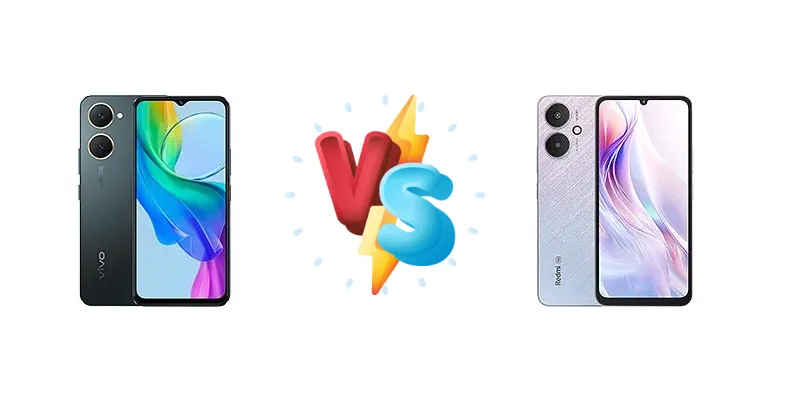
Both the vivo Y18 (India) and the Xiaomi Redmi 13C 5G target the highly competitive sub-₹15,000 segment. However, they approach this market with different strategies: the vivo Y18 focuses on a proven, if older, platform, while the Redmi 13C 5G leaps forward with 5G connectivity and a newer chipset. This comparison dissects the core differences to determine which phone delivers the best value.
🏆 Quick Verdict
For the average user prioritizing future-proofing and smoother performance, the Xiaomi Redmi 13C 5G is the better choice. Its Dimensity 6100+ chipset, built on a more efficient 6nm process, offers a noticeable performance uplift and 5G support. However, the vivo Y18 remains a viable option for those seeking a reliable device with a familiar user experience.
| Network |
|---|
| 2G bands | GSM 850 / 900 / 1800 / 1900 | GSM 850 / 900 / 1800 / 1900 |
| 3G bands | HSDPA 850 / 900 / 2100 | HSDPA 800 / 850 / 900 / 1700(AWS) / 1900 / 2100 - International |
| 4G bands | 1, 3, 5, 8, 38, 40, 41 | 1, 2, 3, 4, 5, 7, 8, 12, 13, 17, 18, 19, 20, 26, 28, 32, 38, 40, 41, 66 - International |
| 5G bands | - | 1, 3, 5, 7, 8, 20, 28, 38, 40, 41, 66, 77, 78 SA/NSA - International |
| Speed | HSPA, LTE | HSPA, LTE, 5G |
| Technology | GSM / HSPA / LTE | GSM / HSPA / LTE / 5G |
| Launch |
|---|
| Announced | 2024, May 03 | 2023, December 06 |
| Status | Available. Released 2024, May 03 | Available. Released 2023, December 16 |
| Body |
|---|
| Build | Glass front, plastic frame, plastic back | Glass front (Gorilla Glass 3), plastic frame, plastic back |
| Dimensions | 163.6 x 75.6 x 8.4 mm (6.44 x 2.98 x 0.33 in) | 168.1 x 77.9 x 8.2 mm (6.62 x 3.07 x 0.32 in) |
| SIM | Nano-SIM + Nano-SIM | Nano-SIM + Nano-SIM |
| Weight | 185 g (6.53 oz) | 192 g or 195 g (6.77 oz) |
| Display |
|---|
| Protection | - | Corning Gorilla Glass 3 |
| Resolution | 720 x 1612 pixels, 20:9 ratio (~269 ppi density) | 720 x 1600 pixels, 20:9 ratio (~260 ppi density) |
| Size | 6.56 inches, 103.4 cm2 (~83.6% screen-to-body ratio) | 6.74 inches, 109.7 cm2 (~83.8% screen-to-body ratio) |
| Type | IPS LCD, 90Hz, 840 nits (HBM) | IPS LCD, 90Hz, 450 nits (typ), 600 nits (HBM) |
| Platform |
|---|
| CPU | Octa-core (2x2.0 GHz Cortex-A75 & 6x1.8 GHz Cortex-A55) | Octa-core (2x2.2 GHz Cortex-A76 & 6x2.0 GHz Cortex-A55) |
| Chipset | Mediatek Helio G85 (12 nm) | Mediatek Dimensity 6100+ (6 nm) |
| GPU | Mali-G52 MC2 | Mali-G57 MC2 |
| OS | Android 14, Funtouch 14 | Android 13, MIUI 14 |
| Memory |
|---|
| Card slot | microSDXC (dedicated slot) | microSDXC (dedicated slot) |
| Internal | 64GB 4GB RAM, 128GB 4GB RAM, 128GB 6GB RAM | 64GB 4GB RAM, 128GB 4GB RAM, 128GB 6GB RAM, 256GB 8GB RAM |
| Main Camera |
|---|
| Features | LED flash, panorama | LED flash, HDR |
| Single | 50 MP, f/1.8, (wide), PDAF
Auxiliary lens | 50 MP, f/1.8, 28mm (wide), 1/2.76", 1.12µm, PDAF
Auxiliary lens |
| Video | 1080p@30fps | 1080p@30fps |
| Selfie camera |
|---|
| Features | - | HDR |
| Single | 8 MP, f/2.0, (wide) | 5 MP, f/2.2, (wide) |
| Video | Yes | 1080p@30fps |
| Sound |
|---|
| 35mm jack | Yes | Yes |
| Loudspeaker | Yes | Yes |
| Comms |
|---|
| Bluetooth | 5.0, A2DP, LE | 5.3, A2DP, LE |
| NFC | No | Yes (market/region dependent) |
| Positioning | GPS, GALILEO, GLONASS, BDS, QZSS | GPS, GLONASS, GALILEO, BDS |
| Radio | FM radio | FM radio |
| USB | USB Type-C 2.0, OTG | USB Type-C 2.0, OTG |
| WLAN | Wi-Fi 802.11 a/b/g/n/ac, dual-band | Wi-Fi 802.11 a/b/g/n/ac, dual-band |
| Features |
|---|
| Sensors | Fingerprint (side-mounted), accelerometer, proximity, compass | Fingerprint (side-mounted), accelerometer, compass |
| Battery |
|---|
| Charging | 15W wired | 18W wired, PD |
| Type | Li-Ion 5000 mAh | 5000 mAh |
| Misc |
|---|
| Colors | Space Black, Gem Green | Starry Black, Twilight Blue, Starry Silver, Starlight Black, Startrail Green, Startrail Silver |
| Models | V2333, V2345 | 23124RN87G, 23124RN87I, 23124RN87C |
| Price | About 100 EUR | $ 198.99 / £ 119.00 / € 116.99 / ₹ 10,895 |
| SAR | 0.98 W/kg (head) 0.84 W/kg (body) | 1.09 W/kg (head) 1.09 W/kg (body) |
| SAR EU | - | 0.98 W/kg (head) 0.98 W/kg (body) |
vivo Y18 (India)
- Familiar and reliable platform
- Potentially lower price point
- Simple and user-friendly interface (typical of vivo)
- Older, less efficient chipset
- No 5G connectivity
- Slower charging speed
Xiaomi Redmi 13C 5G
- 5G connectivity for faster data speeds
- More powerful and efficient Dimensity 6100+ chipset
- Faster 18W charging with PD support
- Xiaomi’s MIUI can be resource-intensive
- Potentially slightly higher price
- Software update support may vary
Display Comparison
Neither device boasts a standout display. Both are likely to feature LCD panels, typical for this price bracket. The key difference lies under the hood: the Redmi 13C 5G’s chipset will likely have a more capable display engine, potentially leading to slightly better color reproduction and responsiveness. However, without specific display specs (resolution, peak brightness, color gamut), it’s difficult to quantify the difference. Bezels are expected to be similar on both devices, reflecting cost-saving measures.
Camera Comparison
Both phones likely feature a primary camera paired with depth and macro sensors. Given the context data, a detailed camera comparison is limited. However, the Redmi 13C 5G’s more powerful chipset allows for more sophisticated image processing algorithms, potentially resulting in better dynamic range and noise reduction. The 2MP macro cameras on both devices are unlikely to deliver significant detail and should be considered a marketing feature rather than a practical tool. Sensor size and aperture values, absent from the data, would be critical for a more accurate assessment.
Performance
The performance gap is the most significant differentiator. The Xiaomi Redmi 13C 5G’s Mediatek Dimensity 6100+ (6nm) is a clear upgrade over the vivo Y18’s Helio G85 (12nm). The 6nm process inherently offers better power efficiency, translating to less heat and sustained performance. The Dimensity 6100+ also features newer CPU cores – Cortex-A76 vs A75 in the Helio G85 – resulting in a roughly 15-20% performance increase in CPU-intensive tasks. This benefits multitasking, app loading times, and overall system responsiveness. The Redmi 13C 5G’s 5G modem is a crucial advantage for users in areas with 5G coverage.
Battery Life
The vivo Y18’s 15W charging is slower than the Redmi 13C 5G’s 18W charging with Power Delivery (PD). While battery capacity isn’t specified, the more efficient Dimensity 6100+ in the Redmi 13C 5G will likely result in comparable or even better real-world battery life despite potentially having a similar capacity. PD support on the Redmi 13C 5G also allows for faster charging with compatible chargers, and broader compatibility with charging accessories.
Buying Guide
Buy the vivo Y18 (India) if you need a dependable smartphone for basic tasks like calling, messaging, and social media, and aren't concerned with 5G connectivity or demanding gaming. Buy the Xiaomi Redmi 13C 5G if you prioritize 5G access, smoother multitasking, and a more modern chipset that will likely receive software updates for a longer period.
Frequently Asked Questions
❓ Will the Dimensity 6100+ in the Redmi 13C 5G get noticeably warmer during extended gaming sessions compared to the Helio G85?
Yes, while both chipsets will heat up during gaming, the Dimensity 6100+ is designed to handle sustained loads more efficiently due to its 6nm process. This means it's less likely to experience significant thermal throttling, maintaining higher frame rates for longer periods compared to the 12nm Helio G85.
❓ Does the Redmi 13C 5G support VoWiFi (Wi-Fi Calling) and VoLTE (Voice over LTE)?
Support for VoWiFi and VoLTE depends on the carrier. The Dimensity 6100+ chipset inherently supports both technologies, but whether they are enabled is determined by the mobile network operator. Check with your carrier to confirm compatibility.
❓ Is the difference in charging speed between 15W and 18W significant in real-world usage?
While 3W doesn't sound like much, the Redmi 13C 5G's 18W charging with Power Delivery will result in a noticeably faster 0-100% charge time. PD also allows for more efficient charging with compatible adapters, minimizing heat generation during the process.