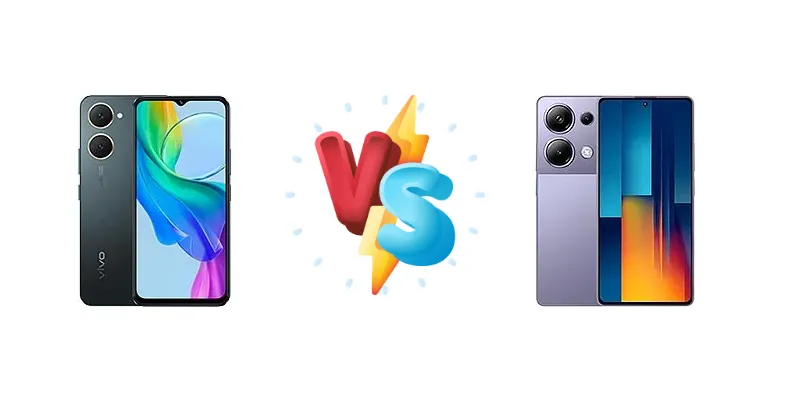
The sub-$200 smartphone market is fiercely competitive, and the vivo Y18 (India) and Xiaomi Poco M6 Pro 4G represent compelling options. While both aim to deliver essential smartphone functionality, they diverge significantly in performance and charging capabilities. This comparison dissects these differences to help you choose the right device for your needs.
🏆 Quick Verdict
For the average user prioritizing performance and convenience, the Xiaomi Poco M6 Pro 4G is the clear winner. Its Helio G99 Ultra chipset and blazing-fast 67W charging significantly outperform the vivo Y18’s Helio G85 and 15W charging. However, the Y18 remains a viable option for those on a tighter budget and with less demanding usage patterns.
| Network |
|---|
| 2G bands | GSM 850 / 900 / 1800 / 1900 | GSM 850 / 900 / 1800 / 1900 |
| 3G bands | HSDPA 850 / 900 / 2100 | HSDPA 800 / 850 / 900 / 1700(AWS) / 1900 / 2100 |
| 4G bands | 1, 3, 5, 8, 38, 40, 41 | 1, 2, 3, 4, 5, 7, 8, 12, 13, 17, 18, 19, 20, 26, 28, 38, 40, 41, 66 |
| Speed | HSPA, LTE | HSPA, LTE |
| Technology | GSM / HSPA / LTE | GSM / HSPA / LTE |
| Launch |
|---|
| Announced | 2024, May 03 | 2024, January 11 |
| Status | Available. Released 2024, May 03 | Available. Released 2024, January 12 |
| Body |
|---|
| Build | Glass front, plastic frame, plastic back | Glass front (Gorilla Glass 5), plastic frame |
| Dimensions | 163.6 x 75.6 x 8.4 mm (6.44 x 2.98 x 0.33 in) | 161.1 x 75 x 8 mm (6.34 x 2.95 x 0.31 in) |
| SIM | Nano-SIM + Nano-SIM | Nano-SIM + Nano-SIM |
| Weight | 185 g (6.53 oz) | 179 g (6.31 oz) |
| Display |
|---|
| Protection | - | Corning Gorilla Glass 5 |
| Resolution | 720 x 1612 pixels, 20:9 ratio (~269 ppi density) | 1080 x 2400 pixels, 20:9 ratio (~395 ppi density) |
| Size | 6.56 inches, 103.4 cm2 (~83.6% screen-to-body ratio) | 6.67 inches, 107.4 cm2 (~88.9% screen-to-body ratio) |
| Type | IPS LCD, 90Hz, 840 nits (HBM) | AMOLED, 120Hz, 1000 nits (HBM), 1300 nits (peak) |
| Platform |
|---|
| CPU | Octa-core (2x2.0 GHz Cortex-A75 & 6x1.8 GHz Cortex-A55) | Octa-core (2x2.2 GHz Cortex-A76 & 6x2.0 GHz Cortex-A55) |
| Chipset | Mediatek Helio G85 (12 nm) | Mediatek Helio G99 Ultra |
| GPU | Mali-G52 MC2 | Mali-G57 MC2 |
| OS | Android 14, Funtouch 14 | Android 13, MIUI 14, planned upgrade to Android 14, HyperOS |
| Memory |
|---|
| Card slot | microSDXC (dedicated slot) | microSDXC (uses shared SIM slot) |
| Internal | 64GB 4GB RAM, 128GB 4GB RAM, 128GB 6GB RAM | 256GB 8GB RAM, 512GB 12GB RAM |
| Main Camera |
|---|
| Features | LED flash, panorama | LED flash, HDR, panorama |
| Single | 50 MP, f/1.8, (wide), PDAF
Auxiliary lens | - |
| Triple | - | 64 MP, f/1.8, 25mm (wide), 1/2.0", 0.7µm, PDAF, OIS
8 MP, f/2.2, (ultrawide)
2 MP (macro) |
| Video | 1080p@30fps | 1080p@30/60fps, gyro-EIS |
| Selfie camera |
|---|
| Single | 8 MP, f/2.0, (wide) | 16 MP, f/2.5, (wide) |
| Video | Yes | 1080p@30/60fps |
| Sound |
|---|
| 35mm jack | Yes | Yes |
| Loudspeaker | Yes | Yes, with dual speakers |
| Comms |
|---|
| Bluetooth | 5.0, A2DP, LE | 5.2, A2DP, LE |
| Infrared port | - | Yes |
| NFC | No | Yes (market/region dependent) |
| Positioning | GPS, GALILEO, GLONASS, BDS, QZSS | GPS, GALILEO, GLONASS, BDS |
| Radio | FM radio | FM radio |
| USB | USB Type-C 2.0, OTG | USB Type-C 2.0, OTG |
| WLAN | Wi-Fi 802.11 a/b/g/n/ac, dual-band | Wi-Fi 802.11 a/b/g/n/ac, dual-band |
| Features |
|---|
| Sensors | Fingerprint (side-mounted), accelerometer, proximity, compass | Fingerprint (under display, optical), accelerometer, gyro, compass |
| Battery |
|---|
| Charging | 15W wired | 67W wired, 100% in 44 min |
| Type | Li-Ion 5000 mAh | 5000 mAh |
| Misc |
|---|
| Colors | Space Black, Gem Green | Black, Blue, Purple |
| Models | V2333, V2345 | 2312FPCA6G |
| Price | About 100 EUR | $ 170.00 |
| SAR | 0.98 W/kg (head) 0.84 W/kg (body) | 1.09 W/kg (head) 1.09 W/kg (body) |
| SAR EU | - | 0.99 W/kg (head) 0.99 W/kg (body) |
vivo Y18 (India)
- Lower price point (likely)
- Reliable for basic tasks
- Mediatek Helio G85 is adequate for everyday use
- Slow 15W charging
- Less powerful processor than the Poco
- Limited performance for gaming
Xiaomi Poco M6 Pro 4G
- 67W fast charging (0-100% in 44 mins)
- More powerful Mediatek Helio G99 Ultra chipset
- Brighter display (1053 nits)
- Longer battery life (11:46h active use)
- Higher price than the vivo Y18 (likely)
- Camera details are limited without further review
- May not include all desired accessories in the box
Display Comparison
The Poco M6 Pro 4G boasts a significantly brighter display, reaching a measured peak of 1053 nits. This is a substantial advantage over what we’d expect from the Y18, making the Poco more usable outdoors under direct sunlight. While both likely utilize IPS LCD panels (given the price point), the higher brightness of the Poco translates to a superior viewing experience. Details regarding the Y18’s display brightness are unavailable, but it’s reasonable to assume it falls considerably below the Poco’s figure. Bezels are likely comparable, and color accuracy is an area where both phones will likely require calibration for professional use.
Camera Comparison
Context data is limited regarding camera specifics beyond 'Photo/Video' for the Poco M6 Pro 4G. However, given Xiaomi’s typical approach, we can expect a primary sensor with a reasonable megapixel count, likely paired with a depth or macro sensor. The Y18’s camera specifications are also unknown. Without sensor size or aperture information, a direct comparison is difficult. It’s crucial to note that the inclusion of a 2MP macro camera on either device offers limited practical benefit; image quality will be significantly lower than the main sensor. Real-world image processing will be a key differentiator, and reviews will be necessary to assess the quality of photos and videos from both devices.
Performance
The core difference lies in the chipsets. The Poco M6 Pro 4G’s Mediatek Helio G99 Ultra is a step up from the vivo Y18’s Helio G85. The G99 Ultra features newer Cortex-A76 cores clocked at 2.2 GHz, compared to the Y18’s Cortex-A75 cores at 2.0 GHz. This architectural improvement, coupled with the higher clock speed, results in noticeably faster application loading times and smoother multitasking. The G99 Ultra’s more efficient 6nm process (vs the G85’s 12nm) also contributes to better thermal management, potentially reducing throttling during extended gaming sessions. While both phones likely feature similar RAM configurations, the G99 Ultra’s superior processing power will be the defining factor for performance-intensive tasks.
Battery Life
The Poco M6 Pro 4G truly shines in the charging department with its 67W wired charging, capable of reaching 100% in just 44 minutes. This is a massive advantage over the vivo Y18’s slow 15W charging. While the Poco M6 Pro 4G’s battery capacity isn’t specified, its active use score of 11:46h suggests a well-optimized battery life. The Y18’s battery capacity is also unknown, but the slower charging speed indicates a less efficient charging system. For users who frequently need to top up their phone quickly, the Poco M6 Pro 4G is the clear winner.
Buying Guide
Buy the vivo Y18 (India) if you need a basic, reliable smartphone for everyday tasks like calls, messaging, and light social media use, and prioritize a lower upfront cost. Buy the Xiaomi Poco M6 Pro 4G if you prefer a smoother experience with more demanding apps, enjoy mobile gaming, and value the convenience of incredibly fast charging – even if it means spending a bit more.
Frequently Asked Questions
❓ Does the Poco M6 Pro 4G’s Helio G99 Ultra get hot during prolonged gaming sessions?
The Helio G99 Ultra’s 6nm process is more efficient than the G85’s 12nm process, suggesting better thermal management. While some heat is inevitable during gaming, the G99 Ultra is less prone to significant throttling compared to the G85, allowing for more sustained performance. However, sustained peak performance will still generate heat.
❓ Is the 67W charging on the Poco M6 Pro 4G compatible with all USB-C chargers?
While the Poco M6 Pro 4G uses the USB-C standard, to achieve the full 67W charging speed, you’ll need a charger that supports Power Delivery (PD) or Quick Charge (QC) protocols and can deliver at least 65W. Using a standard 15W or 20W charger will still charge the phone, but at a significantly slower rate.
❓ How does the vivo Y18 handle multitasking with several apps open?
The vivo Y18’s Helio G85, while capable, will struggle with heavy multitasking. Expect some app reloading and slowdowns when switching between numerous applications simultaneously. It’s best suited for running one or two apps at a time.
❓ What type of storage does the Poco M6 Pro 4G use, and is it expandable?
While not specified in the provided data, Xiaomi typically uses UFS 2.2 storage in this price segment. The Poco M6 Pro 4G likely includes a dedicated microSD card slot for expandable storage, allowing you to increase the internal capacity.