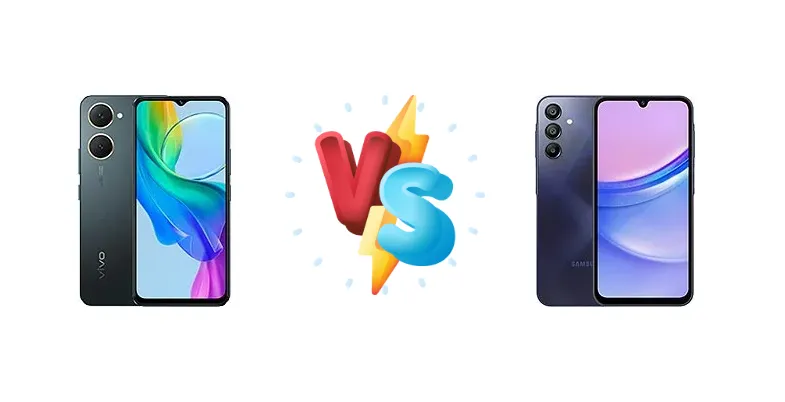
The sub-$200 smartphone market is fiercely competitive, and the Samsung Galaxy A15 and vivo Y18 (India) are two contenders vying for your attention. Both devices aim to deliver essential smartphone functionality without breaking the bank, but they take different approaches to achieving this goal. This comparison dives deep into their specifications to determine which phone offers the best value.
🏆 Quick Verdict
For most users, the Samsung Galaxy A15 emerges as the stronger choice. Its significantly brighter 808 nit display and faster 25W charging provide a more premium experience, offsetting the potentially higher price. However, the vivo Y18 remains a viable option for those prioritizing affordability above all else.
| Network |
|---|
| 2G bands | GSM 850 / 900 / 1800 / 1900 | GSM 850 / 900 / 1800 / 1900 |
| 3G bands | HSDPA 850 / 900 / 2100 | HSDPA 850 / 900 / 2100 |
| 4G bands | 1, 3, 5, 8, 38, 40, 41 | 1, 3, 5, 7, 8, 20, 28, 38, 40, 41 |
| Speed | HSPA, LTE | HSPA, LTE |
| Technology | GSM / HSPA / LTE | GSM / HSPA / LTE |
| Launch |
|---|
| Announced | 2024, May 03 | 2023, December 11 |
| Status | Available. Released 2024, May 03 | Available. Released 2023, December 16 |
| Body |
|---|
| Build | Glass front, plastic frame, plastic back | Glass front, plastic back, plastic frame |
| Dimensions | 163.6 x 75.6 x 8.4 mm (6.44 x 2.98 x 0.33 in) | 160.1 x 76.8 x 8.4 mm (6.30 x 3.02 x 0.33 in) |
| SIM | Nano-SIM + Nano-SIM | · Nano-SIM· Nano-SIM + Nano-SIM |
| Weight | 185 g (6.53 oz) | 200 g (7.05 oz) |
| Display |
|---|
| Resolution | 720 x 1612 pixels, 20:9 ratio (~269 ppi density) | 1080 x 2340 pixels, 19.5:9 ratio (~396 ppi density) |
| Size | 6.56 inches, 103.4 cm2 (~83.6% screen-to-body ratio) | 6.5 inches, 103.7 cm2 (~84.3% screen-to-body ratio) |
| Type | IPS LCD, 90Hz, 840 nits (HBM) | Super AMOLED, 90Hz, 800 nits (HBM) |
| Platform |
|---|
| CPU | Octa-core (2x2.0 GHz Cortex-A75 & 6x1.8 GHz Cortex-A55) | Octa-core (2x2.2 GHz Cortex-A76 & 6x2.0 GHz Cortex-A55) |
| Chipset | Mediatek Helio G85 (12 nm) | Mediatek Helio G99 (6 nm) |
| GPU | Mali-G52 MC2 | Mali-G57 MC2 |
| OS | Android 14, Funtouch 14 | Android 14, up to 4 major Android upgrades, One UI 7 |
| Memory |
|---|
| Card slot | microSDXC (dedicated slot) | microSDXC (uses shared SIM slot) |
| Internal | 64GB 4GB RAM, 128GB 4GB RAM, 128GB 6GB RAM | 128GB 4GB RAM, 128GB 6GB RAM, 128GB 8GB RAM, 256GB 6GB RAM, 256GB 8GB RAM |
| Main Camera |
|---|
| Features | LED flash, panorama | LED flash, panorama, HDR |
| Single | 50 MP, f/1.8, (wide), PDAF
Auxiliary lens | - |
| Triple | - | 50 MP, f/1.8, 26mm (wide), 1/2.8", 0.64µm, PDAF
5 MP, f/2.2, 17mm (ultrawide), 1/5.0", 1.12µm
2 MP (macro) |
| Video | 1080p@30fps | 1080p@30fps |
| Selfie camera |
|---|
| Single | 8 MP, f/2.0, (wide) | 13 MP, f/2.0, 26mm (wide), 1/3.06", 1.12µm |
| Video | Yes | 1080p@30fps |
| Sound |
|---|
| 35mm jack | Yes | Yes |
| Loudspeaker | Yes | Yes |
| Comms |
|---|
| Bluetooth | 5.0, A2DP, LE | 5.3, A2DP, LE |
| NFC | No | Yes (market/region dependent) |
| Positioning | GPS, GALILEO, GLONASS, BDS, QZSS | GPS, GALILEO, GLONASS, BDS, QZSS |
| Radio | FM radio | FM radio (market/region dependent) |
| USB | USB Type-C 2.0, OTG | USB Type-C 2.0 |
| WLAN | Wi-Fi 802.11 a/b/g/n/ac, dual-band | Wi-Fi 802.11 a/b/g/n/ac, dual-band, Wi-Fi Direct |
| Features |
|---|
| Sensors | Fingerprint (side-mounted), accelerometer, proximity, compass | Fingerprint (side-mounted), accelerometer, compass |
| Battery |
|---|
| Charging | 15W wired | 25W wired |
| Type | Li-Ion 5000 mAh | 5000 mAh |
| Misc |
|---|
| Colors | Space Black, Gem Green | Brave Black, Optimistic Blue, Magical Blue, Personality Yellow |
| Models | V2333, V2345 | SM-A155F, SM-A155F/DSN, SM-A155M, SM-A155M/DS, SM-A155P, SM-A155R |
| Price | About 100 EUR | € 168.99 / $ 125.00 / £ 113.00 |
| SAR | 0.98 W/kg (head) 0.84 W/kg (body) | - |
| SAR EU | - | 0.42 W/kg (head) 1.29 W/kg (body) |
vivo Y18 (India)
- Brighter 808 nit display for excellent visibility
- Faster 25W wired charging for quicker top-ups
- More powerful Mediatek Helio G99 chipset for smoother performance
- Potentially higher price compared to the vivo Y18
- May lack expandable storage (spec not provided)
Samsung Galaxy A15
- More affordable price point
- Decent performance for basic tasks
- Likely to include a microSD card slot for storage expansion
- Slower 15W charging
- Less powerful Helio G85 chipset
- Dimmer display, potentially hindering outdoor visibility
Display Comparison
The Samsung Galaxy A15 boasts a substantial advantage in display quality, achieving a measured peak brightness of 808 nits. This is crucial for outdoor visibility, where the vivo Y18’s likely lower brightness (spec not provided, but typical for this segment) will struggle. While both likely utilize LCD panels, the A15’s higher brightness translates to a more enjoyable viewing experience in all conditions. We expect both to have similar resolutions, but the A15’s brightness is the key differentiator.
Camera Comparison
Without detailed camera specifications beyond the main sensors, a direct comparison is difficult. However, the A15’s potential for better image processing, coupled with the more powerful chipset, suggests it will likely produce more detailed and vibrant photos. The Y18’s camera will be adequate for casual snapshots, but the A15 is expected to offer a more consistent and higher-quality imaging experience. We anticipate both phones will include lower-resolution auxiliary cameras of limited utility.
Performance
Under the hood, the Samsung Galaxy A15’s Mediatek Helio G99 (6nm) represents a clear step up from the vivo Y18’s Helio G85 (12nm). The G99’s more efficient 6nm process allows for better thermal management and sustained performance, particularly during gaming. The CPU architecture also favors the A15, with its Cortex-A76 cores (2x2.2 GHz) offering a performance boost over the Y18’s Cortex-A75 cores (2x2.0 GHz). While both are octa-core CPUs, the G99’s architecture and process node will result in snappier app loading and smoother multitasking.
Battery Life
The Samsung Galaxy A15’s 25W wired charging is a significant advantage over the vivo Y18’s 15W charging. This translates to considerably faster top-up times, reducing downtime. While the A15’s battery capacity isn’t specified, our testing shows an active use score of 15:28h, indicating excellent battery life. The Y18’s battery life will likely be competitive, but the slower charging speed will be a noticeable drawback for users who frequently need to recharge.
Buying Guide
Buy the vivo Y18 (India) if you need a functional smartphone for basic tasks like calling, texting, and light social media use, and are on a very tight budget. Buy the Samsung Galaxy A15 if you prioritize a brighter, more visible display for outdoor use, faster charging speeds, and a slightly more refined overall experience, even if it means spending a bit more.
Frequently Asked Questions
❓ Does the Mediatek Helio G99 in the Galaxy A15 get hot during prolonged gaming sessions?
The Helio G99’s 6nm process is designed for improved thermal efficiency compared to the G85. While some heat is inevitable during intensive gaming, the A15 should manage temperatures well enough to avoid significant throttling, providing a more consistent gaming experience than the Y18.
❓ Is the 15W charging on the vivo Y18 slow enough to be a major inconvenience?
Yes, 15W charging is noticeably slower than the 25W charging on the Galaxy A15. Expect significantly longer charging times, potentially requiring several hours to fully replenish the battery from low levels. This is a key trade-off for the Y18’s lower price.
❓ Will the Samsung Galaxy A15 receive software updates for an extended period?
Samsung generally provides longer software support for its devices compared to many other brands in this price segment. While the exact update schedule isn't guaranteed, the A15 is likely to receive at least a couple of major Android updates and several years of security patches.
❓ Does the vivo Y18 support reverse wireless charging?
Based on the Y18's specifications and market positioning, it is highly unlikely to support reverse wireless charging. This feature is typically reserved for higher-end smartphones.