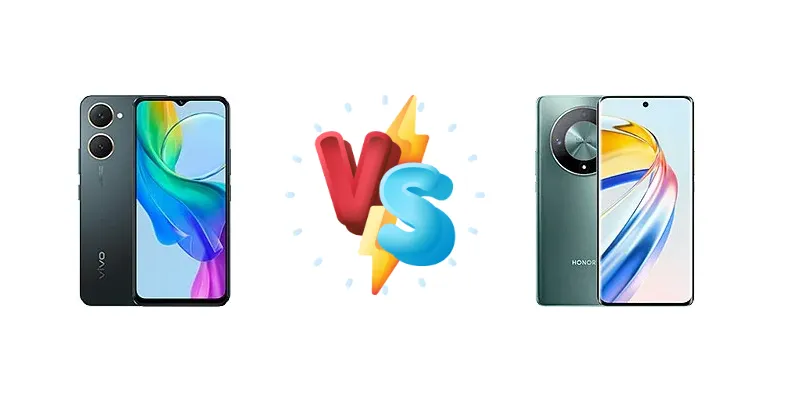
The sub-₹15,000 (approximately $180 USD) smartphone segment in India is fiercely competitive. The vivo Y18, powered by the Mediatek Helio G85, aims for reliable daily use. The Honor X9b, featuring the Qualcomm Snapdragon 6 Gen 1, attempts to elevate the experience with a more modern chipset and faster charging. This comparison dissects the key differences to determine which device offers the best value.
🏆 Quick Verdict
For the average user prioritizing sustained performance and faster charging, the Honor X9b is the clear winner. Its Snapdragon 6 Gen 1, built on a 4nm process, delivers a noticeable performance advantage over the Helio G85 in the vivo Y18, alongside 35W charging for quicker top-ups. However, the Y18 remains a viable option for basic users on a tighter budget.
| Network |
|---|
| 2G bands | GSM 850 / 900 / 1800 / 1900 | GSM 850 / 900 / 1800 / 1900 |
| 3G bands | HSDPA 850 / 900 / 2100 | HSDPA 850 / 900 / 1900 / 2100 |
| 4G bands | 1, 3, 5, 8, 38, 40, 41 | 1, 2, 3, 4, 5, 7, 8, 20, 28, 32, 38, 40, 41 |
| 5G bands | - | 1, 3, 7, 8, 20, 28, 38, 40, 41, 77, 78 SA/NSA |
| Speed | HSPA, LTE | HSPA, LTE, 5G |
| Technology | GSM / HSPA / LTE | GSM / HSPA / LTE / 5G |
| Launch |
|---|
| Announced | 2024, May 03 | 2023, October 18 |
| Status | Available. Released 2024, May 03 | Available. Released 2023, October |
| Body |
|---|
| Build | Glass front, plastic frame, plastic back | - |
| Dimensions | 163.6 x 75.6 x 8.4 mm (6.44 x 2.98 x 0.33 in) | 163.6 x 75.5 x 8 mm (6.44 x 2.97 x 0.31 in) |
| SIM | Nano-SIM + Nano-SIM | Nano-SIM + Nano-SIM |
| Weight | 185 g (6.53 oz) | 185 g (6.53 oz) |
| Display |
|---|
| Resolution | 720 x 1612 pixels, 20:9 ratio (~269 ppi density) | 1220 x 2652 pixels, 19.5:9 ratio (~431 ppi density) |
| Size | 6.56 inches, 103.4 cm2 (~83.6% screen-to-body ratio) | 6.78 inches, 112.6 cm2 (~91.2% screen-to-body ratio) |
| Type | IPS LCD, 90Hz, 840 nits (HBM) | AMOLED, 1B colors, 120Hz, 1200 nits (peak) |
| Platform |
|---|
| CPU | Octa-core (2x2.0 GHz Cortex-A75 & 6x1.8 GHz Cortex-A55) | Octa-core (4x2.2 GHz Cortex-A78 & 4x1.8 GHz Cortex-A55) |
| Chipset | Mediatek Helio G85 (12 nm) | Qualcomm SM6450 Snapdragon 6 Gen 1 (4 nm) |
| GPU | Mali-G52 MC2 | Adreno 710 |
| OS | Android 14, Funtouch 14 | Android 13, Magic OS 7.2 |
| Memory |
|---|
| Card slot | microSDXC (dedicated slot) | No |
| Internal | 64GB 4GB RAM, 128GB 4GB RAM, 128GB 6GB RAM | 256GB 8GB RAM, 256GB 12GB RAM, 512GB 8GB RAM, 512GB 12GB RAM |
| Main Camera |
|---|
| Features | LED flash, panorama | LED flash, panorama, HDR |
| Single | 50 MP, f/1.8, (wide), PDAF
Auxiliary lens | - |
| Triple | - | 108 MP, f/1.8, (wide), 1/1.67", PDAF
5 MP, f/2.2, (ultrawide)
2 MP (macro) |
| Video | 1080p@30fps | 4K@30fps, 1080p@30fps |
| Selfie camera |
|---|
| Single | 8 MP, f/2.0, (wide) | 16 MP, f/2.5, (wide) |
| Video | Yes | 1080p@30fps |
| Sound |
|---|
| 35mm jack | Yes | No |
| Loudspeaker | Yes | Yes |
| Comms |
|---|
| Bluetooth | 5.0, A2DP, LE | 5.1, A2DP, LE |
| Infrared port | - | Yes |
| NFC | No | Yes (market/region dependent) |
| Positioning | GPS, GALILEO, GLONASS, BDS, QZSS | GPS, GLONASS, GALILEO, BDS |
| Radio | FM radio | No |
| USB | USB Type-C 2.0, OTG | USB Type-C 2.0, OTG |
| WLAN | Wi-Fi 802.11 a/b/g/n/ac, dual-band | Wi-Fi 802.11 a/b/g/n/ac, dual-band, Wi-Fi Direct |
| Features |
|---|
| Sensors | Fingerprint (side-mounted), accelerometer, proximity, compass | Fingerprint (under display, optical), accelerometer, gyro, proximity, compass |
| Battery |
|---|
| Charging | 15W wired | 35W wired
Reverse wired |
| Type | Li-Ion 5000 mAh | Li-Po 5800 mAh |
| Misc |
|---|
| Colors | Space Black, Gem Green | Sunrise Orange, Midnight Black, Emerald Green |
| Models | V2333, V2345 | ALI-NX1 |
| Price | About 100 EUR | About 970 EUR |
| SAR | 0.98 W/kg (head) 0.84 W/kg (body) | - |
vivo Y18 (India)
- Lower price point makes it accessible.
- Reliable performance for basic tasks.
- Mediatek Helio G85 is a proven chipset for everyday use.
- Slower charging speed (15W).
- Helio G85 may struggle with demanding games.
- Less efficient chipset leads to potential throttling.
Honor X9b
- Faster 35W charging for quick top-ups.
- More powerful Snapdragon 6 Gen 1 chipset.
- Superior power efficiency and thermal management.
- Reverse wired charging capability.
- Higher price compared to the vivo Y18.
- May not offer significant camera improvements without further specs.
- Performance gains may not be noticeable for very basic users.
Display Comparison
Neither device boasts a standout display. While specific panel details (like peak brightness or color gamut coverage) are absent, the focus here is on the underlying processing power impacting UI smoothness. The Honor X9b’s Snapdragon 6 Gen 1 will contribute to a more responsive user interface and smoother animations, even if the panel technology itself is similar.
Camera Comparison
Without detailed camera specifications, a direct comparison is limited. However, the chipset plays a role in image signal processing (ISP) capabilities. The Snapdragon 6 Gen 1’s ISP is more advanced, potentially leading to better noise reduction, dynamic range, and overall image quality, especially in challenging lighting conditions. The Y18’s Helio G85 ISP is adequate for basic photography, but will likely fall short in complex scenes. The absence of OIS on either device suggests a reliance on software stabilization.
Performance
The core difference lies in the chipsets. The Honor X9b’s Qualcomm Snapdragon 6 Gen 1 (4nm) utilizes Cortex-A78 performance cores clocked at 2.2 GHz, a significant upgrade over the vivo Y18’s Helio G85 (12nm) with its 2.0 GHz Cortex-A75 cores. The 4nm fabrication process of the Snapdragon 6 Gen 1 translates to superior power efficiency and reduced thermal throttling during sustained workloads. This means the X9b will maintain higher clock speeds for longer, benefiting gaming and demanding applications. The Helio G85, while capable, will likely exhibit more performance degradation under prolonged stress. The X9b also benefits from a more modern CPU architecture, offering improved instructions per clock (IPC).
Battery Life
The Honor X9b’s 35W wired charging is a substantial advantage over the vivo Y18’s 15W charging. This translates to significantly faster 0-100% charging times, reducing downtime. While battery capacity isn’t specified, the Snapdragon 6 Gen 1’s superior power efficiency means the X9b can potentially deliver comparable or even better real-world battery life despite potentially having a similar capacity to the Y18. The reverse wired charging feature on the X9b adds further versatility.
Buying Guide
Buy the vivo Y18 (India) if you need a dependable smartphone for essential tasks like calling, messaging, and light social media use, and prioritize a lower upfront cost. Buy the Honor X9b if you prefer a smoother multitasking experience, enjoy occasional gaming, and value the convenience of significantly faster 35W charging, even if it means a slightly higher investment.
Frequently Asked Questions
❓ Will the Snapdragon 6 Gen 1 in the Honor X9b handle demanding games like Genshin Impact or Call of Duty Mobile?
The Snapdragon 6 Gen 1 is capable of running these games, but you'll likely need to lower graphics settings to achieve a consistently smooth frame rate. It's not a dedicated gaming chipset, but it offers a significantly better gaming experience than the Helio G85 in the vivo Y18.
❓ How much faster is the 35W charging on the Honor X9b compared to the 15W charging on the vivo Y18?
The 35W charging on the X9b will drastically reduce charging times. Expect a full charge in approximately 60-75 minutes, compared to potentially over 2 hours for the Y18’s 15W charging. This is a major convenience factor for users who frequently need to top up their battery.
❓ Does the Helio G85 in the vivo Y18 struggle with multitasking?
While the Helio G85 can handle basic multitasking, it may exhibit slowdowns when running multiple demanding apps simultaneously. The Honor X9b’s Snapdragon 6 Gen 1, with its more efficient architecture, will provide a smoother multitasking experience.
❓ Is the camera quality a significant difference between these two phones?
Without detailed camera specs, it's hard to say definitively. However, the Snapdragon 6 Gen 1’s superior ISP in the Honor X9b suggests better image processing, particularly in low-light conditions. Expect potentially sharper images and better dynamic range from the X9b.