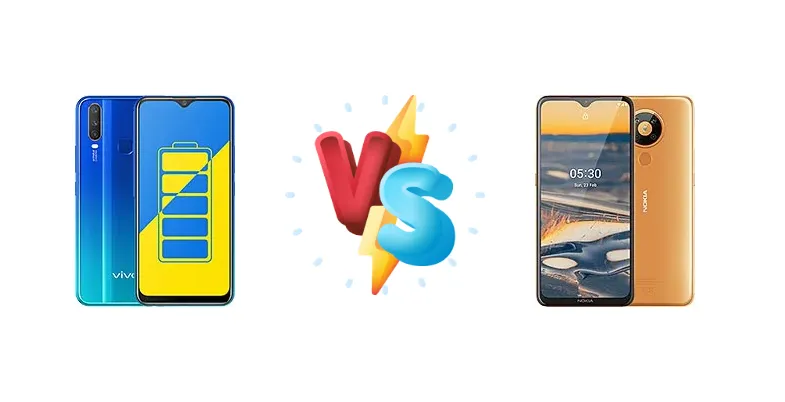
The sub-€100 smartphone market is fiercely competitive. Both the vivo Y15 and Nokia 5.3 aim to deliver essential smartphone functionality at an accessible price point. However, they take different approaches to achieving this, with the Y15 relying on MediaTek’s Helio P22 while the Nokia 5.3 opts for Qualcomm’s Snapdragon 665. This comparison dissects these key differences to determine which device offers the best value.
🏆 Quick Verdict
For most users, the Nokia 5.3 emerges as the better choice. Its Snapdragon 665 chipset, fabricated on an 11nm process, provides a noticeable performance advantage over the vivo Y15’s Helio P22, translating to smoother multitasking and a more responsive user experience. While both phones are budget-focused, the Nokia 5.3 offers a more future-proof platform.
| Network |
|---|
| 2G bands | GSM 850 / 900 / 1800 / 1900 | GSM 850 / 900 / 1800 / 1900 |
| 3G bands | HSDPA 850 / 900 / 2100 | HSDPA 850 / 900 / 1900 / 2100 - Global |
| 4G bands | 1, 3, 5, 8, 40, 41 | 1, 3, 5, 7, 8, 20, 28, 38, 40, 41 - Global |
| Speed | HSPA 42.2/5.76 Mbps, LTE (2CA) Cat6 300/50 Mbps | HSPA 42.2/5.76 Mbps, LTE Cat4 150/50 Mbps |
| Technology | GSM / HSPA / LTE | GSM / HSPA / LTE |
| | - | 1, 3, 5, 8, 40, 41 - India |
| Launch |
|---|
| Announced | 2019, May 28. Released 2019, May | 2020, March 19. Released 2020, April 02 |
| Status | Discontinued | Discontinued |
| Body |
|---|
| Build | Glass front, plastic back, plastic frame | Glass front (Gorilla Glass 3), plastic back, plastic frame |
| Dimensions | 159.4 x 76.8 x 8.9 mm (6.28 x 3.02 x 0.35 in) | 164.3 x 76.6 x 8.5 mm (6.47 x 3.02 x 0.33 in) |
| SIM | Nano-SIM + Nano-SIM | · Nano-SIM· Nano-SIM + Nano-SIM |
| Weight | 190.5 g (6.74 oz) | 185 g (6.53 oz) |
| Display |
|---|
| Protection | - | Corning Gorilla Glass 3 |
| Resolution | 720 x 1544 pixels, 19.3:9 ratio (~268 ppi density) | 720 x 1600 pixels, 20:9 ratio (~268 ppi density) |
| Size | 6.35 inches, 99.6 cm2 (~81.4% screen-to-body ratio) | 6.55 inches, 103.6 cm2 (~82.3% screen-to-body ratio) |
| Type | IPS LCD | IPS LCD, 450 nits (typ) |
| Platform |
|---|
| CPU | Octa-core 2.0 GHz Cortex-A53 | Octa-core (4x2.0 GHz Kryo 260 Gold & 4x1.8 GHz Kryo 260 Silver) |
| Chipset | Mediatek MT6762 Helio P22 (12 nm) | Qualcomm SM6125 Snapdragon 665 (11 nm) |
| GPU | PowerVR GE8320 | Adreno 610 |
| OS | Android 9.0 (Pie), Funtouch 9 | Android 10, upgradable to Android 11, Android One |
| Memory |
|---|
| Card slot | microSDXC (dedicated slot) | microSDXC (dedicated slot) |
| Internal | 64GB 4GB RAM | 64GB 3GB RAM, 64GB 4GB RAM, 64GB 6GB RAM, 128GB 4GB RAM |
| | eMMC 5.1 | eMMC 5.1 |
| Main Camera |
|---|
| Features | LED flash, HDR, panorama | LED flash, HDR, panorama |
| Quad | - | 13 MP, f/1.8, (wide), PDAF
5 MP, 13mm (ultrawide)
2 MP (macro)
Auxiliary lens |
| Triple | 13 MP, f/2.2, PDAF
8 MP, f/2.2, 16mm (ultrawide)
Auxiliary lens | - |
| Video | 1080p@30fps | 4K@30fps, 1080p@30fps |
| Selfie camera |
|---|
| Single | 16 MP, f/2.0, 26mm (wide), 1/3.06", 1.0µm | 8 MP, f/2.0, (wide) |
| Video | 1080p@30fps | 1080p@30fps |
| Sound |
|---|
| 3.5mm jack | Yes | Yes |
| 35mm jack | Yes | Yes |
| Loudspeaker | Yes | Yes |
| Comms |
|---|
| Bluetooth | 5.0, A2DP, LE | 4.2, A2DP, LE, aptX |
| NFC | No | Yes |
| Positioning | GPS, GLONASS, GALILEO, BDS | GPS, GLONASS, BDS |
| Radio | FM radio | FM radio |
| USB | microUSB 2.0, OTG | USB Type-C 2.0, OTG |
| WLAN | Wi-Fi 802.11 b/g/n, Wi-Fi Direct | Wi-Fi 802.11 b/g/n/ac, Wi-Fi Direct |
| Features |
|---|
| Sensors | Fingerprint (rear-mounted), accelerometer, proximity, compass | Fingerprint (rear-mounted), accelerometer, proximity |
| Battery |
|---|
| Charging | - | 10W wired |
| Type | 5000 mAh, non-removable | Li-Po 4000 mAh |
| Misc |
|---|
| Colors | Aqua Blue, Burgundy Red | Cyan, Sand, Charcoal |
| Models | - | TA-1234, TA-1223, TA-1227, TA-1229 |
| Price | About 70 EUR | About 290 EUR |
| SAR | 1.01 W/kg (head) 0.75 W/kg (body) | 1.03 W/kg (head) 0.95 W/kg (body) |
| SAR EU | - | 0.70 W/kg (head) 1.39 W/kg (body) |
| Pricing |
|---|
| 64GB 4GB RAM | € 72.66 | - |
vivo Y15
- Potentially lower initial cost
- Functional for basic smartphone tasks
- May offer slightly longer standby time due to less powerful chipset
- Noticeably slower performance compared to the Nokia 5.3
- Less efficient chipset leading to potential throttling
- Likely inferior camera image processing
Nokia 5.3
- Superior performance thanks to the Snapdragon 665
- More efficient chipset for better battery life under load
- Better image processing capabilities
- Qualcomm ecosystem benefits (potential for better software support)
- Slightly higher price point
- Slow 10W charging
- May not be significantly better in standby time
Display Comparison
Neither device boasts a standout display. Both are likely to feature 720p+ resolution LCD panels, typical for this price bracket. However, the Nokia 5.3 benefits from the more efficient Snapdragon 665, potentially allowing for slightly better brightness control and color reproduction. The absence of specific display specs necessitates a focus on the chipset’s impact on overall visual performance; a more powerful chipset can drive the display more effectively, even with similar panel characteristics.
Camera Comparison
Both phones likely feature a multi-camera setup, but details are scarce. Given the price point, expect primary sensors around 13MP. The Nokia 5.3’s image signal processor (ISP) within the Snapdragon 665 will likely offer superior image processing capabilities compared to the Helio P22’s ISP. This means better dynamic range, noise reduction, and overall image quality, particularly in challenging lighting conditions. The presence of a more powerful chipset allows for more complex computational photography algorithms. We can assume both will have a standard macro and depth sensor, but these are unlikely to be significant differentiators.
Performance
The core difference lies in the chipsets. The Nokia 5.3’s Qualcomm Snapdragon 665 (11nm) is architecturally superior to the vivo Y15’s MediaTek Helio P22 (12nm). The Snapdragon 665 utilizes a Kryo CPU architecture with a mix of performance (Gold) and efficiency (Silver) cores, offering a more balanced approach to power consumption and performance. The Helio P22 relies solely on Cortex-A53 cores, which are less efficient. This translates to a tangible advantage for the Nokia 5.3 in multitasking, app loading times, and overall system responsiveness. The 11nm process node of the Snapdragon 665 also contributes to better thermal efficiency, reducing the likelihood of performance throttling under sustained load.
Battery Life
While specific battery capacities are unknown, both phones likely house around 4000-5000mAh batteries. The Nokia 5.3’s 10W charging is a limiting factor. However, the Snapdragon 665’s superior power efficiency means it will likely deliver comparable or even better battery life despite the slower charging speed. The Helio P22, while less powerful, may consume less energy during idle tasks, but the performance difference will likely outweigh this benefit during active use.
Buying Guide
Buy the vivo Y15 if your primary needs are basic communication – calls, texts, and light social media – and you prioritize a minimal initial investment. It’s a functional device for first-time smartphone users or as a reliable backup. Buy the Nokia 5.3 if you value a smoother, more responsive experience for everyday tasks, occasional gaming, and appreciate the Qualcomm ecosystem’s generally better software support and optimization.
Frequently Asked Questions
❓ Will the Nokia 5.3 struggle with popular apps like WhatsApp and Facebook?
No, the Snapdragon 665 is more than capable of handling everyday apps like WhatsApp, Facebook, and web browsing without significant lag. While it's not a gaming powerhouse, it provides a smooth and responsive experience for common tasks.
❓ Is the Helio P22 in the vivo Y15 suitable for playing mobile games?
The Helio P22 can handle less demanding 2D games, but it will struggle with graphically intensive 3D titles. Expect low frame rates and potential stuttering in popular games like PUBG Mobile or Call of Duty: Mobile, even on low settings. The Nokia 5.3 offers a noticeably better gaming experience.
❓ How does the software experience differ between the vivo Y15 and Nokia 5.3?
The Nokia 5.3 benefits from being part of the Android One program, meaning it receives guaranteed software updates and security patches directly from Google. This provides a cleaner, more secure, and up-to-date software experience compared to vivo's Funtouch OS, which often includes pre-installed bloatware and a customized interface.
❓ Does the Nokia 5.3 support fast charging, and how long does it take to charge?
Unfortunately, the Nokia 5.3 only supports 10W wired charging, which is relatively slow. A full charge from 0% to 100% will likely take around 2.5 to 3.5 hours. While not ideal, the Snapdragon 665's efficiency means you won't be constantly needing to top up the battery.