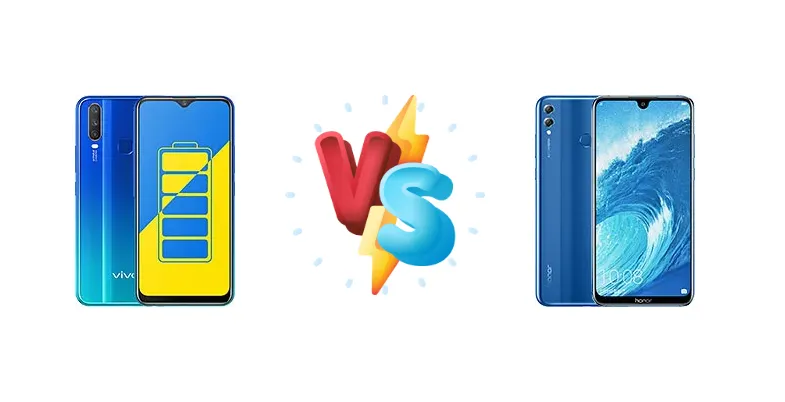
The sub-€150 smartphone market is fiercely competitive. The vivo Y15 and Honor 8X Max represent compelling options for users prioritizing affordability. However, they take different approaches: the Y15 focuses on a modern, if basic, feature set, while the 8X Max leans on a more established chipset for a smoother experience. This comparison dissects their strengths and weaknesses to help you choose.
🏆 Quick Verdict
For most users, the Honor 8X Max is the superior choice. Its Snapdragon 660 chipset provides a noticeable performance advantage over the Helio P22 in the vivo Y15, translating to smoother multitasking and a more responsive user experience. While the Y15 is cheaper, the 8X Max’s 18W charging and reverse charging capabilities add significant value.
| Network |
|---|
| 2G bands | GSM 850 / 900 / 1800 / 1900 | GSM 850 / 900 / 1800 / 1900 |
| 3G bands | HSDPA 850 / 900 / 2100 | HSDPA 850 / 900 / 2100 |
| 4G bands | 1, 3, 5, 8, 40, 41 | 1, 3, 5, 7, 8, 20, 38, 40, 41 - Global |
| Speed | HSPA 42.2/5.76 Mbps, LTE (2CA) Cat6 300/50 Mbps | HSPA 42.2/5.76 Mbps, LTE Cat4 150/50 Mbps |
| Technology | GSM / HSPA / LTE | GSM / CDMA / HSPA / LTE |
| | - | 1, 3, 5, 8, 38, 39, 40, 41 - China |
| Launch |
|---|
| Announced | 2019, May 28. Released 2019, May | 2018, September. Released 2018, September |
| Status | Discontinued | Discontinued |
| Body |
|---|
| Build | Glass front, plastic back, plastic frame | - |
| Dimensions | 159.4 x 76.8 x 8.9 mm (6.28 x 3.02 x 0.35 in) | 177.6 x 86.3 x 8.1 mm (6.99 x 3.40 x 0.32 in) |
| SIM | Nano-SIM + Nano-SIM | Nano-SIM + Nano-SIM |
| Weight | 190.5 g (6.74 oz) | 210 g (7.41 oz) |
| Display |
|---|
| Resolution | 720 x 1544 pixels, 19.3:9 ratio (~268 ppi density) | 1080 x 2244 pixels, 18.7:9 ratio (~350 ppi density) |
| Size | 6.35 inches, 99.6 cm2 (~81.4% screen-to-body ratio) | 7.12 inches, 127.8 cm2 (~83.4% screen-to-body ratio) |
| Type | IPS LCD | IPS LCD |
| Platform |
|---|
| CPU | Octa-core 2.0 GHz Cortex-A53 | Octa-core (4x1.95 GHz Kryo 260 Gold & 4x1.8 GHz Kryo 260 Silver) |
| Chipset | Mediatek MT6762 Helio P22 (12 nm) | Qualcomm SDM660 Snapdragon 660 (14 nm) |
| GPU | PowerVR GE8320 | Adreno 512 |
| OS | Android 9.0 (Pie), Funtouch 9 | Android 8.1 (Oreo), upgradable to Android 9 (Pie), EMUI 9 |
| Memory |
|---|
| Card slot | microSDXC (dedicated slot) | microSDXC (dedicated slot) |
| Internal | 64GB 4GB RAM | 64GB 4GB RAM, 64GB 6GB RAM, 128GB 4GB RAM, 128GB 6GB RAM |
| | eMMC 5.1 | eMMC 5.1 |
| Main Camera |
|---|
| Dual | - | 16 MP, f/2.0, PDAF
Auxiliary lens |
| Features | LED flash, HDR, panorama | LED flash, panorama, HDR |
| Triple | 13 MP, f/2.2, PDAF
8 MP, f/2.2, 16mm (ultrawide)
Auxiliary lens | - |
| Video | 1080p@30fps | 1080p@30fps |
| Selfie camera |
|---|
| Features | - | HDR |
| Single | 16 MP, f/2.0, 26mm (wide), 1/3.06", 1.0µm | 8 MP, f/2.0 |
| Video | 1080p@30fps | 1080p@30fps |
| Sound |
|---|
| 3.5mm jack | Yes | Yes |
| 35mm jack | Yes | Yes |
| Loudspeaker | Yes | Yes, with stereo speakers |
| Comms |
|---|
| Bluetooth | 5.0, A2DP, LE | 4.2, A2DP, LE |
| NFC | No | No |
| Positioning | GPS, GLONASS, GALILEO, BDS | GPS, GLONASS, BDS |
| Radio | FM radio | FM radio |
| USB | microUSB 2.0, OTG | microUSB 2.0, OTG |
| WLAN | Wi-Fi 802.11 b/g/n, Wi-Fi Direct | Wi-Fi 802.11 a/b/g/n/ac, Wi-Fi Direct |
| Features |
|---|
| Sensors | Fingerprint (rear-mounted), accelerometer, proximity, compass | Fingerprint (rear-mounted), accelerometer, gyro, proximity, compass |
| Battery |
|---|
| Charging | - | 18W wired
5W reverse wired |
| Type | 5000 mAh, non-removable | Li-Po 5000 mAh, non-removable |
| Misc |
|---|
| Colors | Aqua Blue, Burgundy Red | Black, Blue, Red |
| Models | - | ARE-AL00, ARE-L22HN, ARE-AL10 |
| Price | About 70 EUR | About 250 EUR |
| SAR | 1.01 W/kg (head) 0.75 W/kg (body) | - |
| Pricing |
|---|
| 64GB 4GB RAM | € 72.66 | - |
vivo Y15
- Potentially lower price point
- Modern design (likely)
- May be more readily available in certain markets
- Significantly weaker performance
- Slower charging speeds
- Inferior camera performance (likely)
Honor 8X Max
- Superior performance with Snapdragon 660
- Faster 18W charging
- 5W reverse wired charging
- Potentially higher price
- May be larger and less pocketable
- Older chipset architecture
Display Comparison
Neither device boasts a standout display. Both likely utilize IPS LCD panels, common in this price bracket. The Honor 8X Max’s larger size (implied by 'Max' branding) suggests a more immersive viewing experience, but without specific nit brightness or color gamut data, it’s difficult to quantify. The Y15’s display is likely optimized for power efficiency, given the Helio P22’s limitations. Expect both to be adequate for everyday use, but not ideal for HDR content or outdoor visibility.
Camera Comparison
Without detailed camera specs, a direct comparison is challenging. However, the market positioning suggests the Honor 8X Max likely features a more capable camera system. While both phones likely include a primary camera and depth sensor, the Snapdragon 660’s image signal processor (ISP) offers superior image processing capabilities. Expect better dynamic range and noise reduction on the 8X Max. The Y15’s camera will likely suffice for casual snapshots, but will struggle in low-light conditions. The presence of 18W charging on the 8X Max suggests a more feature-rich overall package, potentially extending to camera features.
Performance
The core difference lies in the chipsets. The Qualcomm Snapdragon 660 (14nm) in the Honor 8X Max is significantly more powerful than the MediaTek Helio P22 (12nm) in the vivo Y15. The Snapdragon 660’s Kryo 260 cores – a mix of performance and efficiency cores – offer a more balanced and responsive experience. While the Helio P22’s octa-core configuration sounds impressive, its Cortex-A53 cores are less efficient and deliver lower peak performance. This translates to noticeable lag in the Y15 during multitasking and demanding apps. The 8X Max will handle gaming and heavier applications with greater ease. The 14nm process of the SDM660, while older, is well-optimized, and the architectural advantages outweigh the slightly smaller node size of the P22.
Battery Life
The Honor 8X Max’s 18W wired charging is a significant advantage. While the Y15’s battery capacity is unknown, the slower charging speeds suggest a focus on minimizing cost rather than maximizing convenience. The 8X Max also includes 5W reverse wired charging, allowing it to top up other devices – a feature absent on the Y15. The Snapdragon 660’s efficiency, combined with a potentially larger battery (implied by the 'Max' branding), should result in comparable, if not better, real-world battery life on the 8X Max despite the faster charging.
Buying Guide
Buy the vivo Y15 if you need a very basic smartphone for essential tasks like calls, messaging, and light social media use, and your budget is extremely limited. Buy the Honor 8X Max if you prioritize a smoother, more responsive user experience, faster charging, and the convenience of reverse wireless charging, even if it means spending a bit more.
Frequently Asked Questions
❓ Will the vivo Y15 struggle with popular apps like WhatsApp and Facebook?
The Helio P22 chipset in the vivo Y15 is adequate for basic tasks, but running multiple apps simultaneously, or using resource-intensive versions of WhatsApp and Facebook, may result in noticeable lag and slowdowns. The Honor 8X Max’s Snapdragon 660 will handle these apps much more smoothly.
❓ Is the 5W reverse charging on the Honor 8X Max useful for everyday use?
While 5W reverse charging isn't incredibly fast, it's surprisingly useful for topping up accessories like Bluetooth headphones, smartwatches, or even a friend's phone in a pinch. The vivo Y15 lacks this feature entirely.
❓ Can the vivo Y15 handle basic mobile games like Candy Crush or Subway Surfers?
Yes, the vivo Y15 can handle less demanding mobile games like Candy Crush or Subway Surfers. However, more graphically intensive games will likely experience significant frame rate drops and lag, making them less enjoyable.
❓ How much faster is the charging on the Honor 8X Max compared to the vivo Y15?
The Honor 8X Max’s 18W charging is significantly faster than the likely 5-10W charging on the vivo Y15. Expect the 8X Max to charge from 0-100% in around 2-2.5 hours, while the Y15 could take 4+ hours.