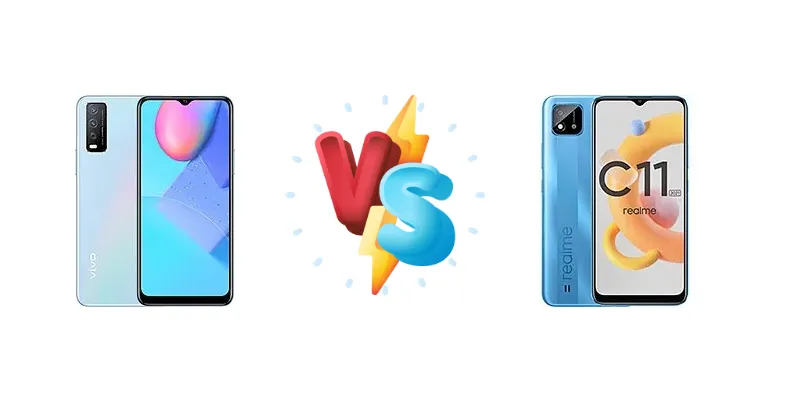
The ultra-budget smartphone segment is fiercely competitive, and the vivo Y12s and Realme C11 (2021) represent two compelling options for users prioritizing affordability. While both aim to deliver essential smartphone functionality at a low price point, they differ significantly in their underlying hardware, particularly in their chipsets. This comparison will dissect those differences to determine which device offers the best value.
🏆 Quick Verdict
For the average user seeking a slightly smoother and more efficient experience, the vivo Y12s is the better choice. Its Mediatek Helio P35, built on a 12nm process, offers a performance advantage over the Realme C11 (2021)'s older, 28nm Unisoc SC9863A, translating to better responsiveness in everyday tasks and potentially longer battery life.
| Network |
|---|
| 2G bands | GSM 850 / 900 / 1800 / 1900 | GSM 850 / 900 / 1800 / 1900 |
| 3G bands | HSDPA 850 / 900 / 2100 | HSDPA 850 / 900 / 1900 / 2100 |
| 4G bands | 1, 3, 5, 7, 8, 38, 40, 41 | 1, 3, 5, 8, 38, 40, 41 |
| Speed | HSPA, LTE | HSPA, LTE |
| Technology | GSM / HSPA / LTE | GSM / HSPA / LTE |
| Launch |
|---|
| Announced | 2020, November 16. Released 2020, November 16 | 2021, June 28 |
| Status | Discontinued | Available. Released 2021, June 28 |
| Body |
|---|
| Build | Glass front, plastic back, plastic frame | Glass front, plastic frame, plastic back |
| Dimensions | 164.4 x 76.3 x 8.4 mm (6.47 x 3.00 x 0.33 in) | 165.2 x 76.4 x 8.9 mm (6.50 x 3.01 x 0.35 in) |
| SIM | Nano-SIM + Nano-SIM | Nano-SIM + Nano-SIM |
| Weight | 191 g (6.74 oz) | 190 g (6.70 oz) |
| | - | Splash resistant design |
| Display |
|---|
| Resolution | 720 x 1600 pixels, 20:9 ratio (~270 ppi density) | 720 x 1600 pixels, 20:9 ratio (~269 ppi density) |
| Size | 6.51 inches, 102.3 cm2 (~81.6% screen-to-body ratio) | 6.52 inches, 102.6 cm2 (~81.3% screen-to-body ratio) |
| Type | IPS LCD | IPS LCD, 400 nits (typ) |
| Platform |
|---|
| CPU | Octa-core (4x2.35 GHz Cortex-A53 & 4x1.8 GHz Cortex-A53) | Octa-core (4x1.6 GHz Cortex-A55 & 4x1.2 GHz Cortex-A55) |
| Chipset | Mediatek MT6765 Helio P35 (12 nm) | Unisoc SC9863A (28 nm) |
| GPU | PowerVR GE8320 | IMG8322 |
| OS | Android 10, Funtouch 11 | Android 11, Realme Go UI |
| Memory |
|---|
| Card slot | microSDXC (dedicated slot) | microSDXC (dedicated slot) |
| Internal | 32GB 3GB RAM, 32GB 4GB RAM, 64GB 4GB RAM, 128GB 4GB RAM | 32GB 2GB RAM, 64GB 4GB RAM |
| | - | eMMC 5.1 |
| Main Camera |
|---|
| Dual | 13 MP, f/2.2, (wide), PDAF
Auxiliary lens | - |
| Features | LED flash, Panorama | LED flash, HDR, panorama |
| Single | - | 8 MP, f/2.0, (wide), AF |
| Video | 1080p@30fps | 1080p@30fps |
| Selfie camera |
|---|
| Features | - | HDR, panorama |
| Single | 8 MP, f/1.8 | 5 MP, f/2.2, (wide) |
| Video | 1080p@30fps | 1080p@30fps |
| Sound |
|---|
| 3.5mm jack | Yes | Yes |
| 35mm jack | Yes | Yes |
| Loudspeaker | Yes | Yes |
| Comms |
|---|
| Bluetooth | 5.0, A2DP, LE | 4.2, A2DP |
| NFC | No | No |
| Positioning | GPS, GLONASS, GALILEO, BDS | GPS, GLONASS, GALILEO, BDS |
| Radio | FM radio | Unspecified |
| USB | microUSB 2.0, OTG | microUSB 2.0, OTG |
| WLAN | Wi-Fi 802.11 a/b/g/n/ac, dual-band, Wi-Fi Direct | Wi-Fi 802.11 b/g/n |
| Features |
|---|
| Sensors | Fingerprint (side-mounted), accelerometer, proximity, compass | Accelerometer, gyro, proximity, compass |
| Battery |
|---|
| Charging | 10W wired
5W reverse wired | 10W wired
Reverse wired |
| Type | 5000 mAh | 5000 mAh |
| Misc |
|---|
| Colors | Glacier Blue, Phantom Black | Cool Blue, Cool Grey |
| Models | V2026, V2033, V2042 | RMX3231 |
| Price | About 120 EUR | About 80 EUR |
vivo Y12s
- More efficient Mediatek Helio P35 chipset
- Potentially smoother multitasking experience
- Likely slightly better battery life
- 10W charging is slow
- Basic camera system
Realme C11 (2021)
- Lowest possible price point
- Functional for basic tasks
- Reverse wired charging
- Older, less efficient Unisoc SC9863A chipset
- Noticeably slower performance
- Potential for more thermal throttling
Display Comparison
Neither device boasts a standout display. Both likely feature basic LCD panels with 720p+ resolution, typical for this price bracket. However, detailed display specs like brightness and color accuracy are unavailable. The focus here is on functionality, not visual fidelity. Bezels are expected to be relatively thick on both models, maximizing screen real estate within a budget.
Camera Comparison
Camera performance is likely to be similar on both devices, with both likely featuring a primary sensor paired with basic auxiliary lenses. Detailed sensor information is missing, but given the price point, expectations should be tempered. The Realme C11 (2021) may include a 5MP main camera, while the Y12s likely has an 8MP main camera. Image processing will be basic on both, relying heavily on software algorithms to enhance photos. The presence of 2MP macro or depth sensors on either device is largely marketing fluff and won't significantly impact image quality.
Performance
The core difference lies in the chipsets. The vivo Y12s utilizes the Mediatek Helio P35, a 12nm octa-core processor with Cortex-A53 cores clocked up to 2.35 GHz. This newer process node and higher clock speeds provide a significant advantage over the Realme C11 (2021)'s Unisoc SC9863A. The SC9863A, built on a 28nm process, features Cortex-A55 cores, but clocked lower at 1.6 GHz and 1.2 GHz. While both are octa-core, the architectural improvements and process node of the Helio P35 translate to better performance per watt. This means the Y12s will likely handle multitasking and app loading more smoothly, and potentially experience less thermal throttling under sustained load. The Realme C11's older chipset will struggle more with demanding apps.
Battery Life
Both phones offer 10W wired charging and reverse wired charging. While the battery capacities are not specified, both are likely in the 4000-5000 mAh range. The Helio P35's superior power efficiency in the Y12s could translate to slightly longer battery life despite potentially having a similar capacity to the Realme C11 (2021). The 10W charging is slow by modern standards, requiring several hours for a full charge on both devices.
Buying Guide
Buy the vivo Y12s if you need a phone that feels a bit more responsive for basic multitasking and app usage, and if you value a slightly more modern chipset architecture. Buy the Realme C11 (2021) if you prioritize absolute lowest cost and are willing to accept a noticeable performance trade-off, primarily using the phone for calls, texts, and very light app usage. Both are suitable for first-time smartphone users or as emergency backup devices.
Frequently Asked Questions
❓ Will the Realme C11 (2021) struggle with popular apps like WhatsApp and Facebook?
While the Realme C11 (2021) can run these apps, the Unisoc SC9863A chipset may result in noticeable lag and slower loading times, especially when multitasking. The vivo Y12s, with its Helio P35, will provide a smoother experience for these common applications.
❓ Is the reverse wired charging feature on either phone useful for anything beyond emergencies?
The 10W reverse wired charging on both devices is extremely slow and best suited for emergency situations, such as providing a small charge to a wireless earbud case. It's not practical for significantly charging other smartphones.
❓ Can either of these phones handle basic mobile gaming?
Both phones can handle very basic 2D games. However, demanding 3D games will likely be unplayable or experience significant frame rate drops due to the limited processing power of their respective chipsets. The Y12s will offer a slightly better gaming experience, but don't expect high performance.