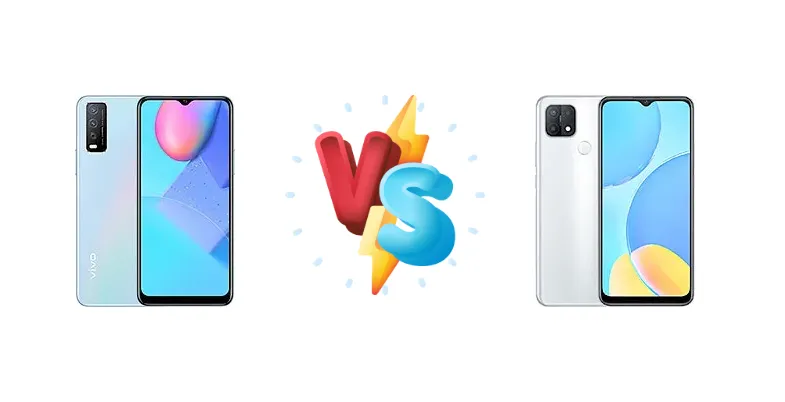
The vivo Y12s and Oppo A15s represent the fiercely competitive ultra-budget smartphone segment. Both devices rely on the Mediatek Helio P35 chipset, making a direct comparison crucial for consumers seeking the most value. This analysis goes beyond simple spec sheets to reveal which phone delivers a superior user experience within this price bracket.
🏆 Quick Verdict
For the average user prioritizing a slightly more versatile charging solution, the vivo Y12s edges out the Oppo A15s. While both phones offer identical core performance due to the Helio P35, the Y12s’ inclusion of 5W reverse wired charging provides a small but potentially useful feature for emergency power sharing.
| Network |
|---|
| 2G bands | GSM 850 / 900 / 1800 / 1900 | GSM 850 / 900 / 1800 / 1900 |
| 3G bands | HSDPA 850 / 900 / 2100 | HSDPA 850 / 900 / 2100 |
| 4G bands | 1, 3, 5, 7, 8, 38, 40, 41 | 1, 3, 5, 8, 38, 40, 41 |
| Speed | HSPA, LTE | HSPA, LTE |
| Technology | GSM / HSPA / LTE | GSM / HSPA / LTE |
| Launch |
|---|
| Announced | 2020, November 16. Released 2020, November 16 | 2020, December 18. Released 2020, December 18 |
| Status | Discontinued | Discontinued |
| Body |
|---|
| Build | Glass front, plastic back, plastic frame | Glass front, plastic back, plastic frame |
| Dimensions | 164.4 x 76.3 x 8.4 mm (6.47 x 3.00 x 0.33 in) | 164 x 75.4 x 7.9 mm (6.46 x 2.97 x 0.31 in) |
| SIM | Nano-SIM + Nano-SIM | Nano-SIM + Nano-SIM |
| Weight | 191 g (6.74 oz) | 177 g (6.24 oz) |
| Display |
|---|
| Resolution | 720 x 1600 pixels, 20:9 ratio (~270 ppi density) | 720 x 1600 pixels, 20:9 ratio (~269 ppi density) |
| Size | 6.51 inches, 102.3 cm2 (~81.6% screen-to-body ratio) | 6.52 inches, 102.6 cm2 (~83.0% screen-to-body ratio) |
| Type | IPS LCD | IPS LCD, 480 nits (typ) |
| Platform |
|---|
| CPU | Octa-core (4x2.35 GHz Cortex-A53 & 4x1.8 GHz Cortex-A53) | Octa-core (4x2.35 GHz Cortex-A53 & 4x1.8 GHz Cortex-A53) |
| Chipset | Mediatek MT6765 Helio P35 (12 nm) | Mediatek MT6765 Helio P35 (12 nm) |
| GPU | PowerVR GE8320 | PowerVR GE8320 |
| OS | Android 10, Funtouch 11 | Android 10, ColorOS 7.2 |
| Memory |
|---|
| Card slot | microSDXC (dedicated slot) | microSDXC |
| Internal | 32GB 3GB RAM, 32GB 4GB RAM, 64GB 4GB RAM, 128GB 4GB RAM | 64GB 4GB RAM, 128GB 4GB RAM |
| | - | eMMC 5.1 |
| Main Camera |
|---|
| Dual | 13 MP, f/2.2, (wide), PDAF
Auxiliary lens | - |
| Features | LED flash, Panorama | LED flash, HDR, panorama |
| Triple | - | 13 MP, f/2.2, (wide), 1/3.1", 1.12µm, PDAF
2 MP (macro)
Auxiliary lens |
| Video | 1080p@30fps | 1080p@30fps |
| Selfie camera |
|---|
| Features | - | HDR |
| Single | 8 MP, f/1.8 | 8 MP, f/2.0, (wide) |
| Video | 1080p@30fps | 1080p@30fps |
| Sound |
|---|
| 3.5mm jack | Yes | Yes |
| 35mm jack | Yes | Yes |
| Loudspeaker | Yes | Yes |
| Comms |
|---|
| Bluetooth | 5.0, A2DP, LE | 5.0, A2DP, LE, aptX |
| NFC | No | No |
| Positioning | GPS, GLONASS, GALILEO, BDS | GPS, GLONASS, GALILEO, BDS |
| Radio | FM radio | FM radio |
| USB | microUSB 2.0, OTG | microUSB 2.0, OTG |
| WLAN | Wi-Fi 802.11 a/b/g/n/ac, dual-band, Wi-Fi Direct | Wi-Fi 802.11 b/g/n, Wi-Fi Direct |
| Features |
|---|
| Sensors | Fingerprint (side-mounted), accelerometer, proximity, compass | Fingerprint (rear-mounted), accelerometer, proximity |
| Battery |
|---|
| Charging | 10W wired
5W reverse wired | 10W wired |
| Type | 5000 mAh | Li-Po 4230 mAh |
| Misc |
|---|
| Colors | Glacier Blue, Phantom Black | Dynamic Black, Fancy White |
| Models | V2026, V2033, V2042 | CPH2179 |
| Price | About 120 EUR | About 130 EUR |
vivo Y12s
- Includes 5W reverse wired charging for emergency power sharing.
- Potentially wider global availability and support.
- Identical Helio P35 performance to the Oppo A15s.
- Software experience (Funtouch OS) can be more heavily customized than ColorOS.
- No specified display details (brightness, color accuracy).
Oppo A15s
- Potentially cleaner and lighter software experience with ColorOS.
- Identical Helio P35 performance to the vivo Y12s.
- Competitive pricing within the ultra-budget segment.
- Lacks reverse wired charging functionality.
- No specified display details (brightness, color accuracy).
Display Comparison
Neither vivo nor Oppo provide detailed display specifications beyond the panel type. Given the price point, both likely utilize IPS LCD panels with 720p+ resolution. The absence of high refresh rates or advanced features like LTPO is expected. The user experience will likely be similar, with color accuracy and brightness being the differentiating factors, though without specific nit ratings, it's impossible to declare a clear winner. Bezels are likely comparable, reflecting the budget nature of both devices.
Camera Comparison
Camera specifications are likely to be similar, focusing on a primary sensor with a modest resolution. The inclusion of 2MP macro or depth sensors on either device should be viewed with skepticism, as their image quality is often limited. Without knowing the sensor size or aperture of the main cameras, it’s difficult to assess image quality differences. Image processing algorithms will play a significant role, and Oppo’s ColorOS often prioritizes vibrant, saturated colors, while vivo’s Funtouch OS tends towards a more natural look. The real-world difference will depend on user preference.
Performance
Both the vivo Y12s and Oppo A15s are powered by the Mediatek Helio P35 (MT6765), a 12nm chipset featuring an octa-core CPU configuration with four cores clocked at 2.35 GHz and four at 1.8 GHz. This means CPU performance will be virtually identical between the two. The GPU is also the same, limiting gaming performance to light titles and older games at lower settings. RAM configurations are not specified, but will heavily influence multitasking capabilities. Thermal management will likely be adequate for basic tasks, but sustained heavy loads could lead to throttling due to the passive cooling solutions typically found in this segment.
Battery Life
Both devices feature 10W wired charging, a standard offering in this price range. While the battery capacity isn't specified, it's likely around 4000-5000 mAh in both cases. A full charge will likely take around 2-3 hours. The vivo Y12s distinguishes itself with 5W reverse wired charging, allowing it to act as a power bank for other devices, albeit at a slow rate. This is a niche feature, but valuable for users who frequently travel or rely on multiple devices.
Buying Guide
Buy the vivo Y12s if you occasionally need to top up other devices via reverse charging, or if you prefer a brand with a slightly wider global presence. Buy the Oppo A15s if you prioritize a potentially cleaner software experience (Oppo’s ColorOS is often lighter than vivo’s Funtouch OS, though this varies by region) and are comfortable with a standard 10W charging setup. Both are excellent choices for first-time smartphone users or those needing a reliable secondary device.
Frequently Asked Questions
❓ Will the Helio P35 in either phone struggle with popular apps like WhatsApp and Facebook?
No, the Helio P35 is sufficient for running everyday apps like WhatsApp, Facebook, and web browsing. However, expect some slowdowns when multitasking heavily or running demanding applications. These phones are designed for basic smartphone functionality, not intensive tasks.
❓ Can either the vivo Y12s or Oppo A15s play PUBG Mobile?
PUBG Mobile is playable on both devices, but only at the lowest graphics settings and frame rates. Expect significant frame drops and a less-than-ideal gaming experience. These phones are not designed for serious mobile gaming.
❓ What type of storage does each phone use, and is it expandable?
While not specified, both phones likely use eMMC storage, which is common in this price range. Expandability via microSD card is highly probable, but the maximum supported capacity varies by region and model. Check the product listing for specific details.
❓ How does the software update policy differ between vivo and Oppo for these models?
Software update support for these ultra-budget devices is typically limited. Expect one major Android update at most, and security patches may be infrequent. Oppo generally offers slightly better software support than vivo in this segment, but neither guarantees long-term updates.