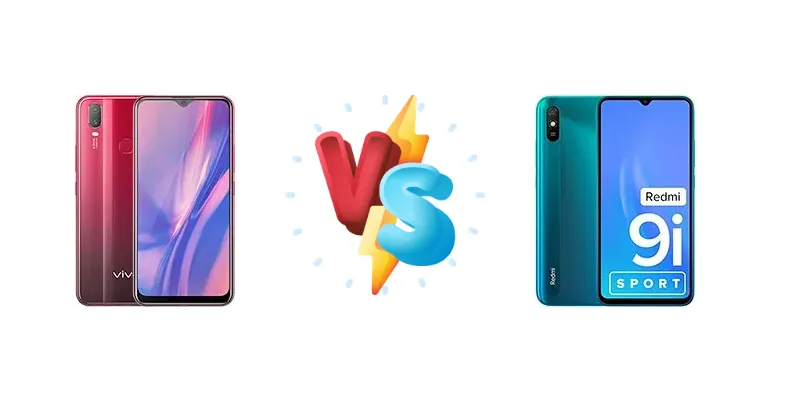
The sub-$150 smartphone market is fiercely competitive. Both the vivo Y12i and Xiaomi Redmi 9i Sport aim to deliver essential smartphone functionality at an accessible price. This comparison dissects their core components – from chipsets to charging – to determine which device offers the best value for users prioritizing affordability and reliability.
🏆 Quick Verdict
For the average user focused on basic tasks like calling, messaging, and light social media, the Xiaomi Redmi 9i Sport edges out the vivo Y12i. Its slightly faster CPU clock speeds in the Helio G25 chipset provide a marginal, but noticeable, performance boost in everyday responsiveness.
| Network |
|---|
| 2G bands | GSM 850 / 900 / 1800 / 1900 | GSM 850 / 900 / 1800 / 1900 |
| 3G bands | HSDPA 850 / 900 / 2100 | HSDPA 850 / 900 / 2100 |
| 4G bands | 1, 3, 5, 8, 40 | 1, 3, 5, 8, 40, 41 |
| Speed | HSPA 42.2/5.76 Mbps, LTE (2CA) Cat6 300/50 Mbps | HSPA, LTE |
| Technology | GSM / HSPA / LTE | GSM / HSPA / LTE |
| Launch |
|---|
| Announced | 2020, July 10. Released 2020, July 10 | 2021, September 28 |
| Status | Discontinued | Available. Released 2021, September 28 |
| Body |
|---|
| Build | Glass front, plastic back, plastic frame | - |
| Dimensions | 159.4 x 76.8 x 8.9 mm (6.28 x 3.02 x 0.35 in) | 164.9 x 77.1 x 9 mm (6.49 x 3.04 x 0.35 in) |
| SIM | Nano-SIM + Nano-SIM | Nano-SIM + Nano-SIM |
| Weight | 190.5 g (6.74 oz) | 194 g (6.84 oz) |
| | - | Water-repellent coating |
| Display |
|---|
| Resolution | 720 x 1544 pixels, 19.3:9 ratio (~268 ppi density) | 720 x 1600 pixels, 20:9 ratio (~269 ppi density) |
| Size | 6.35 inches, 99.6 cm2 (~81.4% screen-to-body ratio) | 6.53 inches, 102.9 cm2 (~81.0% screen-to-body ratio) |
| Type | IPS LCD | IPS LCD, 400 nits (typ) |
| Platform |
|---|
| CPU | Octa-core (4x1.95 GHz Cortex-A53 & 4x1.45 GHz Cortex A53) | Octa-core (4x2.0 GHz Cortex-A53 & 4x1.5 GHz Cortex-A53) |
| Chipset | Qualcomm SDM439 Snapdragon 439 (12 nm) | Mediatek MT6762G Helio G25 (12 nm) |
| GPU | Adreno 505 | PowerVR GE8320 |
| OS | Android 9.0 (Pie), Funtouch 9.1 | Android 10, MIUI 12 |
| Memory |
|---|
| Card slot | microSDXC (uses shared SIM slot) | microSDXC (dedicated slot) |
| Internal | 32GB 3GB RAM | 64GB 4GB RAM, 128GB 4GB RAM |
| | eMMC 5.1 | eMMC 5.1 |
| Main Camera |
|---|
| Dual | 13 MP, f/2.2, PDAF
Auxiliary lens | - |
| Features | LED flash, HDR, panorama | LED flash, HDR |
| Single | 8 MP, f/1.8 | 13 MP, f/2.2, 28mm (wide), 1.0µm, PDAF |
| Video | 1080p@30fps | 1080p@30fps |
| Selfie camera |
|---|
| Features | - | HDR |
| Single | 8 MP, f/1.8 | 5 MP, f/2.2, (wide), 1.12µm |
| Video | 1080p@30fps | 1080p@30fps |
| Sound |
|---|
| 3.5mm jack | Yes | Yes |
| 35mm jack | Yes | Yes |
| Loudspeaker | Yes | Yes |
| Comms |
|---|
| Bluetooth | 4.0, A2DP, LE | 5.0, A2DP, LE |
| NFC | No | No |
| Positioning | GPS, GLONASS, GALILEO, BDS | GPS, GLONASS, BDS |
| Radio | FM radio | FM radio |
| USB | microUSB 2.0, OTG | microUSB 2.0, OTG |
| WLAN | Wi-Fi 802.11 b/g/n, Wi-Fi Direct | Wi-Fi 802.11 а/b/g/n, Wi-Fi Direct |
| Features |
|---|
| Sensors | Fingerprint (rear-mounted), accelerometer, proximity, compass | Accelerometer, proximity, compass |
| Battery |
|---|
| Charging | 10W wired | 10W wired |
| Type | 5000 mAh | Li-Po 5000 mAh |
| Misc |
|---|
| Colors | Agate Red, Mineral Blue | Carbon Black, Coral Green, Metallic Blue |
| Price | About 110 EUR | About 100 EUR |
vivo Y12i
- Potentially better battery efficiency with Snapdragon 439
- Vivo's reputation for stable software
- Conservative, user-friendly interface
- Slightly slower CPU performance compared to Redmi 9i Sport
- Likely less responsive UI
- Limited gaming capabilities
Xiaomi Redmi 9i Sport
- Slightly faster CPU clock speeds with Helio G25
- More responsive user interface
- Xiaomi’s MIUI offers more customization
- MIUI can be resource-intensive
- Potentially shorter battery life under heavy load
- More pre-installed bloatware
Display Comparison
Neither device boasts a standout display. Both likely utilize standard IPS LCD panels, given their price point. The absence of detailed display specs necessitates focusing on performance impact. The chipset’s GPU will be the limiting factor for graphics rendering, rather than panel quality. Expect similar viewing angles and color reproduction on both.
Camera Comparison
Camera performance on both devices will be limited. Given the market segment, expect basic image quality suitable for casual snapshots. Detailed camera specs are unavailable, but it’s safe to assume both feature a primary sensor and potentially a depth or macro lens of minimal resolution. Image processing will be crucial, and Xiaomi’s software often prioritizes vibrant, saturated colors, while vivo tends towards more natural tones. The absence of OIS on either device means low-light photography will be challenging.
Performance
The core difference lies in the chipsets: Qualcomm’s Snapdragon 439 in the vivo Y12i versus MediaTek’s Helio G25 in the Redmi 9i Sport. While both are 12nm chips, the Helio G25 features a slightly higher peak CPU clock speed (2.0 GHz vs 1.95 GHz). This translates to a small advantage in app launch times and general UI fluidity for the Redmi 9i Sport. Both CPUs utilize the same Cortex-A53 architecture, meaning the performance gap won’t be dramatic. The Snapdragon 439 is known for its efficiency, potentially offering slightly better battery life during sustained use, but the difference is likely minimal. Both phones will struggle with demanding games.
Battery Life
Both phones feature 10W wired charging, indicating similar charging speeds – expect around 2.5-3 hours for a full charge. Battery capacity is not specified, but given the target market, both likely house batteries in the 4000-5000 mAh range. The Snapdragon 439’s efficiency *could* translate to slightly longer battery life for the vivo Y12i, but the Helio G25’s performance advantage might lead to more frequent charging cycles if the phone is used heavily.
Buying Guide
Buy the vivo Y12i if you prioritize a brand with a strong track record for software stability and a generally conservative, power-efficient approach. This makes it a good choice for first-time smartphone users or those who value simplicity. Buy the Xiaomi Redmi 9i Sport if you prefer a slightly more responsive experience for the same price, and are comfortable with Xiaomi’s MIUI software, which offers more customization options but can be more resource-intensive.
Frequently Asked Questions
❓ Will the Redmi 9i Sport struggle with popular apps like WhatsApp and Facebook?
While the Helio G25 can handle basic apps like WhatsApp and Facebook, expect some lag when multitasking or using these apps extensively. The 9i Sport is best suited for single-app usage at a time to maintain a smooth experience.
❓ Is the 10W charging speed acceptable for daily use?
10W charging is slow by modern standards. Both phones will take over two hours to fully charge. This is typical for phones in this price range, and users should plan to charge overnight.
❓ Can I play PUBG Mobile on either of these phones?
Playing PUBG Mobile on either the vivo Y12i or Redmi 9i Sport is possible, but only on the lowest graphics settings and with significant frame rate drops. The chipsets are not designed for demanding gaming.
❓ Which phone is better for someone upgrading from a feature phone?
The vivo Y12i is arguably better for first-time smartphone users. Its simpler software and focus on efficiency make it less overwhelming than Xiaomi’s MIUI, which has many features and customization options.