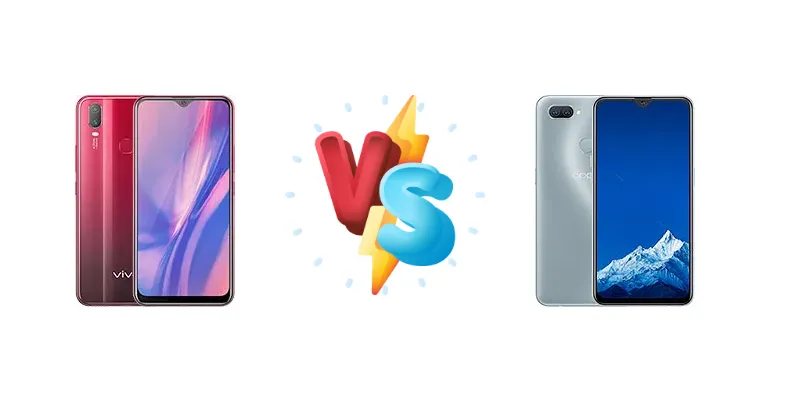
The vivo Y12i and Oppo A12s represent the fiercely competitive entry-level smartphone market. Both aim to deliver essential smartphone functionality at an incredibly affordable price point. However, they diverge in their core processing power, utilizing different chipsets from Qualcomm and MediaTek respectively. This comparison will dissect those differences, and help you determine which device best suits your needs.
🏆 Quick Verdict
For the average user prioritizing consistent performance in everyday tasks, the Oppo A12s edges out the vivo Y12i. Its Helio P35, with higher clocked Cortex-A53 cores, provides a noticeable responsiveness advantage. While both offer similar battery life and charging, the A12s’ slightly faster processor makes it the better all-rounder.
| Network |
|---|
| 2G bands | GSM 850 / 900 / 1800 / 1900 | GSM 850 / 900 / 1800 / 1900 |
| 3G bands | HSDPA 850 / 900 / 2100 | HSDPA 850 / 900 / 2100 |
| 4G bands | 1, 3, 5, 8, 40 | 1, 3, 5, 8, 38, 40, 41 |
| EDGE | - | No |
| GPRS | - | Yes |
| Speed | HSPA 42.2/5.76 Mbps, LTE (2CA) Cat6 300/50 Mbps | HSPA, LTE |
| Technology | GSM / HSPA / LTE | GSM / HSPA / LTE |
| Launch |
|---|
| Announced | 2020, July 10. Released 2020, July 10 | 2020, July 14. Released 2020, July 26 |
| Status | Discontinued | Discontinued |
| Body |
|---|
| Build | Glass front, plastic back, plastic frame | Glass front, plastic back, plastic frame |
| Dimensions | 159.4 x 76.8 x 8.9 mm (6.28 x 3.02 x 0.35 in) | 155.9 x 75.5 x 8.3 mm (6.14 x 2.97 x 0.33 in) |
| SIM | Nano-SIM + Nano-SIM | Nano-SIM + Nano-SIM |
| Weight | 190.5 g (6.74 oz) | 165 g (5.82 oz) |
| Display |
|---|
| Protection | - | Corning Gorilla Glass 3 |
| Resolution | 720 x 1544 pixels, 19.3:9 ratio (~268 ppi density) | 720 x 1520 pixels, 19:9 ratio (~271 ppi density) |
| Size | 6.35 inches, 99.6 cm2 (~81.4% screen-to-body ratio) | 6.2 inches, 95.9 cm2 (~81.5% screen-to-body ratio) |
| Type | IPS LCD | IPS LCD, 450 nits (typ) |
| Platform |
|---|
| CPU | Octa-core (4x1.95 GHz Cortex-A53 & 4x1.45 GHz Cortex A53) | Octa-core (4x2.35 GHz Cortex-A53 & 4x1.8 GHz Cortex-A53) |
| Chipset | Qualcomm SDM439 Snapdragon 439 (12 nm) | Mediatek MT6765 Helio P35 (12 nm) |
| GPU | Adreno 505 | PowerVR GE8320 |
| OS | Android 9.0 (Pie), Funtouch 9.1 | Android 9.0 (Pie), ColorOS 6.1 |
| Memory |
|---|
| Call records | - | Yes |
| Card slot | microSDXC (uses shared SIM slot) | microSDXC (dedicated slot) |
| Internal | 32GB 3GB RAM | 32GB 3GB RAM |
| Phonebook | - | Yes |
| | eMMC 5.1 | eMMC 5.1 |
| Main Camera |
|---|
| Dual | 13 MP, f/2.2, PDAF
Auxiliary lens | 13 MP, f/2.2, (wide), 1/3.1", 1.12µm, PDAF
Auxiliary lens |
| Features | LED flash, HDR, panorama | LED flash, HDR, panorama |
| Single | 8 MP, f/1.8 | - |
| Video | 1080p@30fps | 1080p@30fps |
| Selfie camera |
|---|
| Features | - | HDR |
| Single | 8 MP, f/1.8 | 5 MP, f/2.4, 1/5.0", 1.12µm |
| Video | 1080p@30fps | - |
| Sound |
|---|
| 3.5mm jack | Yes | Yes |
| 35mm jack | Yes | Yes |
| Loudspeaker | Yes | Yes |
| Comms |
|---|
| Bluetooth | 4.0, A2DP, LE | 5.0, A2DP, LE |
| NFC | No | No |
| Positioning | GPS, GLONASS, GALILEO, BDS | GPS, GLONASS, BDS |
| Radio | FM radio | FM radio |
| USB | microUSB 2.0, OTG | microUSB 2.0, OTG |
| WLAN | Wi-Fi 802.11 b/g/n, Wi-Fi Direct | Wi-Fi 802.11 a/b/g/n/ac, dual-band, Wi-Fi Direct |
| Features |
|---|
| Games | - | No |
| Messaging | - | SMS |
| Sensors | Fingerprint (rear-mounted), accelerometer, proximity, compass | Fingerprint (rear-mounted), accelerometer, gyro, proximity, compass |
| Battery |
|---|
| Charging | 10W wired | 10W wired |
| Type | 5000 mAh | Li-Po 4230 mAh |
| Misc |
|---|
| Colors | Agate Red, Mineral Blue | Deep Blue, Flowing Silver |
| Price | About 110 EUR | About 120 EUR |
| SAR | - | 1.28 W/kg (head) 0.42 W/kg (body) |
| SAR EU | - | 1.49 W/kg (head) |
vivo Y12i
- Qualcomm chipset may offer better long-term software support.
- Potential for wider custom ROM availability.
- Established brand reputation for software optimization.
- Slower CPU clock speeds compared to the Oppo A12s.
- Potentially less responsive user experience.
- Likely similar camera performance to the Oppo A12s.
Oppo A12s
- Faster CPU clock speeds for improved responsiveness.
- Snappier performance in everyday tasks.
- Competitive price point.
- MediaTek chipset may have shorter software support lifecycle.
- Potentially less stable custom ROM support.
- Similar battery life and charging to the vivo Y12i.
Display Comparison
Neither device boasts a standout display. Both are likely to feature LCD panels with 720p+ resolution, typical for this price bracket. Detailed specifications regarding brightness and color accuracy are unavailable, but expect both to perform adequately indoors. The focus here isn't on visual fidelity, but on basic usability.
Camera Comparison
Camera performance is likely to be similar, relying on software processing to enhance images from their respective sensors. Given the market segment, both devices likely feature a primary sensor around 13MP, accompanied by auxiliary lenses (depth, macro) of lower resolution. The quality of these auxiliary lenses is often negligible. The image processing style will likely differ between vivo and Oppo, with vivo often leaning towards more vibrant, saturated colors, while Oppo tends towards a more natural look. Without detailed sensor specifications, it’s difficult to declare a clear winner.
Performance
The core difference lies in the chipsets. The Oppo A12s utilizes the MediaTek Helio P35, featuring four Cortex-A53 cores clocked at 2.35 GHz, paired with another four at 1.8 GHz. The vivo Y12i, conversely, employs the Qualcomm Snapdragon 439, with four Cortex-A53 cores at 1.95 GHz and another four at 1.45 GHz. While both are octa-core designs, the A12s’ higher peak clock speeds on its primary cores provide a tangible performance advantage in CPU-bound tasks. This translates to faster app loading times and smoother multitasking. The Snapdragon 439’s lower clock speeds on its efficiency cores may offer slightly better power efficiency during very light usage, but the difference is likely minimal. Both utilize a 12nm process, suggesting similar thermal characteristics.
Battery Life
Both the vivo Y12i and Oppo A12s feature 10W wired charging. Battery capacity is not specified, but typical capacities for phones in this class range from 4000mAh to 5000mAh. Given the relatively low power draw of their respective chipsets and displays, both devices should comfortably last a full day of moderate use. The 10W charging will result in a relatively slow charge time – expect around 2.5 to 3.5 hours for a full charge from 0%.
Buying Guide
Buy the vivo Y12i if you prioritize Qualcomm’s established software support and a potentially wider range of custom ROM availability. This is ideal for users who enjoy tinkering or anticipate needing long-term software updates beyond the manufacturer’s support window. Buy the Oppo A12s if you prefer a more responsive user experience for daily tasks like browsing, social media, and light app usage. The Helio P35’s higher clock speeds translate to snappier performance in these scenarios.
Frequently Asked Questions
❓ Will the Helio P35 in the Oppo A12s struggle with demanding games like PUBG Mobile?
The Helio P35 is an entry-level chipset and will not deliver a high-end gaming experience. PUBG Mobile will likely be playable at low settings with reduced frame rates. Expect occasional stuttering and frame drops, especially during intense action sequences. The Snapdragon 439 in the vivo Y12i will offer a similar gaming experience.
❓ Does either phone support fast charging, or will I be waiting a long time to charge the battery?
Both the vivo Y12i and Oppo A12s support only 10W wired charging. This is a relatively slow charging standard. Expect a full charge from 0% to take approximately 2.5 to 3.5 hours. Neither device supports fast charging technologies like Quick Charge or Power Delivery.
❓ Which phone is likely to receive more software updates and security patches?
Qualcomm chipsets generally have better software support than MediaTek. While both brands have their own update schedules, the vivo Y12i, with its Snapdragon 439, may receive updates for a slightly longer period. However, given the budget nature of both devices, long-term software support should not be a primary purchasing factor.