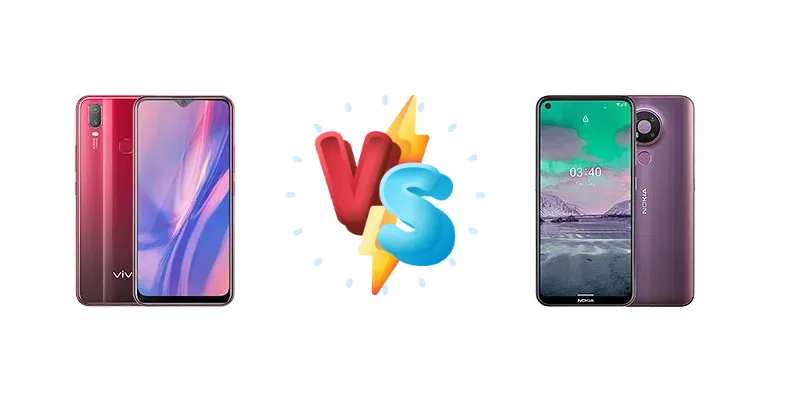
The sub-$150 smartphone market is fiercely competitive. Both the vivo Y12i and Nokia 3.4 aim to deliver essential smartphone functionality at an accessible price point. However, they achieve this with different chipsets – the Qualcomm Snapdragon 439 in the Y12i and the Snapdragon 460 in the Nokia 3.4 – leading to distinct performance characteristics. This comparison will dissect those differences and help you determine which device best suits your needs.
🏆 Quick Verdict
For most users, the Nokia 3.4 offers a more compelling experience. The Snapdragon 460, built on an 11nm process, provides a noticeable performance uplift over the Snapdragon 439’s 12nm node, resulting in smoother multitasking and a more responsive user interface. While both phones share 10W charging, the Nokia 3.4’s slightly more modern architecture makes it the better overall value.
| Network |
|---|
| 2G bands | GSM 850 / 900 / 1800 / 1900 | GSM 850 / 900 / 1800 / 1900 |
| 3G bands | HSDPA 850 / 900 / 2100 | HSDPA 850 / 900 / 1700(AWS) / 1900 / 2100 |
| 4G bands | 1, 3, 5, 8, 40 | 1, 2, 3, 4, 5, 7, 8, 12, 17, 13, 28, 66 |
| Speed | HSPA 42.2/5.76 Mbps, LTE (2CA) Cat6 300/50 Mbps | HSPA, LTE |
| Technology | GSM / HSPA / LTE | GSM / HSPA / LTE |
| Launch |
|---|
| Announced | 2020, July 10. Released 2020, July 10 | 2020, September 22. Released 2020, October 26 |
| Status | Discontinued | Discontinued |
| Body |
|---|
| Build | Glass front, plastic back, plastic frame | - |
| Dimensions | 159.4 x 76.8 x 8.9 mm (6.28 x 3.02 x 0.35 in) | 161 x 76 x 8.7 mm (6.34 x 2.99 x 0.34 in) |
| SIM | Nano-SIM + Nano-SIM | · Nano-SIM· Nano-SIM + Nano-SIM |
| Weight | 190.5 g (6.74 oz) | 180 g (6.35 oz) |
| Display |
|---|
| Resolution | 720 x 1544 pixels, 19.3:9 ratio (~268 ppi density) | 720 x 1560 pixels, 19.5:9 ratio (~269 ppi density) |
| Size | 6.35 inches, 99.6 cm2 (~81.4% screen-to-body ratio) | 6.39 inches, 100.2 cm2 (~81.9% screen-to-body ratio) |
| Type | IPS LCD | IPS LCD, 400 nits (typ) |
| Platform |
|---|
| CPU | Octa-core (4x1.95 GHz Cortex-A53 & 4x1.45 GHz Cortex A53) | Octa-core (4x1.8 GHz Cortex-A73 & 4x1.8 GHz Cortex-A53) |
| Chipset | Qualcomm SDM439 Snapdragon 439 (12 nm) | Qualcomm SM4250 Snapdragon 460 (11 nm) |
| GPU | Adreno 505 | Adreno 610 |
| OS | Android 9.0 (Pie), Funtouch 9.1 | Android 10, upgradable to Android 11 |
| Memory |
|---|
| Card slot | microSDXC (uses shared SIM slot) | microSDXC (dedicated slot) |
| Internal | 32GB 3GB RAM | 32GB 3GB RAM, 64GB 3GB RAM, 64GB 4GB RAM |
| | eMMC 5.1 | eMMC 5.1 |
| Main Camera |
|---|
| Dual | 13 MP, f/2.2, PDAF
Auxiliary lens | - |
| Features | LED flash, HDR, panorama | LED flash, HDR, panorama |
| Single | 8 MP, f/1.8 | - |
| Triple | - | 13 MP, (wide), PDAF
5 MP, (ultrawide)
Auxiliary lens |
| Video | 1080p@30fps | 1080p@30fps |
| Selfie camera |
|---|
| Single | 8 MP, f/1.8 | 8 MP, (wide) |
| Video | 1080p@30fps | 1080p@30fps |
| Sound |
|---|
| 3.5mm jack | Yes | Yes |
| 35mm jack | Yes | Yes |
| Loudspeaker | Yes | Yes |
| Comms |
|---|
| Bluetooth | 4.0, A2DP, LE | 4.2, A2DP, aptX |
| NFC | No | Yes (market/region dependent) |
| Positioning | GPS, GLONASS, GALILEO, BDS | GPS, GLONASS, GALILEO, BDS |
| Radio | FM radio | FM radio |
| USB | microUSB 2.0, OTG | USB Type-C 2.0 |
| WLAN | Wi-Fi 802.11 b/g/n, Wi-Fi Direct | Wi-Fi 802.11 b/g/n |
| Features |
|---|
| Sensors | Fingerprint (rear-mounted), accelerometer, proximity, compass | Fingerprint (rear-mounted), accelerometer, gyro, proximity |
| Battery |
|---|
| Charging | 10W wired | 10W wired |
| Type | 5000 mAh | Li-Po 4000 mAh |
| Misc |
|---|
| Colors | Agate Red, Mineral Blue | Fjord, Dusk, Charcoal |
| Models | - | TA-1288, TA-1285, TA-1283 |
| Price | About 110 EUR | About 100 EUR |
| SAR | - | 0.83 W/kg (head) 1.05 W/kg (body) |
| SAR EU | - | 0.36 W/kg (head) 1.56 W/kg (body) |
vivo Y12i
- Potentially lower initial purchase price.
- Sufficient for basic smartphone tasks.
- Qualcomm chipset offers reliable performance for its class.
- Older Snapdragon 439 chipset is less efficient.
- Less powerful CPU architecture compared to the Nokia 3.4.
- May struggle with demanding apps and multitasking.
Nokia 3.4
- More powerful Snapdragon 460 chipset.
- More efficient 11nm process for better battery life.
- Superior CPU architecture with Cortex-A73 cores.
- Likely better image processing capabilities.
- May be slightly more expensive than the vivo Y12i.
- 10W charging is slow compared to modern standards.
- Still an entry-level device with limitations.
Display Comparison
Neither device boasts a standout display. Both likely utilize LCD panels, a common trait in this price bracket. The focus here isn't on resolution or refresh rate, but on the underlying processing power to drive the UI smoothly. Display quality will likely be similar, with both offering adequate viewing angles and color reproduction for everyday use. The absence of higher refresh rates or HDR support is expected at this price point.
Camera Comparison
Both phones likely feature modest camera setups. Without specific sensor details, it’s difficult to make a definitive judgment. However, the image signal processor (ISP) within the Snapdragon 460 is more advanced, potentially leading to better image processing, particularly in low-light conditions. The Nokia 3.4’s ISP is likely to offer improved noise reduction and dynamic range compared to the Y12i. Expect both to struggle with complex scenes and offer limited detail in challenging lighting.
Performance
The core difference lies in the chipsets. The Nokia 3.4’s Snapdragon 460, fabricated on an 11nm process, is more efficient than the vivo Y12i’s Snapdragon 439 (12nm). This translates to better thermal management and sustained performance. The CPU architecture also differs significantly: the Nokia 3.4 features 4x 1.8 GHz Cortex-A73 cores alongside 4x 1.8 GHz Cortex-A53 cores, while the Y12i has 4x 1.95 GHz Cortex-A53 and 4x 1.45 GHz Cortex-A53. The A73 cores in the Nokia 3.4 are considerably more powerful than the A53 cores in the vivo Y12i, resulting in faster app loading times and smoother multitasking. While both are octa-core, the architectural advantage favors the Nokia 3.4.
Battery Life
Both devices are equipped with 10W wired charging, indicating similar charging speeds – expect around 2.5 to 3 hours for a full charge. Battery capacity isn’t specified, but given the target market, both likely house batteries in the 4000-5000 mAh range. The Snapdragon 460’s improved efficiency could translate to slightly better battery life on the Nokia 3.4, as it consumes less power during typical usage. However, real-world battery life will heavily depend on individual usage patterns.
Buying Guide
Buy the vivo Y12i if you prioritize a slightly lower initial cost and are primarily focused on basic tasks like calls, texts, and light social media use. The Snapdragon 439 is sufficient for these scenarios. Buy the Nokia 3.4 if you value a more fluid user experience, occasional gaming, and a chipset that’s better equipped to handle future Android updates and app demands. The Snapdragon 460 provides a tangible performance advantage.
Frequently Asked Questions
❓ Will the Nokia 3.4 handle popular games like PUBG Mobile?
While the Snapdragon 460 isn't a gaming powerhouse, it can run PUBG Mobile at lower settings. Expect frame rate drops during intense action. The vivo Y12i’s Snapdragon 439 will struggle more noticeably with this title, requiring even lower settings and potentially resulting in a less enjoyable experience.
❓ Does the Snapdragon 460 in the Nokia 3.4 offer a noticeable improvement in app loading times compared to the vivo Y12i?
Yes, the Snapdragon 460’s Cortex-A73 cores provide a significant performance boost over the Snapdragon 439’s Cortex-A53 cores. This translates to faster app launch times, smoother scrolling, and a more responsive user interface overall. You’ll notice the difference when switching between apps or opening resource-intensive applications.
❓ Are software updates likely to be better supported on the Nokia 3.4?
Nokia has a strong commitment to software updates and security patches, even on their budget devices. The vivo Y12i, while receiving updates, may not have the same level of long-term support as the Nokia 3.4. This is a key consideration for users who prioritize security and access to the latest Android features.