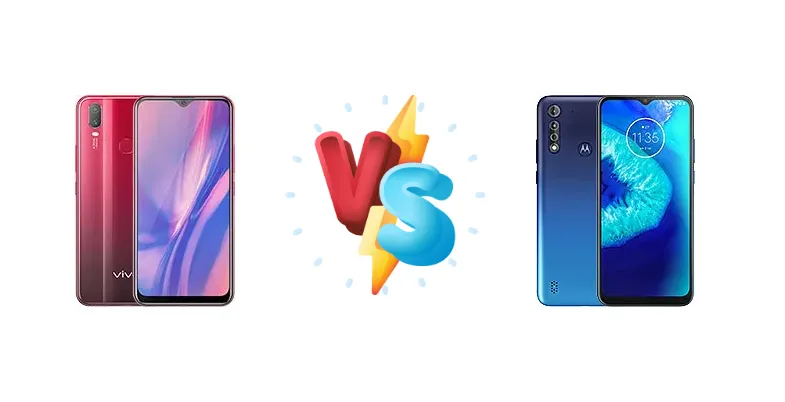
The sub-$150 smartphone market is fiercely competitive. Both the vivo Y12i and Motorola Moto G8 Power Lite aim to deliver essential smartphone functionality at an accessible price. This comparison dissects their core components – from chipsets to charging – to determine which device offers the best value for users prioritizing either raw processing power or sustained battery life.
🏆 Quick Verdict
For the average user prioritizing consistent, if not blazing-fast, performance, the Motorola Moto G8 Power Lite edges out the vivo Y12i. Its Helio P35 chipset, with slightly higher clocked Cortex-A53 cores, provides a more responsive experience in everyday tasks, despite both phones sharing similar RAM configurations. However, the Y12i remains a viable option for those seeking a familiar brand.
| Network |
|---|
| 2G bands | GSM 850 / 900 / 1800 / 1900 | GSM 850 / 900 / 1800 / 1900 |
| 3G bands | HSDPA 850 / 900 / 2100 | HSDPA 850 / 900 / 1900 / 2100 |
| 4G bands | 1, 3, 5, 8, 40 | LTE |
| Speed | HSPA 42.2/5.76 Mbps, LTE (2CA) Cat6 300/50 Mbps | HSPA, LTE |
| Technology | GSM / HSPA / LTE | GSM / HSPA / LTE |
| Launch |
|---|
| Announced | 2020, July 10. Released 2020, July 10 | 2020, April 03. Released 2020, April 03 |
| Status | Discontinued | Discontinued |
| Body |
|---|
| Build | Glass front, plastic back, plastic frame | Glass front, plastic back, plastic frame |
| Dimensions | 159.4 x 76.8 x 8.9 mm (6.28 x 3.02 x 0.35 in) | 164.9 x 75.8 x 9.2 mm (6.49 x 2.98 x 0.36 in) |
| SIM | Nano-SIM + Nano-SIM | · Nano-SIM· Nano-SIM + Nano-SIM |
| Weight | 190.5 g (6.74 oz) | 200 g (7.05 oz) |
| | - | Water-repellent coating |
| Display |
|---|
| Resolution | 720 x 1544 pixels, 19.3:9 ratio (~268 ppi density) | 720 x 1600 pixels, 20:9 ratio (~269 ppi density) |
| Size | 6.35 inches, 99.6 cm2 (~81.4% screen-to-body ratio) | 6.5 inches, 102.8 cm2 (~82.2% screen-to-body ratio) |
| Type | IPS LCD | IPS LCD |
| Platform |
|---|
| CPU | Octa-core (4x1.95 GHz Cortex-A53 & 4x1.45 GHz Cortex A53) | Octa-core (4x2.3 GHz Cortex-A53 & 4x1.8 GHz Cortex-A53) |
| Chipset | Qualcomm SDM439 Snapdragon 439 (12 nm) | Mediatek MT6765 Helio P35 (12 nm) |
| GPU | Adreno 505 | PowerVR GE8320 |
| OS | Android 9.0 (Pie), Funtouch 9.1 | Android 9.0 (Pie) |
| Memory |
|---|
| Card slot | microSDXC (uses shared SIM slot) | microSDXC (dedicated slot) |
| Internal | 32GB 3GB RAM | 64GB 4GB RAM |
| | eMMC 5.1 | eMMC 5.1 |
| Main Camera |
|---|
| Dual | 13 MP, f/2.2, PDAF
Auxiliary lens | - |
| Features | LED flash, HDR, panorama | LED flash, HDR, panorama |
| Single | 8 MP, f/1.8 | - |
| Triple | - | 16 MP, f/2.0, (wide), 1.0µm, PDAF
2 MP (macro)
Auxiliary lens |
| Video | 1080p@30fps | 1080p@30fps |
| Selfie camera |
|---|
| Features | - | HDR |
| Single | 8 MP, f/1.8 | 8 MP, f/2.0, (wide), 1.12µm |
| Video | 1080p@30fps | 1080p@30fps |
| Sound |
|---|
| 3.5mm jack | Yes | Yes |
| 35mm jack | Yes | Yes |
| Loudspeaker | Yes | Yes |
| Comms |
|---|
| Bluetooth | 4.0, A2DP, LE | 4.2, A2DP, LE |
| NFC | No | No |
| Positioning | GPS, GLONASS, GALILEO, BDS | GPS, GLONASS, GALILEO |
| Radio | FM radio | FM radio |
| USB | microUSB 2.0, OTG | microUSB 2.0 |
| WLAN | Wi-Fi 802.11 b/g/n, Wi-Fi Direct | Wi-Fi 802.11 b/g/n, Wi-Fi Direct |
| Features |
|---|
| Sensors | Fingerprint (rear-mounted), accelerometer, proximity, compass | Fingerprint (rear-mounted), accelerometer, gyro, proximity |
| Battery |
|---|
| Charging | 10W wired | 10W wired |
| Type | 5000 mAh | Li-Po 5000 mAh |
| Misc |
|---|
| Colors | Agate Red, Mineral Blue | Arctic Blue, Royal Blue |
| Models | - | XT2055-2 |
| Price | About 110 EUR | About 160 EUR |
vivo Y12i
- Potentially lower price point
- Familiar vivo brand
- Snapdragon chipset may offer slightly better power efficiency in very light tasks
- Slower CPU clock speeds
- Likely less responsive multitasking
- Potentially less optimized software
Motorola Moto G8 Power Lite
- Faster CPU clock speeds for improved responsiveness
- Motorola’s cleaner Android experience
- Likely larger battery capacity
- MediaTek chipset may have slightly lower resale value
- Potentially less aggressive software optimizations
- 10W charging is slow
Display Comparison
Neither device boasts a standout display. Both likely utilize LCD panels, common in this price bracket. The absence of detailed display specs necessitates focusing on performance implications. A potentially lower panel cost on the Y12i could contribute to its affordability, but the G8 Power Lite’s slightly more powerful chipset might offset any minor display differences in perceived smoothness during scrolling and video playback.
Camera Comparison
Both phones likely feature basic camera setups, and detailed sensor information is lacking. It’s safe to assume both include a primary camera and potentially depth/macro sensors of limited utility. Without knowing sensor sizes or apertures, it’s difficult to declare a clear winner. Image processing will likely be the differentiating factor, and Motorola’s software tends towards more natural colors, while vivo often employs more aggressive sharpening and saturation. The absence of OIS on either device means low-light performance will be heavily reliant on software algorithms.
Performance
The core difference lies in the chipsets: Qualcomm’s Snapdragon 439 in the Y12i versus MediaTek’s Helio P35 in the G8 Power Lite. While both are 12nm chips, the Helio P35 features a higher peak CPU clock speed (2.3 GHz vs 1.95 GHz). This translates to a noticeable, albeit not dramatic, performance advantage for the G8 Power Lite in CPU-bound tasks. The Snapdragon 439’s architecture splits its cores into faster and slower clusters, potentially offering better power efficiency during light tasks, but the G8 Power Lite’s consistently faster cores provide a more uniform experience. Both rely on an Adreno 505 GPU (Snapdragon) or PowerVR GE8320 (Helio), offering similar, entry-level graphics performance.
Battery Life
Both devices feature 10W wired charging, indicating similar charging speeds. The battery capacity is not specified, but given the 'Power' branding of the G8 Power Lite, it likely has a larger battery than the Y12i. Even with a similar capacity, the Helio P35’s slightly more efficient architecture could contribute to longer screen-on time. The 10W charging, however, is a significant limitation on both devices, requiring several hours for a full charge.
Buying Guide
Buy the vivo Y12i if you prioritize brand recognition and a potentially smoother software experience (depending on regional customizations). It's a good choice for users who primarily use their phone for basic communication and light social media. Buy the Motorola Moto G8 Power Lite if you need a phone that feels a bit more responsive during multitasking and app launches, and if you value a slightly more powerful processor for the price. It's ideal for users who occasionally play less demanding mobile games or use multiple apps simultaneously.
Frequently Asked Questions
❓ Will the Motorola Moto G8 Power Lite struggle with popular apps like Facebook or WhatsApp?
While not a powerhouse, the Helio P35 in the Moto G8 Power Lite is generally sufficient for running social media apps like Facebook and WhatsApp smoothly. However, expect some loading times and occasional stutters when multitasking with other demanding applications. The Y12i will likely exhibit similar behavior, potentially with slightly longer loading times.
❓ Is the 10W charging on either phone acceptable for daily use?
10W charging is slow by modern standards. Both the vivo Y12i and Motorola Moto G8 Power Lite will take several hours (likely 3-4) to fully charge from 0%. This means overnight charging is highly recommended. If fast charging is a priority, these phones are not ideal choices.
❓ Can either of these phones handle basic mobile games like PUBG Mobile or Free Fire?
Both phones can *run* PUBG Mobile and Free Fire, but expect to play at the lowest graphics settings and frame rates. The experience won't be optimal, and you may encounter lag or frame drops, especially during intense action. The Moto G8 Power Lite’s slightly more capable GPU might provide a marginally smoother experience.
❓ Which phone is likely to receive more software updates?
Motorola has a relatively good track record of providing at least one major Android update and security patches for its budget devices. Vivo’s update policy can be more regional and less consistent. Therefore, the Moto G8 Power Lite is likely to receive more timely software updates.