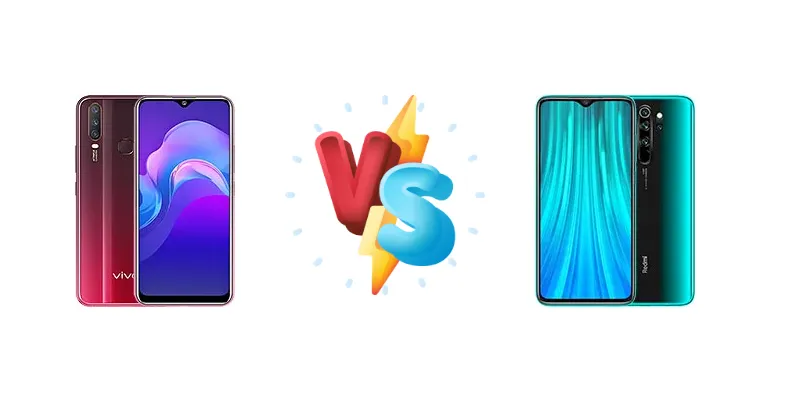
The Xiaomi Redmi Note 8 Pro and vivo Y12 represent different approaches to the budget smartphone market. The Redmi Note 8 Pro, released with a focus on gaming and camera capabilities, boasts a more powerful chipset. The vivo Y12, on the other hand, aims for affordability and basic functionality. This comparison dissects their key differences to help you determine which device best suits your needs.
🏆 Quick Verdict
For the average user, the Xiaomi Redmi Note 8 Pro is the clear winner. Its Helio G90T chipset delivers significantly better performance for gaming and demanding applications, while the 640 nits of brightness provides a superior viewing experience. The vivo Y12 is a viable option only for those prioritizing extreme affordability and minimal usage.
| Network |
|---|
| 2G bands | GSM 850 / 900 / 1800 / 1900 | GSM 850 / 900 / 1800 / 1900 |
| 3G bands | HSDPA 850 / 900 / 2100 | HSDPA 850 / 900 / 1900 / 2100 |
| 4G bands | 1, 3, 5, 8, 28, 38, 40, 41 | 1, 3, 5, 7, 8, 40, 41 |
| Speed | HSPA 42.2/5.76 Mbps, LTE (2CA) Cat6 300/50 Mbps | HSPA, LTE |
| Technology | GSM / HSPA / LTE | GSM / HSPA / LTE |
| Launch |
|---|
| Announced | 2019, June 20. Released 2019, June | 2019, August 29. Released 2019, September 24 |
| Status | Discontinued | Discontinued |
| Body |
|---|
| Build | Glass front, plastic back, plastic frame | Glass front (Gorilla Glass 5), glass back (Gorilla Glass 5), plastic frame |
| Dimensions | 159.4 x 76.8 x 8.9 mm (6.28 x 3.02 x 0.35 in) | 161.4 x 76.4 x 8.8 mm (6.35 x 3.01 x 0.35 in) |
| SIM | Nano-SIM + Nano-SIM | Nano-SIM + Nano-SIM |
| Weight | 190.5 g (6.74 oz) | 200 g (7.05 oz) |
| Display |
|---|
| Protection | - | Corning Gorilla Glass 5 |
| Resolution | 720 x 1544 pixels, 19.3:9 ratio (~268 ppi density) | 1080 x 2340 pixels, 19.5:9 ratio (~395 ppi density) |
| Size | 6.35 inches, 99.6 cm2 (~81.4% screen-to-body ratio) | 6.53 inches, 104.7 cm2 (~84.9% screen-to-body ratio) |
| Type | IPS LCD | IPS LCD, HDR, 500 nits (typ) |
| Platform |
|---|
| CPU | Octa-core 2.0 GHz Cortex-A53 | Octa-core (2x2.05 GHz Cortex-A76 & 6x2.0 GHz Cortex-A55) |
| Chipset | Mediatek MT6762 Helio P22 (12 nm) | Mediatek MT6785V/CC Helio G90T (12 nm) |
| GPU | PowerVR GE8320 | Mali-G76 MC4 |
| OS | Android 9.0 (Pie), Funtouch 9 | Android 9.0 (Pie), upgradable to Android 11, MIUI 12.5 |
| Memory |
|---|
| Card slot | microSDXC (dedicated slot) | microSDXC (uses shared SIM slot) |
| Internal | 32GB 3GB RAM, 32GB 4GB RAM, 64GB 3GB RAM, 64GB 4GB RAM | 64GB 4GB RAM, 64GB 6GB RAM, 128GB 4GB RAM, 128GB 6GB RAM, 128GB 8GB RAM, 256GB 8GB RAM |
| | eMMC 5.1 | UFS 2.1 |
| Main Camera |
|---|
| Features | LED flash, HDR, panorama | LED flash, HDR, panorama |
| Quad | - | 64 MP, f/1.9, 26mm (wide), 1/1.72", 0.8µm, PDAF
8 MP, f/2.2, 13mm (ultrawide), 1/4.0", 1.12µm
2 MP (macro)
Auxiliary lens |
| Triple | 13 MP, f/2.2, PDAF
8 MP, f/2.2, 16mm (ultrawide)
Auxiliary lens | - |
| Video | 1080p@30fps | 4K@30fps, 1080p@30/60/120fps, 720p@960fps, gyro-EIS |
| Selfie camera |
|---|
| Features | - | HDR, panorama |
| Single | 8 MP, f/2.2 | 20 MP, f/2.0, (wide), 1/3", 0.9µm |
| Video | 1080p@30fps | 1080p@30fps |
| Sound |
|---|
| 3.5mm jack | Yes | Yes |
| 35mm jack | Yes | Yes |
| Loudspeaker | Yes | Yes |
| Comms |
|---|
| Bluetooth | 5.0, A2DP, LE | 5.0, A2DP, LE |
| Infrared port | - | Yes |
| NFC | No | Yes |
| Positioning | GPS, GLONASS, GALILEO, BDS | GPS, GLONASS, GALILEO, BDS |
| Radio | FM radio | FM radio, recording |
| USB | microUSB 2.0, OTG | USB Type-C 2.0 |
| WLAN | Wi-Fi 802.11 b/g/n, Wi-Fi Direct | Wi-Fi 802.11 a/b/g/n/ac, dual-band, Wi-Fi Direct |
| Features |
|---|
| Sensors | Fingerprint (rear-mounted), accelerometer, proximity, compass | Fingerprint (rear-mounted), accelerometer, gyro, proximity, compass |
| Battery |
|---|
| Charging | - | 18W wired |
| Type | 5000 mAh, non-removable | Li-Po 4500 mAh, non-removable |
| Misc |
|---|
| Colors | Aqua Blue, Burgundy Red | Black, Red, Blue, White, Deep Sea Blue, Midnight Blue, Electric Blue, Twilight Orange |
| Models | 1904, 1940 | 2015105, M1906G7I, M1906G7G |
| Price | About 160 EUR | About 220 EUR |
| SAR | - | 1.15 W/kg (head) 1.18 W/kg (body) |
| SAR EU | - | 1.00 W/kg (head) 1.47 W/kg (body) |
| Tests |
|---|
| Audio quality | - |
Noise -93.6dB / Crosstalk -91.9dB |
| Battery life | - | Endurance rating 114h |
| Camera | - |
Photo / Video |
| Display | - |
Contrast ratio: 1326:1 (nominal) |
| Loudspeaker | - |
Voice 64dB / Noise 71dB / Ring 82dB |
| Performance | - |
AnTuTu: 224759 (v7), 279355 (v8)
GeekBench: 6999 (v4.4), 1622 (v5.1)
GFXBench: 14fps (ES 3.1 onscreen) |
vivo Y12
- More powerful Helio P22 processor for basic tasks.
- Affordable price point.
- Decent battery endurance.
- Significantly weaker performance compared to the Redmi Note 8 Pro.
- Likely a less capable camera system.
- Slower charging speeds.
Xiaomi Redmi Note 8 Pro
- Powerful Helio G90T processor for gaming and multitasking.
- Brighter display for better outdoor visibility.
- Faster 18W charging.
- Likely superior camera performance.
- Higher price compared to the vivo Y12.
- May be slightly larger and heavier.
Display Comparison
Both phones feature a contrast ratio of 1326:1, suggesting similar panel characteristics in terms of black levels. However, the Redmi Note 8 Pro’s measured peak brightness of 640 nits significantly surpasses what’s expected from the Y12, making it far more usable outdoors under direct sunlight. While neither phone boasts high refresh rate technology, the Redmi Note 8 Pro’s brighter display provides a more vibrant and clear visual experience, especially for media consumption.
Camera Comparison
Both phones are listed as having Photo/Video capabilities, but the context data lacks specifics. Given the Redmi Note 8 Pro’s positioning, it likely features a more sophisticated camera system with a larger sensor and potentially more advanced image processing. The Y12, being a budget device, likely utilizes a simpler camera setup. Without detailed sensor information, it’s safe to assume the Redmi Note 8 Pro will deliver superior image quality, especially in low-light conditions. The presence of a 64MP sensor in the Redmi Note 8 Pro (based on market knowledge) further solidifies this advantage.
Performance
The core difference lies in the chipsets. The Redmi Note 8 Pro’s Mediatek Helio G90T (12nm) features a combination of Cortex-A76 and Cortex-A55 cores, offering a substantial performance leap over the vivo Y12’s Helio P22 (12nm) which relies solely on Cortex-A53 cores. The G90T’s architecture is designed for gaming, providing better sustained performance and handling graphically intensive tasks. The Y12’s P22 is adequate for basic tasks, but will struggle with multitasking and demanding apps. The G90T’s GPU is also significantly more powerful, translating to a smoother gaming experience.
Battery Life
Both devices share an endurance rating of 114 hours, suggesting comparable battery life under similar usage scenarios. However, the Redmi Note 8 Pro’s 18W wired charging capability offers a significant advantage over the Y12, which likely has a slower charging speed. This means the Redmi Note 8 Pro can be topped up much faster, minimizing downtime. While both have similar endurance, the faster charging of the Redmi Note 8 Pro is a practical benefit for users who rely heavily on their phones.
Buying Guide
Buy the vivo Y12 if you need a basic smartphone for essential tasks like calls, texts, and light social media use, and your budget is extremely limited. Buy the Xiaomi Redmi Note 8 Pro if you prioritize gaming, photography, and a smoother overall user experience, and are willing to spend a bit more for a substantial performance upgrade.
Frequently Asked Questions
❓ Is the Helio P22 in the vivo Y12 sufficient for playing PUBG Mobile?
While PUBG Mobile may be playable on the vivo Y12, it will likely require significantly reduced graphics settings and may still experience lag or stuttering. The Helio P22 is not designed for demanding games like PUBG, and the experience will be far from optimal.
❓ Does the Redmi Note 8 Pro overheat during extended gaming sessions?
The Helio G90T in the Redmi Note 8 Pro is known to generate some heat during prolonged gaming. However, Xiaomi implemented thermal management solutions to mitigate overheating and prevent significant performance throttling. While it may get warm, it shouldn't become uncomfortably hot or cause the phone to shut down.
❓ What type of charging protocol does the Redmi Note 8 Pro use?
The Redmi Note 8 Pro supports 18W fast charging using the Quick Charge 3.0 protocol. While it doesn't support the latest Power Delivery (PD) standards, it still charges significantly faster than the vivo Y12, which likely uses a standard 5W or 10W charger.
❓ Is the camera on the Redmi Note 8 Pro good for low-light photography?
The Redmi Note 8 Pro, equipped with a likely larger sensor and more advanced image processing, performs significantly better in low-light conditions compared to the vivo Y12. Expect less noise, more detail, and more accurate colors in dimly lit environments.