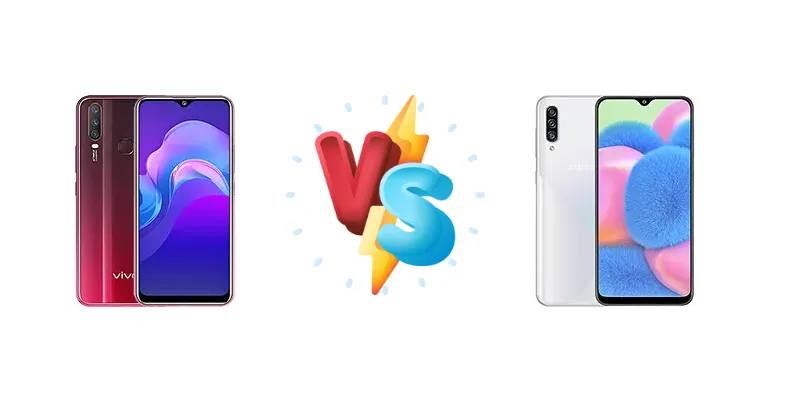
The sub-$200 smartphone market is fiercely competitive. The vivo Y12 and Samsung Galaxy A30s represent compelling options for users prioritizing affordability. However, they take different approaches to achieving that price point, particularly in chipset selection and feature sets. This comparison dissects the key differences to determine which device delivers the best value.
🏆 Quick Verdict
For most users, the Samsung Galaxy A30s is the superior choice. Its Exynos 7904 chipset provides a noticeable performance uplift over the vivo Y12’s Helio P22, and the inclusion of 15W fast charging is a significant convenience. While the Y12 is cheaper, the A30s offers a more refined experience.
| Network |
|---|
| 2G bands | GSM 850 / 900 / 1800 / 1900 | GSM 850 / 900 / 1800 / 1900 |
| 3G bands | HSDPA 850 / 900 / 2100 | HSDPA 850 / 900 / 1700(AWS) / 1900 / 2100 |
| 4G bands | 1, 3, 5, 8, 28, 38, 40, 41 | 1, 2, 3, 4, 5, 7, 8, 12, 13, 17, 20, 28, 38, 40, 41, 66 |
| Speed | HSPA 42.2/5.76 Mbps, LTE (2CA) Cat6 300/50 Mbps | HSPA, LTE |
| Technology | GSM / HSPA / LTE | GSM / HSPA / LTE |
| Launch |
|---|
| Announced | 2019, June 20. Released 2019, June | 2019, August 22. Released 2019, September 11 |
| Status | Discontinued | Discontinued |
| Body |
|---|
| Build | Glass front, plastic back, plastic frame | Glass front, plastic back, plastic frame |
| Dimensions | 159.4 x 76.8 x 8.9 mm (6.28 x 3.02 x 0.35 in) | 158.5 x 74.7 x 7.8 mm (6.24 x 2.94 x 0.31 in) |
| SIM | Nano-SIM + Nano-SIM | · Nano-SIM· Nano-SIM + Nano-SIM |
| Weight | 190.5 g (6.74 oz) | 169 g (5.96 oz) |
| Display |
|---|
| Protection | - | Asahi Dragontrail Glass |
| Resolution | 720 x 1544 pixels, 19.3:9 ratio (~268 ppi density) | 720 x 1560 pixels, 19.5:9 ratio (~268 ppi density) |
| Size | 6.35 inches, 99.6 cm2 (~81.4% screen-to-body ratio) | 6.4 inches, 100.5 cm2 (~84.9% screen-to-body ratio) |
| Type | IPS LCD | Super AMOLED |
| Platform |
|---|
| CPU | Octa-core 2.0 GHz Cortex-A53 | Octa-core (2x1.8 GHz Cortex-A73 & 6x1.6 GHz Cortex-A53) |
| Chipset | Mediatek MT6762 Helio P22 (12 nm) | Exynos 7904 (14 nm) |
| GPU | PowerVR GE8320 | Mali-G71 MP2 |
| OS | Android 9.0 (Pie), Funtouch 9 | Android 9.0 (Pie), upgradable to Android 11, One UI 3.1 |
| Memory |
|---|
| Card slot | microSDXC (dedicated slot) | microSDXC (dedicated slot) |
| Internal | 32GB 3GB RAM, 32GB 4GB RAM, 64GB 3GB RAM, 64GB 4GB RAM | 32GB 3GB RAM, 64GB 4GB RAM, 128GB 4GB RAM |
| | eMMC 5.1 | eMMC 5.1 |
| Main Camera |
|---|
| Features | LED flash, HDR, panorama | LED flash, panorama, HDR |
| Single | - | 13 MP, AF |
| Triple | 13 MP, f/2.2, PDAF
8 MP, f/2.2, 16mm (ultrawide)
Auxiliary lens | 25 MP, f/1.7, 27mm (wide), PDAF
8 MP, f/2.2, 13mm (ultrawide), 1/4.0", 1.12µm
Auxiliary lens |
| Video | 1080p@30fps | 1080p@30fps |
| Selfie camera |
|---|
| Single | 8 MP, f/2.2 | 16 MP, f/2.0, 26mm (wide), 1/3.06", 1.0µm |
| Video | 1080p@30fps | 1080p@30fps |
| Sound |
|---|
| 3.5mm jack | Yes | Yes |
| 35mm jack | Yes | Yes |
| Loudspeaker | Yes | Yes |
| Comms |
|---|
| Bluetooth | 5.0, A2DP, LE | 5.0, A2DP, LE |
| Infrared port | - | Yes |
| NFC | No | Yes (market/region dependent) |
| Positioning | GPS, GLONASS, GALILEO, BDS | GPS, GLONASS, GALILEO, BDS |
| Radio | FM radio | FM radio |
| USB | microUSB 2.0, OTG | USB Type-C 2.0, OTG |
| WLAN | Wi-Fi 802.11 b/g/n, Wi-Fi Direct | Wi-Fi 802.11 a/b/g/n/ac, dual-band, Wi-Fi Direct |
| Features |
|---|
| Sensors | Fingerprint (rear-mounted), accelerometer, proximity, compass | Fingerprint (under display, optical), accelerometer, gyro, proximity, compass |
| Battery |
|---|
| Charging | - | 15W wired |
| Type | 5000 mAh, non-removable | Li-Po 4000 mAh, non-removable |
| Misc |
|---|
| Colors | Aqua Blue, Burgundy Red | Prism Crush Black, Prism Crush White, Prism Crush Green, Prism Crush Violet2 |
| Models | 1904, 1940 | SM-A307F, SM-A307FN, SM-A307G, SM-A307GN, SM-A307GT |
| Price | About 160 EUR | About 260 EUR |
| SAR | - | 0.87 W/kg (head) 0.43 W/kg (body) |
| SAR EU | - | 1.05 W/kg (head) 1.54 W/kg (body) |
| Pricing |
|---|
| 128GB 4GB RAM | - | $ 194.02 |
| 64GB 4GB RAM | - | $ 269.99 |
| RENEWED | - | £ 120.00 |
vivo Y12
- Potentially lower price point
- Likely larger battery capacity (estimated)
- Simple and straightforward user experience
- Significantly weaker processor performance
- Slower charging speeds
- Less refined camera software
Samsung Galaxy A30s
- More powerful Exynos 7904 chipset
- 15W fast charging support
- Potentially better display calibration
- Slightly higher price
- Battery capacity may be smaller than Y12 (unconfirmed)
- Software updates may be less frequent
Display Comparison
Neither device boasts a standout display. Both likely utilize LCD panels, a common cost-saving measure in this segment. The A30s’ display size is not specified, but the Y12’s is also not a key selling point. Without detailed specs like peak brightness or color gamut coverage, it’s difficult to declare a clear winner. However, Samsung generally offers better display calibration even on budget devices, suggesting a potentially more accurate and pleasing visual experience on the A30s.
Camera Comparison
Camera performance is likely similar, relying heavily on software processing. Both phones likely feature a primary camera and depth sensor. The A30s’ camera specs are not fully detailed, but the Y12’s likely includes a 13MP main sensor. Without knowing the aperture or sensor size of either camera, it’s difficult to assess low-light performance. The inclusion of a 2MP macro camera on the Y12 is unlikely to provide significant benefit due to its low resolution and fixed focus. Image processing algorithms will play a crucial role, and Samsung’s generally more refined software could give the A30s an edge.
Performance
The performance gap is the most significant differentiator. The Samsung Galaxy A30s’ Exynos 7904, built on a 14nm process, features a more sophisticated CPU configuration with two Cortex-A73 cores clocked at 1.8GHz alongside six Cortex-A53 cores. This contrasts with the vivo Y12’s Mediatek Helio P22, which relies solely on eight Cortex-A53 cores clocked at 2.0GHz. While the Y12 has a higher clock speed, the A73 cores in the A30s offer significantly greater individual performance. This translates to faster app loading times, smoother multitasking, and a more responsive user interface. The A30s is also better suited for light gaming. The 14nm process of the Exynos also suggests potentially better thermal efficiency under sustained load.
Battery Life
The vivo Y12’s battery capacity is not specified, but typical for this segment is around 5000mAh. The Samsung Galaxy A30s benefits from 15W wired charging, a substantial advantage over the likely 10W charging on the Y12. This means the A30s can be topped up much faster, reducing downtime. While a larger battery capacity on the Y12 might offer slightly longer screen-on time, the faster charging of the A30s provides a more convenient user experience.
Buying Guide
Buy the vivo Y12 if you need a basic smartphone for essential tasks like calls, messaging, and light social media use, and your budget is extremely limited. You're prioritizing absolute lowest cost over performance. Buy the Samsung Galaxy A30s if you prefer a smoother, more responsive experience for everyday tasks, enjoy occasional gaming, and value the convenience of faster charging. You're willing to spend a little more for a more capable device.
Frequently Asked Questions
❓ Does the Exynos 7904 in the Galaxy A30s overheat during prolonged gaming sessions?
The Exynos 7904 is a relatively efficient chip. While it may get warm during extended gaming, it's unlikely to experience significant thermal throttling, especially given the phone's plastic construction which aids in heat dissipation. It's a more capable gaming chip than the Helio P22 in the Y12, but don't expect flagship-level performance.
❓ Is the 2MP macro camera on the vivo Y12 actually useful for taking detailed close-up photos?
Unfortunately, the 2MP macro camera on the Y12 is unlikely to deliver impressive results. Its low resolution and fixed focus limit its ability to capture truly detailed close-up shots. It's primarily a marketing feature and shouldn't be a major factor in your purchasing decision.
❓ Can the Samsung Galaxy A30s handle popular games like PUBG Mobile at acceptable frame rates?
The Exynos 7904 can run PUBG Mobile, but you'll likely need to use medium graphics settings to maintain a stable frame rate. Don't expect to max out the settings, but it should provide a playable experience. The Helio P22 in the Y12 will struggle with PUBG Mobile, even on the lowest settings.
❓ How long does it take to fully charge the Samsung Galaxy A30s with the 15W charger?
With the included 15W charger, the Samsung Galaxy A30s should fully charge from 0% to 100% in approximately 2 to 2.5 hours. This is significantly faster than the vivo Y12, which likely takes over 3 hours with its slower charging technology.