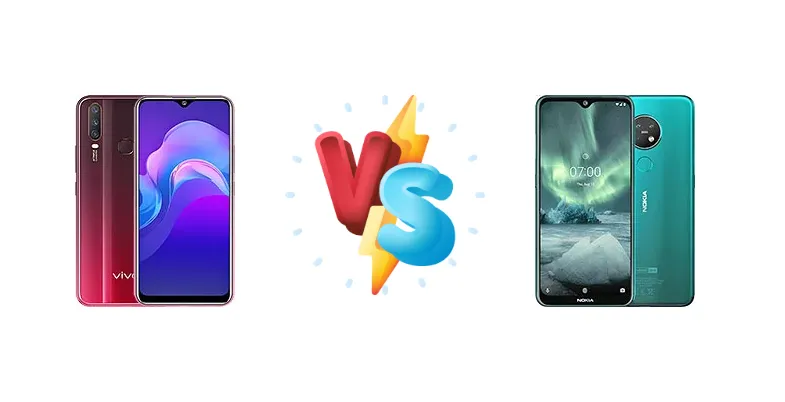
The Nokia 7.2 and vivo Y12 represent two distinct approaches to the budget smartphone market. The Nokia 7.2, leveraging Qualcomm’s Snapdragon 660, aims for a balance of performance and features, while the vivo Y12 focuses on providing a functional experience with MediaTek’s Helio P22. This comparison dissects their key differences to determine which device offers the best value.
🏆 Quick Verdict
For most users, the Nokia 7.2 is the superior choice. Its Snapdragon 660 chipset delivers significantly better performance than the Helio P22 in the vivo Y12, making it more capable for multitasking and demanding applications. While both offer similar battery endurance, the Nokia 7.2’s brighter display and more powerful processor justify its slightly higher price.
| Network |
|---|
| 2G bands | GSM 850 / 900 / 1800 / 1900 | GSM 850 / 900 / 1800 / 1900 |
| 3G bands | HSDPA 850 / 900 / 2100 | HSDPA 850 / 900 / 2100 - ROW |
| 4G bands | 1, 3, 5, 8, 28, 38, 40, 41 | 1, 3, 5, 7, 8, 20, 28, 38, 40, 41 - ROW |
| Speed | HSPA 42.2/5.76 Mbps, LTE (2CA) Cat6 300/50 Mbps | HSPA 42.2/5.76 Mbps, LTE (2CA) Cat6 300/50 Mbps or LTE Cat4 150/50 Mbps |
| Technology | GSM / HSPA / LTE | GSM / HSPA / LTE |
| | - | 1, 3, 5, 8, 40, 41 - IN |
| Launch |
|---|
| Announced | 2019, June 20. Released 2019, June | 2019, September 05. Released 2019, September 23 |
| Status | Discontinued | Discontinued |
| Body |
|---|
| Build | Glass front, plastic back, plastic frame | Glass front (Gorilla Glass 3), glass back (Gorilla Glass 3), plastic frame |
| Dimensions | 159.4 x 76.8 x 8.9 mm (6.28 x 3.02 x 0.35 in) | 159.9 x 75.2 x 8.3 mm (6.30 x 2.96 x 0.33 in) |
| SIM | Nano-SIM + Nano-SIM | · Nano-SIM· Nano-SIM + Nano-SIM |
| Weight | 190.5 g (6.74 oz) | 180 g (6.35 oz) |
| Display |
|---|
| Protection | - | Corning Gorilla Glass 3 |
| Resolution | 720 x 1544 pixels, 19.3:9 ratio (~268 ppi density) | 1080 x 2280 pixels, 19:9 ratio (~400 ppi density) |
| Size | 6.35 inches, 99.6 cm2 (~81.4% screen-to-body ratio) | 6.3 inches, 99.1 cm2 (~82.4% screen-to-body ratio) |
| Type | IPS LCD | IPS LCD, HDR10 |
| Platform |
|---|
| CPU | Octa-core 2.0 GHz Cortex-A53 | Octa-core (4x2.2 GHz Kryo 260 Gold & 4x1.8 GHz Kryo 260 Silver) |
| Chipset | Mediatek MT6762 Helio P22 (12 nm) | Qualcomm SDM660 Snapdragon 660 (14 nm) |
| GPU | PowerVR GE8320 | Adreno 512 |
| OS | Android 9.0 (Pie), Funtouch 9 | Android 9.0 (Pie), upgradable to Android 11, Android One |
| Memory |
|---|
| Card slot | microSDXC (dedicated slot) | microSDXC (dedicated slot) |
| Internal | 32GB 3GB RAM, 32GB 4GB RAM, 64GB 3GB RAM, 64GB 4GB RAM | 64GB 4GB RAM, 64GB 6GB RAM, 128GB 4GB RAM, 128GB 6GB RAM |
| | eMMC 5.1 | eMMC 5.1 |
| Main Camera |
|---|
| Features | LED flash, HDR, panorama | Zeiss optics, LED flash, panorama, HDR |
| Triple | 13 MP, f/2.2, PDAF
8 MP, f/2.2, 16mm (ultrawide)
Auxiliary lens | 48 MP, f/1.8, (wide), 1/2.0", 0.8µm, PDAF
8 MP, f/2.2, 13mm (ultrawide), 1/4.0", 1.12µm
Auxiliary lens |
| Video | 1080p@30fps | 4K@30fps, 1080p@30fps (gyro-EIS) |
| Selfie camera |
|---|
| Features | - | Zeiss optics, HDR |
| Single | 8 MP, f/2.2 | 20 MP, f/2.0, (wide), 1/3", 0.9µm |
| Video | 1080p@30fps | 1080p@30fps |
| Sound |
|---|
| 3.5mm jack | Yes | Yes |
| 35mm jack | Yes | Yes |
| Loudspeaker | Yes | Yes |
| Comms |
|---|
| Bluetooth | 5.0, A2DP, LE | 5.0, A2DP, EDR, LE, aptX |
| NFC | No | Yes (excl. India) |
| Positioning | GPS, GLONASS, GALILEO, BDS | GPS, GLONASS, GALILEO, BDS |
| Radio | FM radio | FM radio |
| USB | microUSB 2.0, OTG | USB Type-C 2.0, OTG |
| WLAN | Wi-Fi 802.11 b/g/n, Wi-Fi Direct | Wi-Fi 802.11 b/g/n/ac, dual-band, Wi-Fi Direct |
| Features |
|---|
| Sensors | Fingerprint (rear-mounted), accelerometer, proximity, compass | Fingerprint (rear-mounted), accelerometer, gyro, proximity, compass |
| Battery |
|---|
| Charging | - | 10W wired |
| Type | 5000 mAh, non-removable | Li-Po 3500 mAh, non-removable |
| Misc |
|---|
| Colors | Aqua Blue, Burgundy Red | Cyan Green, Charcoal, Ice |
| Models | 1904, 1940 | TA-1193, TA-1178, TA-1196, TA-1181 |
| Price | About 160 EUR | About 240 EUR |
| SAR | - | 1.15 W/kg (head) 0.90 W/kg (body) |
| SAR EU | - | 0.99 W/kg (head) 1.44 W/kg (body) |
| Tests |
|---|
| Audio quality | - |
Noise -93.0dB / Crosstalk -93.4dB |
| Battery life | - |
Endurance rating 69h
|
| Camera | - |
Photo / Video |
| Display | - |
Contrast ratio: 1342:1 (nominal) |
| Loudspeaker | - |
-29.6 LUFS (Average)
|
| Performance | - |
AnTuTu: 139495 (v7), 164484 (v8)
GeekBench: 5440 (v4.4), 1398 (v5.1)
GFXBench: 8.1fps (ES 3.1 onscreen) |
vivo Y12
- Superior processor performance with Snapdragon 660
- Brighter and more vibrant display
- Potentially better camera quality
- Slower 10W charging
- May be slightly more expensive than the vivo Y12
Nokia 7.2
- More affordable price point
- Decent battery life (69h endurance)
- Functional for basic smartphone tasks
- Significantly weaker processor performance
- Likely lower display quality
- Potentially inferior camera
Display Comparison
The Nokia 7.2 boasts a significantly more impressive display experience. Its measured peak brightness of 585 nits, coupled with a 1342:1 contrast ratio, ensures excellent visibility even in outdoor conditions. While the contrast ratio is nominally the same as the Y12, the higher brightness is a key differentiator. The vivo Y12’s display specifications are not provided, suggesting a lower brightness level and potentially less vibrant colors. This makes the Nokia 7.2 the clear winner for media consumption and outdoor usability.
Camera Comparison
Both devices are listed as having Photo/Video capabilities, but detailed camera specifications are lacking. However, given the Nokia 7.2’s positioning, it likely features a more sophisticated camera system with potentially larger sensors and better image processing. The Snapdragon 660’s image signal processor (ISP) is also more capable than the Helio P22’s, resulting in better image quality, especially in low-light conditions. Without specific sensor details for the vivo Y12, it’s reasonable to assume its camera performance will be inferior.
Performance
The performance gap between these two devices is substantial. The Nokia 7.2’s Qualcomm Snapdragon 660, built on a 14nm process, features a Kryo CPU architecture with a combination of performance (2.2 GHz) and efficiency (1.8 GHz) cores. This contrasts sharply with the vivo Y12’s MediaTek Helio P22 (12nm), which relies solely on Cortex-A53 cores clocked at 2.0 GHz. The Snapdragon 660’s superior architecture and higher clock speeds translate to noticeably faster app loading times, smoother multitasking, and a more responsive user experience. While the Helio P22 is adequate for basic tasks, it will struggle with more demanding applications and games.
Battery Life
Both the Nokia 7.2 and vivo Y12 achieve an endurance rating of 69 hours, indicating comparable battery life. However, this doesn’t tell the whole story. The Nokia 7.2’s more efficient Snapdragon 660 chipset may contribute to slightly better real-world battery performance under heavy use. Both devices support 10W wired charging, which is relatively slow by today’s standards, meaning a full charge will take a considerable amount of time. The similar endurance ratings suggest that battery life will largely depend on individual usage patterns.
Buying Guide
Buy the vivo Y12 if you prioritize absolute affordability and need a basic smartphone for essential tasks like calls, texts, and light social media use. Its simplicity and lower price point make it ideal for first-time smartphone owners or those on a very tight budget. Buy the Nokia 7.2 if you value smoother performance, a brighter and more vibrant display, and a more versatile camera experience. It’s the better option for users who enjoy occasional gaming, streaming video, or capturing higher-quality photos.
Frequently Asked Questions
❓ Will the Nokia 7.2 handle demanding games like PUBG Mobile?
The Snapdragon 660 in the Nokia 7.2 is capable of running PUBG Mobile, but you’ll likely need to lower the graphics settings to achieve a smooth frame rate. The Helio P22 in the vivo Y12 will struggle with PUBG Mobile, even on the lowest settings.
❓ How significant is the difference in app loading times between these two phones?
The difference in app loading times is quite noticeable. The Nokia 7.2’s Snapdragon 660 will open apps significantly faster than the vivo Y12’s Helio P22, thanks to its more powerful CPU and GPU.
❓ Is the 10W charging speed on either phone a major drawback?
Yes, 10W charging is relatively slow. Expect a full charge to take over 2 hours. Neither phone offers fast charging capabilities, so be prepared to charge overnight.
❓ Given the similar battery endurance ratings, does that mean I won't notice a difference in daily use?
While the endurance ratings are the same, the Nokia 7.2's more efficient processor means it will likely maintain that battery life for longer *under load*. If you're a heavy user, the Nokia 7.2 will likely last longer on a single charge.