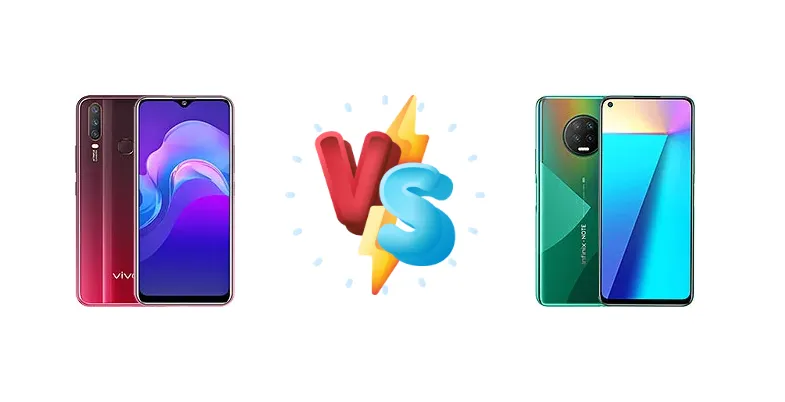
Both the vivo Y12 and Infinix Note 7 target the ultra-budget smartphone market, but they approach it with different strategies. The Y12 prioritizes a simple, streamlined experience, while the Note 7 aims for a more feature-rich package, particularly in performance and charging speed. This comparison dissects the core differences to help you choose the right device.
🏆 Quick Verdict
For most users, the Infinix Note 7 is the superior choice. Its Helio G70 chipset delivers noticeably faster performance than the vivo Y12’s Helio P22, and the inclusion of 18W fast charging is a significant advantage. While the Y12 is more affordable, the Note 7’s extra power justifies the price difference.
| Network |
|---|
| 2G bands | GSM 850 / 900 / 1800 / 1900 | GSM 850 / 900 / 1800 / 1900 |
| 3G bands | HSDPA 850 / 900 / 2100 | HSDPA 850 / 900 / 2100 |
| 4G bands | 1, 3, 5, 8, 28, 38, 40, 41 | 1, 3, 5, 8, 38, 40, 41 |
| Speed | HSPA 42.2/5.76 Mbps, LTE (2CA) Cat6 300/50 Mbps | HSPA 42.2/5.76 Mbps, LTE Cat4 150/50 Mbps |
| Technology | GSM / HSPA / LTE | GSM / HSPA / LTE |
| | - | 1, 3, 5, 7, 8, 20, 28, 38, 40, 41 |
| Launch |
|---|
| Announced | 2019, June 20. Released 2019, June | 2020, April 06. Released 2020, July |
| Status | Discontinued | Discontinued |
| Body |
|---|
| Build | Glass front, plastic back, plastic frame | - |
| Dimensions | 159.4 x 76.8 x 8.9 mm (6.28 x 3.02 x 0.35 in) | 173.4 x 79 x 8.8 mm (6.83 x 3.11 x 0.35 in) |
| SIM | Nano-SIM + Nano-SIM | Nano-SIM + Nano-SIM |
| Weight | 190.5 g (6.74 oz) | 206 g (7.27 oz) |
| Display |
|---|
| Protection | - | Corning Gorilla Glass |
| Resolution | 720 x 1544 pixels, 19.3:9 ratio (~268 ppi density) | 720 x 1640 pixels (~258 ppi density) |
| Size | 6.35 inches, 99.6 cm2 (~81.4% screen-to-body ratio) | 6.95 inches, 114.7 cm2 (~83.7% screen-to-body ratio) |
| Type | IPS LCD | IPS LCD |
| Platform |
|---|
| CPU | Octa-core 2.0 GHz Cortex-A53 | Octa-core (2x2.0 GHz Cortex-A75 & 6x1.7 GHz Cortex-A55) |
| Chipset | Mediatek MT6762 Helio P22 (12 nm) | Mediatek MT6769V/CB Helio G70 (12 nm) |
| GPU | PowerVR GE8320 | Mali-G52 2EEMC2 |
| OS | Android 9.0 (Pie), Funtouch 9 | Android 10, XOS 6.0 |
| Memory |
|---|
| Card slot | microSDXC (dedicated slot) | microSDXC (dedicated slot) |
| Internal | 32GB 3GB RAM, 32GB 4GB RAM, 64GB 3GB RAM, 64GB 4GB RAM | 64GB 4GB RAM, 128GB 4GB RAM, 128GB 6GB RAM |
| | eMMC 5.1 | eMMC 5.1 |
| Main Camera |
|---|
| Features | LED flash, HDR, panorama | Quad-LED flash, panorama, HDR |
| Quad | - | 48 MP, f/1.8, (wide), 1/2.0", 0.8µm, PDAF
2 MP (macro)
2 MP, f/1.8, (dedicated video camera) - 128/6 model only
Auxiliary lens |
| Triple | 13 MP, f/2.2, PDAF
8 MP, f/2.2, 16mm (ultrawide)
Auxiliary lens | - |
| Video | 1080p@30fps | 1080p@30fps |
| Selfie camera |
|---|
| Single | 8 MP, f/2.2 | 16 MP, f/2.0, 26mm (wide), 1/3.06", 1.0µm |
| Video | 1080p@30fps | 1080p@30fps |
| Sound |
|---|
| 3.5mm jack | Yes | Yes |
| 35mm jack | Yes | Yes |
| Loudspeaker | Yes | Yes, with dual speakers |
| Comms |
|---|
| Bluetooth | 5.0, A2DP, LE | 5.0, A2DP, LE |
| NFC | No | No |
| Positioning | GPS, GLONASS, GALILEO, BDS | GPS |
| Radio | FM radio | FM radio |
| USB | microUSB 2.0, OTG | microUSB 2.0, OTG |
| WLAN | Wi-Fi 802.11 b/g/n, Wi-Fi Direct | Wi-Fi 802.11 a/b/g/n/ac, dual-band |
| Features |
|---|
| Sensors | Fingerprint (rear-mounted), accelerometer, proximity, compass | Fingerprint (side-mounted), accelerometer, proximity, compass |
| Battery |
|---|
| Charging | - | 18W wired |
| Type | 5000 mAh, non-removable | 5000 mAh |
| Misc |
|---|
| Colors | Aqua Blue, Burgundy Red | Forest Green, Aether Black, Bolivia Blue |
| Models | 1904, 1940 | X690B, X690 |
| Price | About 160 EUR | - |
vivo Y12
- Potentially lower price point
- Simple and straightforward user experience
- Reliable for basic tasks
- Significantly slower performance
- Slow charging speeds
- Limited multitasking capabilities
Infinix Note 7
- Faster and more responsive performance
- 18W fast charging support
- Better suited for gaming and demanding apps
- Slightly higher price
- May have more bloatware (typical of Infinix)
- Potentially larger physical size
Display Comparison
Neither device boasts a standout display. Both likely utilize LCD panels, common in this price bracket. Without specific data on brightness or color gamut, it’s safe to assume both offer adequate, but not exceptional, viewing experiences. The focus here isn't on visual fidelity, but on functional usability.
Camera Comparison
Without detailed camera specs beyond the chipsets, a direct comparison is difficult. However, the Helio G70 typically supports more advanced image signal processors (ISPs), potentially leading to better image processing in the Note 7. The Y12 likely relies on basic software algorithms. The presence of a more powerful chipset in the Note 7 suggests it can handle more complex computational photography tasks, even if the sensor resolution is similar. It's reasonable to expect better low-light performance and dynamic range from the Note 7.
Performance
The core difference lies in the chipsets. The Infinix Note 7’s Mediatek Helio G70 (12nm) is a substantial upgrade over the vivo Y12’s Helio P22 (12nm). The G70 features a combination of 2x 2.0 GHz Cortex-A75 and 6x 1.7 GHz Cortex-A55 cores, offering significantly better multi-core performance than the Y12’s Octa-core 2.0 GHz Cortex-A53 setup. The A75 cores in the G70 provide a noticeable boost in responsiveness for demanding apps and games. This translates to faster app loading times and smoother multitasking on the Note 7. While both are 12nm, the architectural improvements in the G70 are key.
Battery Life
While battery capacity isn't specified, the Infinix Note 7’s 18W wired charging is a game-changer. The vivo Y12 likely supports standard 10W charging, resulting in significantly longer charge times. Even with a similar battery capacity, the Note 7 will offer a more convenient charging experience, allowing users to quickly top up their device when needed. This is a major advantage for users who are frequently on the go.
Buying Guide
Buy the vivo Y12 if you need a basic, reliable smartphone for essential tasks like calls, messaging, and light social media use, and your budget is extremely limited. Buy the Infinix Note 7 if you prioritize smoother multitasking, occasional gaming, and faster charging, and are willing to spend a little more for a more responsive experience.
Frequently Asked Questions
❓ Will the Infinix Note 7 run PUBG Mobile smoothly?
The Helio G70 in the Infinix Note 7 is capable of running PUBG Mobile at medium settings with reasonable frame rates. While it won't deliver a flagship-level experience, it's significantly better equipped for gaming than the vivo Y12's Helio P22, which would struggle with consistent performance.
❓ Is the difference in performance between the Helio G70 and Helio P22 noticeable in everyday use?
Yes, the difference is quite noticeable. The Helio G70's more powerful cores and improved architecture result in faster app loading times, smoother scrolling, and a more responsive overall experience. Tasks like web browsing, social media, and multitasking will feel significantly snappier on the Infinix Note 7.
❓ Does the Infinix Note 7 support reverse charging?
Based on typical Infinix Note series features, it's unlikely the Note 7 supports reverse charging. This feature is rarely found in this price segment, and isn't explicitly mentioned in the available specifications.
❓ How long does it take to fully charge the Infinix Note 7 with the 18W charger?
While a precise time isn't available, with the 18W charger, the Infinix Note 7 should fully charge in approximately 2-2.5 hours, depending on battery capacity. This is considerably faster than the vivo Y12, which would likely take 3.5-4 hours with a standard 10W charger.