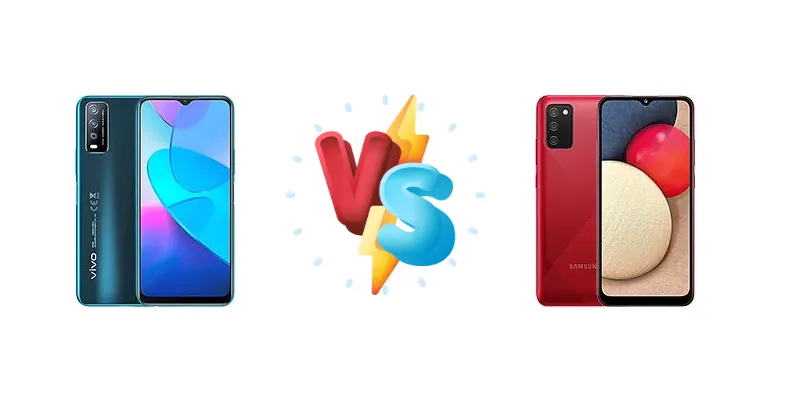
The vivo Y11s and Samsung Galaxy A02s represent the extreme end of the smartphone price spectrum, targeting users who prioritize affordability above all else. Both devices aim to deliver a functional smartphone experience without breaking the bank, but they achieve this with different approaches to chipset selection and feature sets. This comparison dives deep into the specifications to determine which phone offers the best value.
🏆 Quick Verdict
For the average user, the vivo Y11s emerges as the slightly better choice. Its newer Qualcomm Snapdragon 460 chipset, built on a more efficient 11nm process, provides a tangible performance advantage over the older 14nm Snapdragon 450 in the Galaxy A02s. While both offer similar battery endurance, the Y11s’ more modern architecture offers a better long-term user experience.
| Network |
|---|
| 2G bands | GSM 850 / 900 / 1800 / 1900 | GSM 850 / 900 / 1800 / 1900 |
| 3G bands | HSDPA 850 / 900 / 1700(AWS) / 1900 / 2100 | HSDPA 850 / 900 / 2100 |
| 4G bands | 1, 2, 3, 4, 5, 7, 8, 20, 28, 38, 40, 41 | 1, 3, 5, 7, 8, 20, 28, 38, 40, 41 |
| Speed | HSPA, LTE | HSPA 42.2/5.76 Mbps, LTE Cat4 150/50 Mbps |
| Technology | GSM / HSPA / LTE | GSM / HSPA / LTE |
| Launch |
|---|
| Announced | 2020, October 21. Released 2021, January 05 | 2020, November 24. Released 2021, January 04 |
| Status | Discontinued | Discontinued |
| Body |
|---|
| Build | Glass front, plastic back, plastic frame | Glass front, plastic back, plastic frame |
| Dimensions | 164.4 x 76.3 x 8.4 mm (6.47 x 3.00 x 0.33 in) | 164.2 x 75.9 x 9.1 mm (6.46 x 2.99 x 0.36 in) |
| SIM | Nano-SIM + Nano-SIM | · Nano-SIM· Nano-SIM + Nano-SIM |
| Weight | 191 g (6.74 oz) | 196 g (6.91 oz) |
| Display |
|---|
| Protection | - | Scratch-resistant glass |
| Resolution | 720 x 1600 pixels, 20:9 ratio (~270 ppi density) | 720 x 1600 pixels, 20:9 ratio (~270 ppi density) |
| Size | 6.51 inches, 102.3 cm2 (~81.6% screen-to-body ratio) | 6.5 inches, 102.0 cm2 (~81.8% screen-to-body ratio) |
| Type | IPS LCD | PLS LCD |
| Platform |
|---|
| CPU | Octa-core (4x1.8 GHz Kryo 240 & 4x1.6 GHz Kryo 240) | Octa-core 1.8 GHz Cortex-A53 |
| Chipset | Qualcomm SM4250 Snapdragon 460 (11 nm) | Qualcomm SDM450 Snapdragon 450 (14 nm) |
| GPU | Adreno 610 | Adreno 506 |
| OS | Android 10, Funtouch 11 | Android 10, upgradable to Android 12, One UI 4.1 |
| Memory |
|---|
| Card slot | microSDXC (dedicated slot) | microSDXC (dedicated slot) |
| Internal | 32GB 3GB RAM | 16GB 1GB RAM, 32GB 2GB RAM, 32GB 3GB RAM, 32GB 4GB RAM, 64GB 3GB RAM, 64GB 4GB RAM |
| | eMMC 5.1 | eMMC 5.1 |
| Main Camera |
|---|
| Dual | 13 MP, f/2.2, (wide), PDAF
Auxiliary lens | - |
| Features | LED flash, Panorama | LED flash |
| Single | - | 3.15 MP |
| Triple | - | 13 MP, f/2.2, (wide), AF
2 MP (macro)
Auxiliary lens |
| Video | 1080p@30fps | 1080p@30fps |
| Selfie camera |
|---|
| Single | 8 MP, f/1.8, (wide) | 5 MP, f/2.2 |
| Video | 1080p@30fps | - |
| Sound |
|---|
| 3.5mm jack | Yes | Yes |
| 35mm jack | Yes | Yes |
| Loudspeaker | Yes | Yes |
| Comms |
|---|
| Bluetooth | 5.0, A2DP, LE | 4.2, A2DP |
| NFC | No | No |
| Positioning | GPS, GLONASS, GALILEO, BDS | GPS, GLONASS, GALILEO, BDS |
| Radio | FM radio | Unspecified |
| USB | microUSB 2.0, OTG | USB Type-C 2.0 |
| WLAN | Wi-Fi 802.11 a/b/g/n/ac, dual-band, Wi-Fi Direct | Wi-Fi 802.11 b/g/n, Wi-Fi Direct |
| Features |
|---|
| Sensors | Fingerprint (side-mounted), accelerometer, proximity, compass | Accelerometer, proximity |
| Battery |
|---|
| Charging | 10W wired | 15W wired |
| Stand-by | - | Up to 530 h (2G) / Up to 530 h (3G) |
| Talk time | - | Up to 6 h 12 min (2G) / Up to 6 h 18 min (3G) |
| Type | 5000 mAh | Li-Po 5000 mAh |
| Misc |
|---|
| Colors | Glacier Blue, Phantom Black | Black, White, Red, Blue |
| Models | V2028 | SM-A025F, SM-A025F/DS, SM-A025G, SM-A025G/DS, SM-A025M, SM-A025M/DS, SM-A025U, SM-A025V, SM-A025A, SM-A025U1, SM-A025AZ, SM-S124DL |
| Price | About 270 EUR | About 110 EUR |
| SAR | - | 1.15 W/kg (head) 0.79 W/kg (body) |
| SAR EU | - | 0.40 W/kg (head) 1.37 W/kg (body) |
| Tests |
|---|
| Audio quality | - |
Noise -81.4dB / Crosstalk -80.5dB |
| Battery life | - |
Endurance rating 114h
|
| Camera | - |
Photo / Video |
| Display | - |
Contrast ratio: 1765:1 (nominal) |
| Loudspeaker | - |
-29.8 LUFS (Average)
|
| Performance | - |
AnTuTu: 90811 (v8)
GeekBench: 495 (v5.1)
GFXBench: 6.1fps (ES 3.1 onscreen) |
vivo Y11s
- More efficient Snapdragon 460 chipset
- Potentially better long-term performance
- Slightly better power efficiency
- Charging speed is slower at 10W
- Display specifications are unknown
Samsung Galaxy A02s
- Brighter display (406 nits)
- Faster 15W charging
- Lower price point
- Older, less efficient Snapdragon 450 chipset
- Potentially sluggish performance with demanding apps
- 14nm process can lead to more heat
Display Comparison
The Samsung Galaxy A02s boasts a measured peak brightness of 406 nits, paired with a 1765:1 contrast ratio. While respectable for the price, the vivo Y11s’ display specifications are not provided, suggesting a similar, if not slightly lower, performance. The contrast ratio is identical on both, indicating similar panel technology. Neither device is expected to offer exceptional color accuracy or viewing angles, but the A02s’ higher measured brightness will provide better visibility in direct sunlight. The lack of information on the Y11s’ panel type prevents a deeper analysis of color gamut coverage.
Camera Comparison
Both devices feature 'Photo / Video' capabilities, but detailed camera specifications are absent. Given their price point, image quality is unlikely to be a standout feature on either device. The absence of information regarding sensor size, aperture, or image stabilization suggests both rely on basic camera modules. The inclusion of a 2MP macro camera on the A02s is a common, but often underwhelming, feature in this segment. Expect similar performance in good lighting conditions, with significant degradation in low-light scenarios.
Performance
The core difference between these two phones lies in their chipsets. The vivo Y11s utilizes the Qualcomm Snapdragon 460, fabricated on an 11nm process, featuring an octa-core CPU split into 4x1.8 GHz Kryo 240 and 4x1.6 GHz Kryo 240 cores. The Samsung Galaxy A02s, conversely, employs the older Snapdragon 450, built on a less efficient 14nm process, with an octa-core 1.8 GHz Cortex-A53 CPU. The 11nm process of the Snapdragon 460 translates to improved power efficiency and thermal performance, allowing for sustained performance under load. While both are octa-core, the Kryo cores in the 460 offer architectural improvements over the Cortex-A53, resulting in a noticeable performance uplift in real-world usage.
Battery Life
Both the vivo Y11s and Samsung Galaxy A02s achieve an endurance rating of 114 hours, indicating comparable battery life under typical usage. However, the Snapdragon 460’s 11nm process in the Y11s contributes to better power efficiency, potentially extending battery life slightly during demanding tasks. The Galaxy A02s supports 15W wired charging, while the Y11s is limited to 10W. This means the A02s will charge faster from 0-100%, a benefit for users who frequently need to top up their battery quickly.
Buying Guide
Buy the vivo Y11s if you need a phone that feels more responsive for everyday tasks like browsing and social media, and if you anticipate keeping the phone for more than a year. The Snapdragon 460 will age more gracefully. Buy the Samsung Galaxy A02s if you prioritize a slightly brighter display and are looking for the absolute lowest price point, accepting that performance will be more limited and potentially feel sluggish with heavier apps.
Frequently Asked Questions
❓ Will the Snapdragon 460 in the vivo Y11s handle popular games like PUBG Mobile?
The Snapdragon 460 can run PUBG Mobile, but expect to play at lower graphics settings and frame rates to maintain a stable experience. It's not a gaming powerhouse, but it's a step up from the Snapdragon 450 in the A02s, offering slightly smoother gameplay.
❓ Is the 15W charging on the Samsung Galaxy A02s a significant advantage over the vivo Y11s' 10W charging?
Yes, 15W charging will noticeably reduce the time it takes to fully charge the Galaxy A02s. While both phones have similar battery endurance, the faster charging speed is beneficial for users who need to quickly replenish their battery throughout the day.
❓ How much does software optimization play a role in the performance of these phones?
Software optimization is crucial. While the Snapdragon 460 is technically superior, poorly optimized software on the vivo Y11s could negate some of its advantages. Samsung's One UI, while feature-rich, can also be resource-intensive. User experience will vary depending on the specific software version and pre-installed apps.