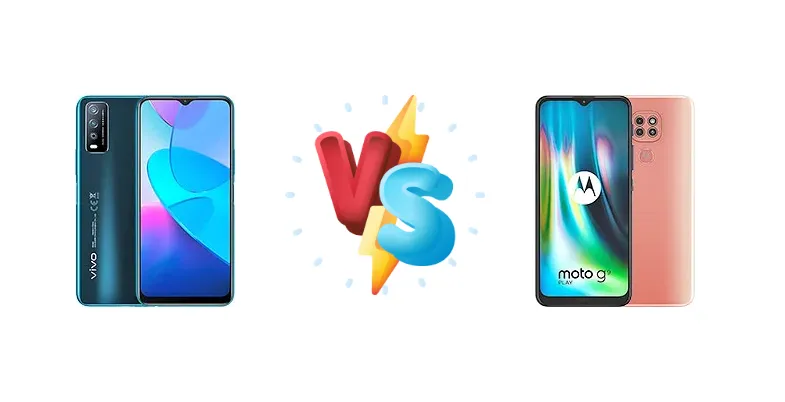
The sub-$200 smartphone market is fiercely competitive. The vivo Y11s and Motorola Moto G9 Play both aim to deliver essential features at an accessible price point, but they take different approaches. The Y11s focuses on a streamlined experience with a newer Snapdragon 460, while the Moto G9 Play leverages the slightly more powerful Snapdragon 662 alongside a brighter display and faster charging. This comparison dissects the key differences to determine which device offers the best value.
🏆 Quick Verdict
For most users, the Motorola Moto G9 Play is the better choice. Its Snapdragon 662 chipset provides a noticeable performance edge, and the 20W charging significantly reduces downtime. While the Y11s is a capable device, the G9 Play’s superior processing power and faster charging justify the slight price difference.
| Network |
|---|
| 2G bands | GSM 850 / 900 / 1800 / 1900 | GSM 850 / 900 / 1800 / 1900 |
| 3G bands | HSDPA 850 / 900 / 1700(AWS) / 1900 / 2100 | HSDPA 850 / 900 / 1900 / 2100 |
| 4G bands | 1, 2, 3, 4, 5, 7, 8, 20, 28, 38, 40, 41 | 1, 2, 3, 5, 7, 8, 18, 19, 20, 26, 28, 38, 40, 41 |
| EDGE | - | Class 10 |
| GPRS | - | Class 10 |
| Speed | HSPA, LTE | HSPA 42.2/5.76 Mbps, LTE Cat4 150/50 Mbps |
| Technology | GSM / HSPA / LTE | GSM / HSPA / LTE |
| Launch |
|---|
| Announced | 2020, October 21. Released 2021, January 05 | 2020, August 24. Released 2020, August 28 |
| Status | Discontinued | Discontinued |
| Body |
|---|
| Build | Glass front, plastic back, plastic frame | Glass front, plastic back, plastic frame |
| Dimensions | 164.4 x 76.3 x 8.4 mm (6.47 x 3.00 x 0.33 in) | 165.2 x 75.7 x 9.2 mm (6.50 x 2.98 x 0.36 in) |
| Keyboard | - | QWERTY |
| SIM | Nano-SIM + Nano-SIM | · Nano-SIM· Nano-SIM + Nano-SIM |
| Weight | 191 g (6.74 oz) | 200 g (7.05 oz) |
| | - | Water-repellent coating |
| Display |
|---|
| Resolution | 720 x 1600 pixels, 20:9 ratio (~270 ppi density) | 720 x 1600 pixels, 20:9 ratio (~269 ppi density) |
| Size | 6.51 inches, 102.3 cm2 (~81.6% screen-to-body ratio) | 6.5 inches, 102.8 cm2 (~82.2% screen-to-body ratio) |
| Type | IPS LCD | IPS LCD |
| Platform |
|---|
| CPU | Octa-core (4x1.8 GHz Kryo 240 & 4x1.6 GHz Kryo 240) | Octa-core (4x2.0 GHz Kryo 260 Gold & 4x1.8 GHz Kryo 260 Silver) |
| Chipset | Qualcomm SM4250 Snapdragon 460 (11 nm) | Qualcomm SM6115 Snapdragon 662 (11 nm) |
| GPU | Adreno 610 | Adreno 610 |
| OS | Android 10, Funtouch 11 | Android 10, upgradable to Android 11 |
| Memory |
|---|
| Card slot | microSDXC (dedicated slot) | microSDXC (uses shared SIM slot) |
| Internal | 32GB 3GB RAM | 64GB 4GB RAM, 128GB 4GB RAM |
| | eMMC 5.1 | - |
| Main Camera |
|---|
| Dual | 13 MP, f/2.2, (wide), PDAF
Auxiliary lens | - |
| Features | LED flash, Panorama | LED flash, HDR, panorama |
| Single | - | 1.3 MP |
| Triple | - | 48 MP, f/1.7, (wide), 1/2.0", 0.8µm, PDAF
2 MP (macro)
Auxiliary lens |
| Video | 1080p@30fps | 1080p@30/60fps |
| Selfie camera |
|---|
| Features | - | HDR |
| Single | 8 MP, f/1.8, (wide) | 8 MP, f/2.2, 1.12µm |
| Video | 1080p@30fps | 1080p@30fps |
| Sound |
|---|
| 3.5mm jack | Yes | Yes |
| 35mm jack | Yes | Yes |
| Loudspeaker | Yes | Yes |
| Comms |
|---|
| Bluetooth | 5.0, A2DP, LE | 5.0, A2DP, LE |
| Infrared port | - | Yes |
| NFC | No | Yes |
| Positioning | GPS, GLONASS, GALILEO, BDS | GPS, GLONASS, GALILEO |
| Radio | FM radio | FM radio |
| USB | microUSB 2.0, OTG | USB Type-C 2.0 |
| WLAN | Wi-Fi 802.11 a/b/g/n/ac, dual-band, Wi-Fi Direct | Wi-Fi 802.11 a/b/g/n/ac, dual-band, Wi-Fi Direct |
| Features |
|---|
| Browser | - | WAP 2.0/xHTML, HTML (PocketIE) |
| Sensors | Fingerprint (side-mounted), accelerometer, proximity, compass | Fingerprint (rear-mounted), accelerometer, gyro, proximity |
| Battery |
|---|
| Charging | 10W wired | 20W wired |
| Type | 5000 mAh | Li-Po 5000 mAh |
| Misc |
|---|
| Colors | Glacier Blue, Phantom Black | Forest Green, Sapphire Blue, Spring Pink |
| Models | V2028 | XT2083, XT2083-1 |
| Price | About 270 EUR | About 430 EUR |
| Tests |
|---|
| Camera | - |
Photo / Video |
| Display | - |
Contrast ratio: 1944:1 |
| Loudspeaker | - |
-27.6 LUFS (Good)
|
| Performance | - |
AnTuTu: 170064 (v8)
GeekBench: 1402 (v5.1)
GFXBench: 13fps (ES 3.1 onscreen) |
vivo Y11s
- Potentially cleaner software experience (typical of vivo)
- Slightly newer chipset generation (Snapdragon 460)
- May be more readily available in certain markets
- Slower Snapdragon 460 processor
- Significantly slower 10W charging
- Likely lower display brightness
Motorola Moto G9 Play
- More powerful Snapdragon 662 processor
- Faster 20W wired charging
- Brighter display (465 nits)
- Better overall performance for multitasking and gaming
- Software experience may include more bloatware (typical of Motorola)
- Potentially less frequent software updates
Display Comparison
The Motorola Moto G9 Play boasts a significant advantage in display quality, achieving a measured peak brightness of 465 nits. This is crucial for outdoor visibility, a common pain point in this price bracket. While both phones share a 1944:1 contrast ratio, the higher brightness of the G9 Play translates to a more vibrant and usable experience in bright conditions. The Y11s’ display specifications are not provided, suggesting a potentially lower brightness level, making it less suitable for outdoor use. Bezels are likely comparable given the price points, and color accuracy is assumed to be standard for the segment.
Camera Comparison
Both phones are listed as having 'Photo / Video' capabilities, lacking specific details. However, given the price segment, expectations should be tempered. The absence of sensor size or aperture information makes a direct comparison difficult. It’s likely both phones rely on software processing to enhance image quality. The Y11s may prioritize simplicity in its camera app, while the Moto G9 Play might offer more features. Without further data, it’s safe to assume camera performance will be similar, focusing on adequate results in good lighting conditions.
Performance
The core difference lies in the chipsets. The Motorola Moto G9 Play’s Snapdragon 662 (11nm) is a step up from the vivo Y11s’ Snapdragon 460 (11nm). The 662 features a Kryo 260 CPU configuration with 4x2.0 GHz Gold cores and 4x1.8 GHz Silver cores, compared to the Y11s’ 4x1.8 GHz Kryo 240 and 4x1.6 GHz Kryo 240. This translates to faster app loading times and smoother multitasking on the Moto G9 Play. While both are 11nm chips, the architectural improvements in the Kryo 260 cores provide a tangible performance boost. The Y11s will handle basic tasks adequately, but the G9 Play offers a more responsive experience, particularly for gaming and resource-intensive applications.
Battery Life
The Motorola Moto G9 Play’s 20W wired charging is a clear advantage over the vivo Y11s’ 10W charging. This means significantly faster top-ups, reducing downtime. While battery capacity isn’t specified for either device, the faster charging of the G9 Play mitigates the impact of a potentially smaller battery. A full charge on the G9 Play will likely take around 90-120 minutes, while the Y11s could require over two hours. This difference is substantial for users who rely heavily on their phones throughout the day.
Buying Guide
Buy the vivo Y11s if you prioritize a minimalist software experience and are primarily focused on basic tasks like calling, texting, and light social media use. Its Snapdragon 460 is sufficient for these needs. Buy the Motorola Moto G9 Play if you want a phone that can handle more demanding apps, occasional gaming, and benefit from faster charging speeds, making it ideal for users who are frequently on the go.
Frequently Asked Questions
❓ Is the Snapdragon 662 in the Moto G9 Play capable of playing demanding games like PUBG Mobile?
Yes, the Snapdragon 662 is capable of running PUBG Mobile, though you'll likely need to use medium graphics settings for a smooth experience. The Adreno 620 GPU provides sufficient power for casual gaming, and the 662's CPU won't bottleneck performance as much as the Snapdragon 460 in the Y11s.
❓ How much faster is the 20W charging on the Moto G9 Play compared to the 10W charging on the vivo Y11s?
The 20W charging on the Moto G9 Play will significantly reduce charging times. Expect a full charge in approximately 90-120 minutes, whereas the Y11s with its 10W charger could take over two hours to reach 100%. This is a substantial difference for users who need to quickly top up their battery.
❓ Does the Motorola Moto G9 Play have a lot of bloatware pre-installed?
Motorola phones are known to include some pre-installed apps, often referred to as bloatware. While not excessive, you can expect to find a few third-party apps pre-loaded on the Moto G9 Play. Fortunately, most of these can be uninstalled or disabled if desired.