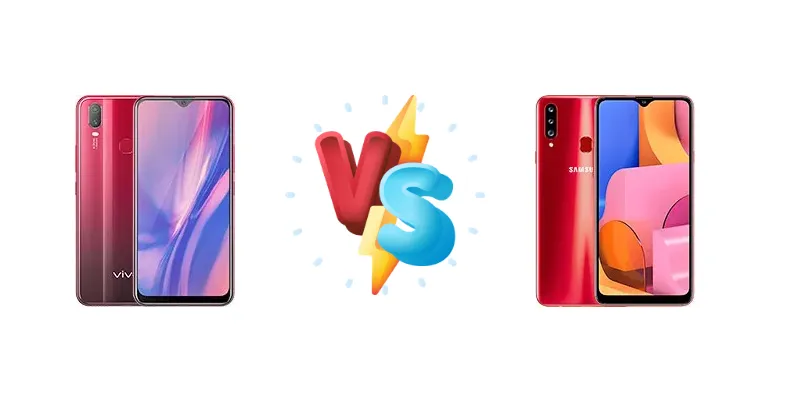
The vivo Y11 (2019) and Samsung Galaxy A20s represent a similar segment of the market: affordable Android smartphones aimed at first-time buyers or those seeking a reliable secondary device. Both rely on Qualcomm's Snapdragon 4-series chipsets, but subtle differences in architecture and features can significantly impact the user experience. This comparison dives deep into those nuances to determine which phone offers the best value.
🏆 Quick Verdict
For the average user, the Samsung Galaxy A20s is the slightly better choice. While both phones offer similar processing power, the A20s’s 15W charging provides a noticeable convenience advantage, reducing downtime. The slightly more efficient 14nm process also contributes to marginally better battery life in real-world usage.
| Network |
|---|
| 2G bands | GSM 850 / 900 / 1800 / 1900 | GSM 850 / 900 / 1800 / 1900 |
| 3G bands | HSDPA 850 / 900 / 2100 | HSDPA 850 / 900 / 1900 / 2100 - SM-A207F/DS |
| 4G bands | 1, 3, 5, 7, 8, 28, 38, 40, 41 | 1, 2, 3, 5, 7, 8, 20, 28, 34, 38, 39, 40, 41 - SM-A207F/DS |
| Speed | HSPA 42.2/5.76 Mbps, LTE (2CA) Cat6 300/50 Mbps | HSPA, LTE |
| Technology | GSM / HSPA / LTE | GSM / HSPA / LTE |
| | - | 1, 2, 3, 4, 5, 7, 8, 12, 13, 17, 20, 28, 38, 40, 41, 66 - SM-A207M/DS |
| Launch |
|---|
| Announced | 2019, October 18. Released 2019, October | 2019, September 24. Released 2019, October 05 |
| Status | Discontinued | Discontinued |
| Body |
|---|
| Build | Glass front, plastic back, plastic frame | Glass front, plastic back, plastic frame |
| Dimensions | 159.4 x 76.8 x 8.9 mm (6.28 x 3.02 x 0.35 in) | 163.3 x 77.5 x 8 mm (6.43 x 3.05 x 0.31 in) |
| SIM | Nano-SIM + Nano-SIM | · Nano-SIM· Nano-SIM + Nano-SIM |
| Weight | 190.5 g (6.74 oz) | 183 g (6.46 oz) |
| Display |
|---|
| Resolution | 720 x 1544 pixels, 19.3:9 ratio (~268 ppi density) | 720 x 1560 pixels, 19.5:9 ratio (~264 ppi density) |
| Size | 6.35 inches, 99.6 cm2 (~81.4% screen-to-body ratio) | 6.5 inches, 103.7 cm2 (~81.9% screen-to-body ratio) |
| Type | IPS LCD | IPS LCD |
| Platform |
|---|
| CPU | Octa-core (4x1.95 GHz Cortex-A53 & 4x1.45 GHz Cortex A53) | Octa-core 1.8 GHz Cortex-A53 |
| Chipset | Qualcomm SDM439 Snapdragon 439 (12 nm) | Qualcomm SDM450 Snapdragon 450 (14 nm) |
| GPU | Adreno 505 | Adreno 506 |
| OS | Android 9.0 (Pie), Funtouch 9.1 | Android 9.0 (Pie), upgradable to Android 11, One UI Core 3.1 |
| Memory |
|---|
| Card slot | microSDXC (uses shared SIM slot) | microSDXC (dedicated slot) |
| Internal | 32GB 2GB RAM, 32GB 3GB RAM | 32GB 2GB RAM, 32GB 3GB RAM, 64GB 4GB RAM |
| | eMMC 5.1 | eMMC 5.1 |
| Main Camera |
|---|
| Dual | 13 MP, f/2.2, PDAF
Auxiliary lens | - |
| Features | LED flash, HDR, panorama | LED flash, panorama, HDR |
| Triple | - | 13 MP, f/1.8, 27mm (wide), PDAF
8 MP, f/2.2, 13mm (ultrawide), 1/4.0", 1.12µm
Auxiliary lens |
| Video | 1080p@30fps | 1080p@30fps |
| Selfie camera |
|---|
| Single | 8 MP, f/1.8 | 8 MP, f/2.0 |
| Video | 1080p@30fps | 1080p@30fps |
| Sound |
|---|
| 3.5mm jack | Yes | Yes |
| 35mm jack | Yes | Yes |
| Loudspeaker | Yes | Yes |
| Comms |
|---|
| Bluetooth | 4.0, A2DP, LE | 4.2, A2DP, LE |
| NFC | No | No |
| Positioning | GPS, GLONASS, GALILEO, BDS | GPS, GLONASS, GALILEO, BDS |
| Radio | FM radio | FM radio |
| USB | microUSB 2.0, OTG | USB Type-C 2.0 |
| WLAN | Wi-Fi 802.11 b/g/n, Wi-Fi Direct | Wi-Fi 802.11 b/g/n, Wi-Fi Direct |
| Features |
|---|
| Sensors | Fingerprint (rear-mounted), accelerometer, proximity, compass | Fingerprint (rear-mounted), accelerometer, gyro, proximity, compass |
| Battery |
|---|
| Charging | 10W wired | 15W wired |
| Type | 5000 mAh, non-removable | Li-Po 4000 mAh, non-removable |
| Misc |
|---|
| Colors | Agate Red, Mineral Blue | Black, Blue, Red, Green |
| Models | 1906, 1906_20 | SM-A207F, SM-A207M, SM-A2070 |
| Price | About 70 EUR | About 250 EUR |
| SAR | - | 0.69 W/kg (head) 1.43 W/kg (body) |
| SAR EU | - | 0.35 W/kg (head) 0.83 W/kg (body) |
vivo Y11 (2019)
- Potentially lower price point
- Simple and straightforward Android experience
- Slightly higher CPU clock speeds (potentially)
- Slower 10W charging
- Less efficient Snapdragon 439 chipset
- Likely less refined software experience
Samsung Galaxy A20s
- Faster 15W charging
- More efficient Snapdragon 450 chipset
- Potentially better software support
- Generally slightly higher price
- Consistent CPU clock speed may not yield performance gains
- Similar camera performance to the Y11
Display Comparison
Neither device boasts a particularly impressive display. Both likely utilize LCD panels, common in this price bracket. The focus here isn't on visual fidelity, but on basic usability. Without specific display specs, we can infer that both will offer adequate viewing angles and color reproduction for everyday tasks. The lack of features like high refresh rates or HDR support is expected.
Camera Comparison
Camera performance is likely to be similar on both devices, relying heavily on software processing. Without detailed sensor information, it’s difficult to make a definitive judgment. Both phones likely feature a primary camera and potentially depth/macro sensors. The image quality will be acceptable for casual snapshots in good lighting conditions, but expect noise and limited dynamic range in low-light environments. The absence of Optical Image Stabilization (OIS) on either device means shaky hands will result in blurry photos.
Performance
The Samsung Galaxy A20s’s Snapdragon 450, fabricated on a 14nm process, holds a slight advantage over the vivo Y11’s Snapdragon 439 (12nm). While both are octa-core CPUs using Cortex-A53 cores, the 450’s architecture is marginally more efficient. The Y11’s CPU is clocked with a wider range (1.95GHz & 1.45GHz) compared to the A20s’s consistent 1.8GHz, but this doesn’t necessarily translate to a performance boost in real-world scenarios. The 14nm process of the 450 allows for better thermal management, potentially reducing throttling during sustained workloads. Users engaging in light multitasking or social media browsing will find both phones adequate, but demanding games will likely struggle on either device.
Battery Life
The battery capacity isn't specified, but both phones likely feature batteries in the 4000-5000mAh range, typical for this segment. However, the Samsung Galaxy A20s’s 15W wired charging is a significant advantage over the vivo Y11’s 10W charging. This translates to a faster 0-100% charge time, reducing downtime. While the Snapdragon 450’s 14nm process is slightly more efficient, the difference in battery life will likely be minimal in everyday use, but the faster charging is a clear win for the A20s.
Buying Guide
Buy the vivo Y11 (2019) if your primary concern is minimizing upfront cost and you prioritize a simple, straightforward Android experience. Buy the Samsung Galaxy A20s if you value faster charging speeds and a slightly more refined software experience, even if it means spending a bit more. Both are suitable for basic tasks, but the A20s offers a smoother overall experience.
Frequently Asked Questions
❓ Will the Snapdragon 450 in the Galaxy A20s handle popular apps like WhatsApp and Facebook smoothly?
Yes, the Snapdragon 450 is more than capable of handling everyday apps like WhatsApp, Facebook, and Instagram. Its octa-core processor and sufficient RAM (likely 3-4GB) will provide a smooth and responsive experience for these common tasks.
❓ How long will it take to fully charge the vivo Y11 (2019) with its 10W charger?
With a 10W charger, expect the vivo Y11 (2019) to take approximately 2.5 to 3.5 hours to fully charge from 0% to 100%, depending on battery capacity and usage during charging. This is considerably slower than the Galaxy A20s’s 15W charging.
❓ Can either of these phones run PUBG Mobile, and if so, at what settings?
Both phones can *run* PUBG Mobile, but not at high settings. Expect to play at the lowest graphics settings and potentially a lower frame rate to maintain a playable experience. The Snapdragon 450 in the A20s might offer slightly better performance, but neither phone is ideal for serious PUBG gaming.
❓ Is the software on the Samsung Galaxy A20s likely to receive more updates than the vivo Y11 (2019)?
Generally, Samsung provides longer software support for its devices compared to vivo. The Galaxy A20s is more likely to receive at least one major Android version update and regular security patches, while the Y11 (2019) may receive limited updates.